Checking writing worksheet for Years 1–2: Write it, check it
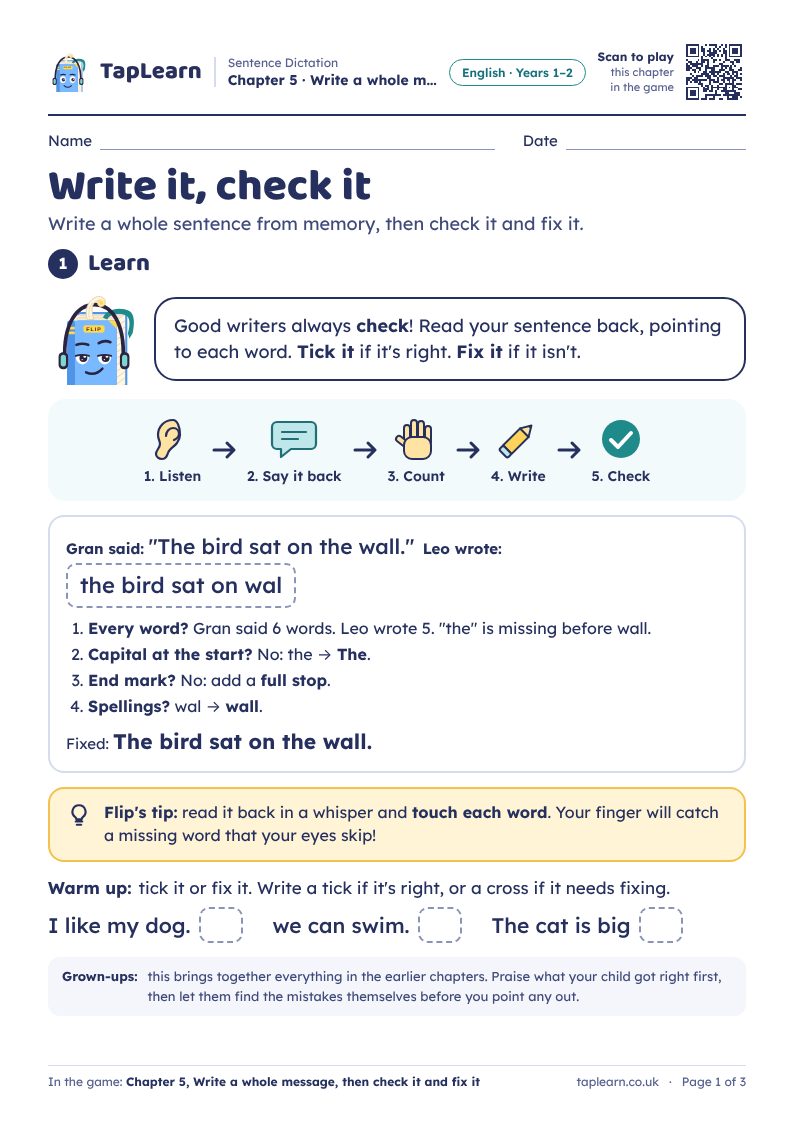
Write It, Check It is a printable checking writing worksheet for Years 1 and 2 (ages 5 to 7) that teaches children to write a dictated sentence from memory, then read it back to spot and fix mistakes. It covers the Year 1 and Year 2 English statements to write from memory simple sentences dictated by the teacher.
What it practises: Spot the mistakes on Dot's wobbly postcards, then listen, say, count, write and check whole sentences, comparing your word count and fixing errors before posting (tick it or fix it).
This worksheet is for members
Membership opens every chapter of every game and every worksheet, for all your children.
See the plansAlready a member? Log in to print it.
Start with the free one: Say it, count it (chapter 1).
Print it on A4, in colour or black and white. Do it after the chapter, or before it to see what your child already knows.
What's on the worksheet
Your child writes a whole dictated message from memory, then reads it back to spot and fix missing words, capitals, end marks and spellings. Includes a fridge message activity and an answers sheet.
- Page 1 · Learn
- The five steps from listen to check, Leo's sentence about a bird checked and fixed step by step, Flip's whisper-and-touch tip, and a tick-it-or-fix-it warm-up.
- Page 2 · Try it together
- Fridge message: the child hears a short message, says it back, counts the words, writes it from memory, then ticks or fixes each word with a crayon before sticking it on the fridge.
- Page 3 · Practise
- Ring and fix one mistake in each sentence, find three mistakes in Mia's sentence, write and check two dictated sentences, and a challenge about Sam's missing word.
- Answers sheet
- Every answer, mix-ups like not noticing a missing word, and tick-it-or-fix-it and spot-my-slip ideas.
3 A4 pages and an answers sheet · about 25 minutes
Using it at home
- Praise what your child got right first, then let them find mistakes themselves before you point any out.
- For the fridge message, try "Dad is a good cook." or "Can we go to the park today?" If the word counts don't match, read it back together.
- Say a sentence twice with a word missing the second time, and see if your child hears what's gone.
Watch out for
- Not noticing a missing word.
- Compare the count: "You heard 6 words. How many did you write?"
- Not noticing missing capitals or end marks.
- Check the two ends every time: capital at the start, mark at the end.
- Not noticing a misspelt word.
- Ask "Does any word look odd?" and sound it out again, or remember the tricky word.
Questions from the worksheet
- Each sentence has one mistake. Draw a ring round it, then write the fix: We went the park.
- Mia heard: "Can Ava come to my house on Sunday?" Mia wrote: can Ava come to my hous on Sunday. Find 3 mistakes.
- Listen to a grown-up's sentence. Say it back, write it, then tick each check.
- Sam wrote: I like play in the park. He read it quickly in his head and said it was right. Is it? How could he catch the mistake?
The answers are on the answers sheet, for grown-ups.
National curriculum in England
This worksheet practises these statements from the Year 1 english programme of study:
- Write from memory simple sentences dictated by the teacher that include words using the GPCs (grapheme-phoneme correspondences) and common exception words taught so far
- Write from memory simple sentences dictated by the teacher that include words using the GPCs (grapheme-phoneme correspondences), common exception words and punctuation taught so far (Year 2 english)
In the classroom
- Model tick it or fix it with a class sentence on the board, touching each word as you read it aloud.
- Give pairs Mia's sentence to correct, then compare the three mistakes each pair found.
Questions and answers
How can children check their own writing?
Read it back aloud, touching each word. Check every word is there, the capital and end mark are right, and any odd-looking spelling.
Why read writing aloud to check it?
Reading quickly in your head skips over gaps. Reading aloud and touching each word catches missing words.
What is 'tick it or fix it'?
It is a checking routine: point to each word as you read it back, tick it if it's right and fix it if it isn't.
 TapLearn