Capitals and full stops worksheet for Years 1–2: Capital, space, stop
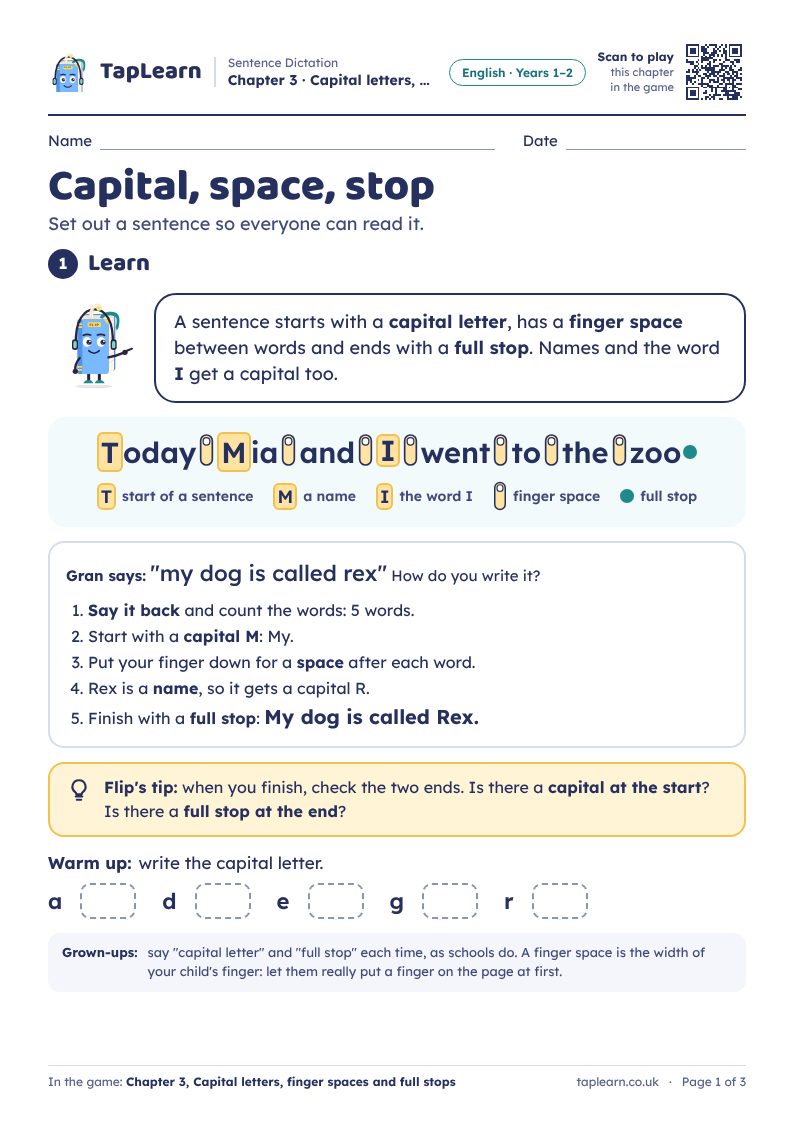
Capital, Space, Stop is a printable capitals and full stops worksheet for Years 1 and 2 (ages 5 to 7) that teaches children to set out a dictated sentence with a capital letter, finger spaces and a full stop. It covers the Year 1 English statement to write from memory simple sentences dictated by the teacher, using the sounds and common exception words taught so far.
What it practises: Fix Dot's windswept postcards, then write whole dictated sentences with a capital letter at the start, capitals for names and I, finger spaces between words and a full stop at the end.
This worksheet is for members
Membership opens every chapter of every game and every worksheet, for all your children.
See the plansAlready a member? Log in to print it.
Start with the free one: Say it, count it (chapter 1).
Print it on A4, in colour or black and white. Do it after the chapter, or before it to see what your child already knows.
What's on the worksheet
Your child writes dictated sentences with a capital letter, finger spaces and a full stop, plus capitals for names and I. Includes a be-the-teacher activity fixing a grown-up's mistakes, and an answers sheet.
- Page 1 · Learn
- A sentence labelled with capitals for the start, a name and I, finger spaces and a full stop, a worked example writing my dog is called rex, and a capitals warm-up.
- Page 2 · Try it together
- Be the teacher: the grown-up writes sentences with mistakes, and the child reads each one and fixes capitals, spaces and full stops in colour. Then swap roles.
- Page 3 · Practise
- Ring the sentence written correctly, rewrite sentences with capitals and full stops, split squashed words, write two dictated sentences with checks, and a challenge.
- Answers sheet
- Every answer, mix-ups like squashed words, and capital hunt and full stop clap ideas.
3 A4 pages and an answers sheet · about 20 minutes
Using it at home
- Say "capital letter" and "full stop" each time, as schools do, and let your child put a real finger on the page for spaces at first.
- In be the teacher, make your mistakes obvious at first, like "i like cake" or "theboxisred."
- Hunt for capital letters on a cereal box and decide whether each starts a sentence or a name.
Watch out for
- Forgetting capitals at the start, for names, or for I.
- Use the two-ends check, then ask "Is anyone named in it?"
- Forgetting the full stop at the end.
- Say "full stop" out loud as your child writes the last word.
- Squashing words together.
- Let your child put a real finger on the page after each word until spaces come naturally.
Questions from the worksheet
- Draw a ring round the sentence that is written correctly: the sun is hot. / The sun is hot. / The sun is hot
- Write each sentence again with capital letters and a full stop: ava and i can hop
- Oh no, the spaces have gone! Draw a line between the words. Then count them: Thedogcanrun.
- Sam wrote: i went to the park with ben. He says it's all right. What did he forget? Write it correctly.
The answers are on the answers sheet, for grown-ups.
National curriculum in England
This worksheet practises this statement from the Year 1 english programme of study:
- Write from memory simple sentences dictated by the teacher that include words using the GPCs (grapheme-phoneme correspondences) and common exception words taught so far
In the classroom
- Play full stop clap: read a short story aloud and the class claps at every full stop.
- Display a sentence with mistakes and let the class be the teacher, fixing it together.
Questions and answers
What does a Year 1 sentence need?
A capital letter at the start, finger spaces between words and a full stop at the end. Names and the word I also need capitals.
What is a finger space?
A finger space is the gap between words, about the width of a child's finger, which keeps writing easy to read.
Why check both ends of a sentence?
Checking the start for a capital and the end for a full stop catches the two most common slips.
 TapLearn