Sounding out spelling worksheet for Years 1–2: Sound it out
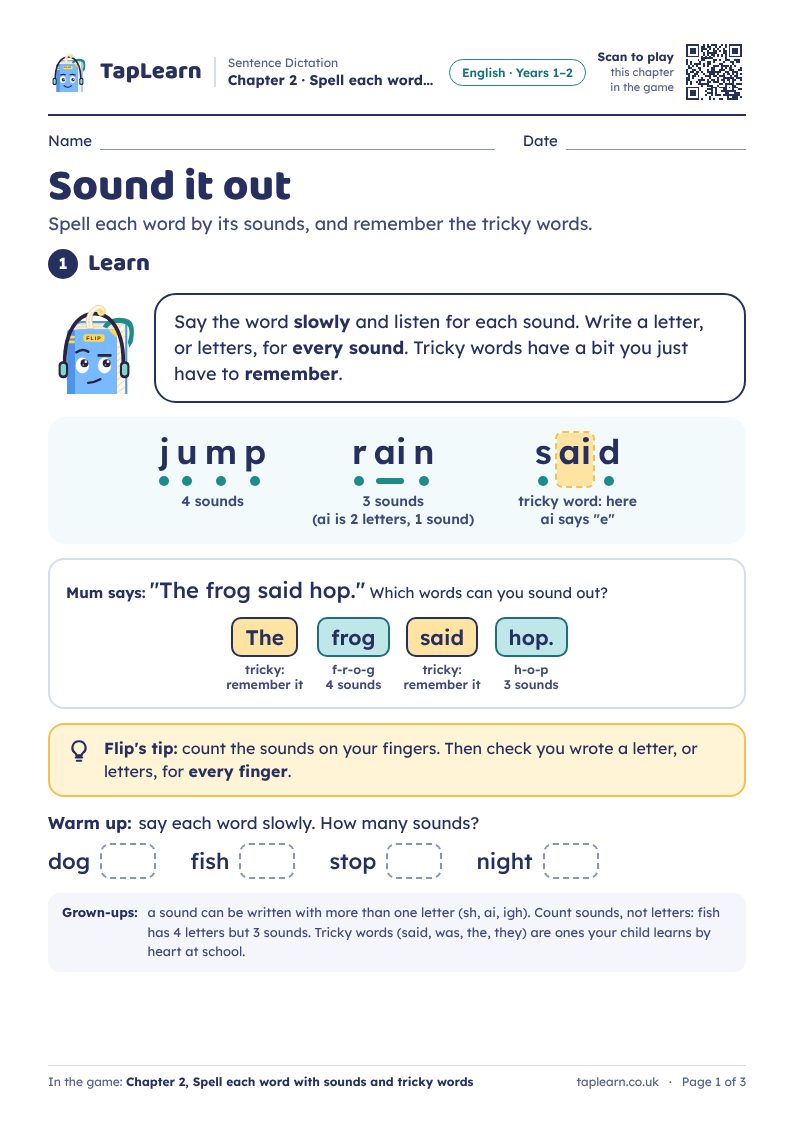
Sound It Out is a printable sounding out spelling worksheet for Years 1 and 2 (ages 5 to 7) that teaches children to spell each word by its sounds and to remember tricky words like said and was. It covers the Year 1 English statement to write from memory simple sentences dictated by the teacher, using the sounds and common exception words taught so far.
What it practises: Write each word of a dictated sentence in its own box, sounding out regular words and remembering common exception words like said and was, with the sounds shown underneath (sound buttons).
This worksheet is for members
Membership opens every chapter of every game and every worksheet, for all your children.
See the plansAlready a member? Log in to print it.
Start with the free one: Say it, count it (chapter 1).
Print it on A4, in colour or black and white. Do it after the chapter, or before it to see what your child already knows.
What's on the worksheet
Your child spells the words in a dictated sentence by saying each sound and writing a letter or letters for it, and remembers tricky words like said and was. Includes a sound steps activity and an answers sheet.
- Page 1 · Learn
- How jump, rain and said break into sounds, a worked example sorting the words in The frog said hop, Flip's count-the-sounds tip, and a how-many-sounds warm-up.
- Page 2 · Try it together
- Sound steps: the grown-up says a word, the child says it slowly taking one step for each sound, then writes a letter or letters for every step.
- Page 3 · Practise
- Write lost sounds into words, ring the right spelling of tricky words, fix words with a missing sound, write three dictated words and a sentence, and a challenge about sed.
- Answers sheet
- Every answer, mix-ups like jup for jump, and sound fingers and tricky-word-of-the-day ideas.
3 A4 pages and an answers sheet · about 20 minutes
Using it at home
- A sound can be written with more than one letter (sh, ai, igh). Count sounds, not letters: fish has 4 letters but 3 sounds.
- In sound steps, try hat, ship, jump, rain, stamp and night. For ship, sh is one sound, so one step.
- Choose a tricky word of the day and spot it in a bedtime book.
Watch out for
- Spelling tricky words by sound, like sed for said.
- Praise the good listening, then show the real spelling and point out the tricky bit.
- Leaving out a sound, like jup for jump.
- It happens most where two consonants sit together. Say the word slowly and count the sounds on fingers.
- Writing one letter for a two-letter sound, like s for sh.
- Ask "Which letters make that sound?"
Questions from the worksheet
- Tricky words! Draw a ring round the right spelling: sed or said, was or woz, thay or they.
- A sound is missing from each underlined word. Write the word correctly: I can jup over the log.
- Listen to a grown-up. Write the 3 words, then the sentence.
- Leo wrote: Mum sed we can go. "Sed" sounds right when you say it. So why is it wrong? How should it be spelt?
The answers are on the answers sheet, for grown-ups.
National curriculum in England
This worksheet practises this statement from the Year 1 english programme of study:
- Write from memory simple sentences dictated by the teacher that include words using the GPCs (grapheme-phoneme correspondences) and common exception words taught so far
In the classroom
- Play sound steps as a class, with children stepping on the spot for each sound.
- Use Practise B as a quick tricky-word check on mini-whiteboards.
Questions and answers
What are tricky words?
Tricky words, or common exception words, have a part that can't be sounded out, like said and was. Children learn them by heart.
How do children spell words by sounding out?
They say the word slowly, listen for each sound and write a letter or letters for every sound.
How many sounds are in fish?
Fish has 3 sounds: f, i and sh. The sh sound is written with two letters.
 TapLearn