Sentence dictation worksheet for Years 1–2: Say it, count it
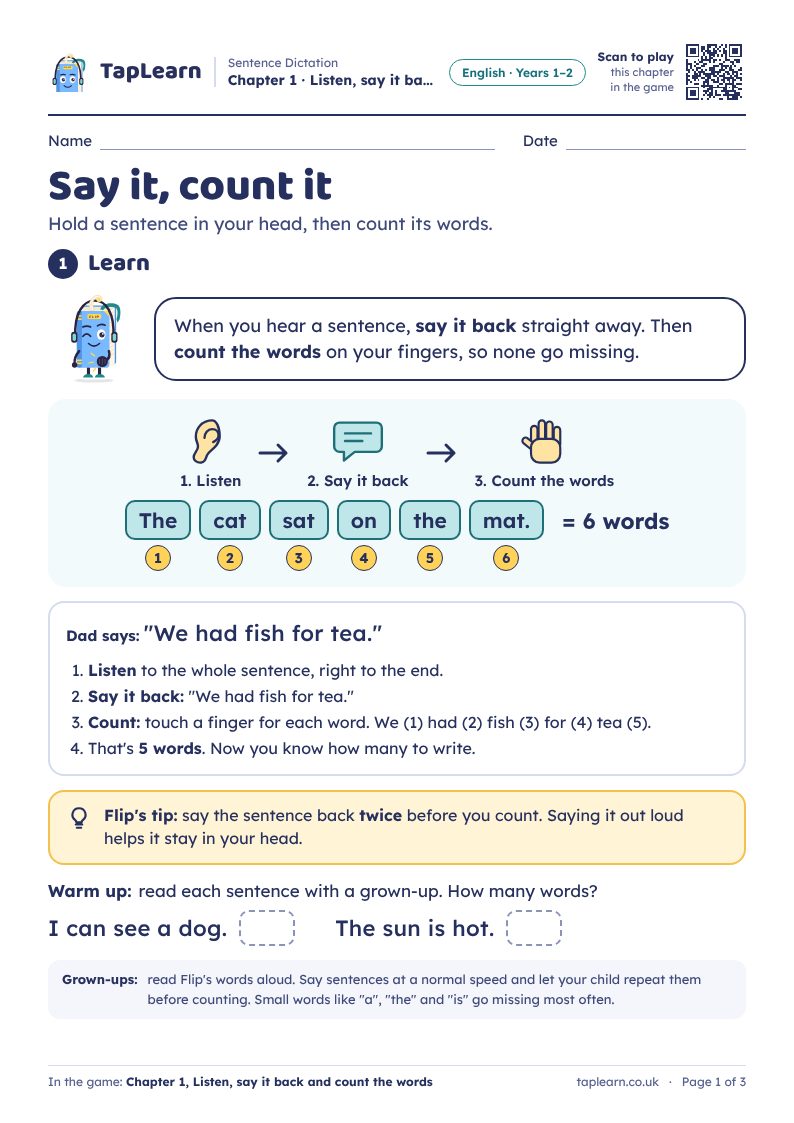
Say It, Count It is a printable sentence dictation worksheet for Years 1 and 2 (ages 5 to 7) that teaches children to listen to a sentence, say it back and count its words before writing. It covers the Year 1 English statement to write from memory simple sentences dictated by the teacher, using the sounds and common exception words taught so far.
What it practises: Learn to hold a dictated sentence in your head by saying it back out loud, tapping a bead for each word, picking how many words there are and rebuilding the sentence in order.
Free to print, no account needed.
Print it on A4, in colour or black and white. Do it after the chapter, or before it to see what your child already knows.
What's on the worksheet
Your child practises holding a spoken sentence in their head: listen, say it back and count the words so none go missing. Includes a sentence train activity with spoons or blocks and an answers sheet.
- Page 1 · Learn
- Listen, say it back and count the words shown with The cat sat on the mat, a worked example counting We had fish for tea, Flip's say-it-twice tip, and a warm-up.
- Page 2 · Try it together
- Sentence train: the grown-up says a sentence, the child says it back, then lays down a spoon or block for each word and counts the train. Then swap roles.
- Page 3 · Practise
- Dot and count words, match sentences to word counts, find the word Leo lost, draw a box for each word in a grown-up's sentence, and a challenge about counting.
- Answers sheet
- Every answer, mix-ups like losing small words, and tea-time echo and grow-a-sentence ideas.
3 A4 pages and an answers sheet · about 20 minutes
Using it at home
- Say sentences at a normal speed and let your child repeat them before counting. Small words like a, the and is go missing most often.
- In the sentence train, try "I like jam." and "We can go to the park." If a word goes missing, say it again and touch each thing as you say each word.
- Play grow a sentence: start with "I ate cake." and take turns adding a word, saying it all back each time.
Watch out for
- Losing small words, so counting too few.
- Say it again and touch a finger for every word. Remember today is one word, even with two beats.
- Muddling the order, like "We fish had for tea".
- Ask "Does that sound right?" and say it back together as one smooth sentence.
Questions from the worksheet
- Count the words. Draw a line from each sentence to its number: The fox ran into the wood.
- Leo lost a word! Draw a ^ where the word should go, then write it: I went to shop with Gran.
- Listen to a grown-up's sentence. Say it back, then draw a box for each word.
- Ava hears: "The dog ran up the hill." She says it back and counts 5 words. Is she right? Count it yourself.
The answers are on the answers sheet, for grown-ups.
National curriculum in England
This worksheet practises this statement from the Year 1 english programme of study:
- Write from memory simple sentences dictated by the teacher that include words using the GPCs (grapheme-phoneme correspondences) and common exception words taught so far
In the classroom
- Use the sentence train as a whole-class activity, with children standing up as each word is said.
- Play tea-time echo as a starter: say a sentence and the class says it back and counts on fingers.
Questions and answers
What is dictation in Year 1 and Year 2?
Dictation means listening to a sentence read aloud and writing it from memory. Children use the sounds, tricky words and punctuation they have learnt so far.
Why should children say a sentence back before writing it?
Saying it back straight away helps the sentence stay in their head, so no words go missing when they write.
Why count the words in a dictated sentence?
Knowing how many words there are lets children check they have written them all.
 TapLearn