Reading left to right worksheet for Reception: Left to right
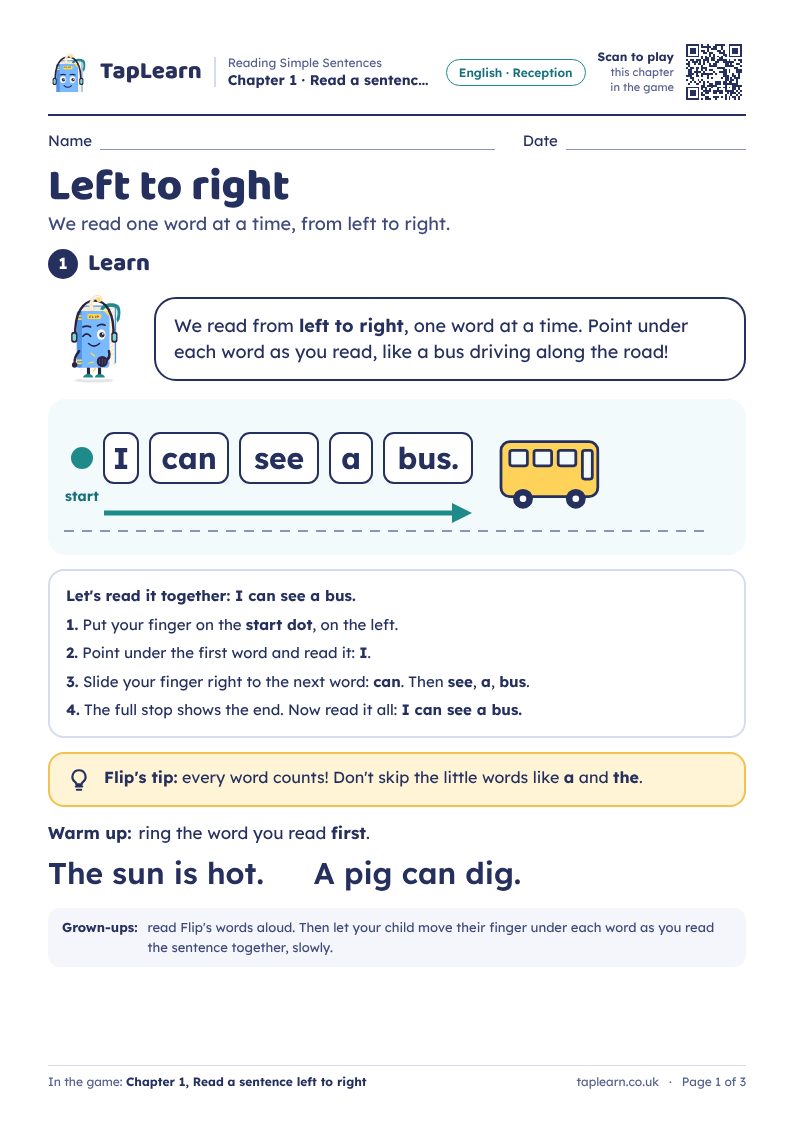
Left to Right is a printable reading left to right worksheet for Reception (ages 4 to 5) that teaches children to start on the left, point under each word and read every word, even little ones like a and the. It links to the Reception (EYFS) statement on reading aloud simple sentences that match their phonics, including some common exception words.
What it practises: Learn that a sentence is a row of words with spaces between them, by tapping each word from left to right, counting the words and finding the first and last word.
Free to print, no account needed.
Print it on A4, in colour or black and white. Do it after the chapter, or before it to see what your child already knows.
What's on the worksheet
Your child reads a simple sentence one word at a time from left to right, pointing under each word and counting the words. Includes a word card sentences game with a toy car and an answers sheet.
- Page 1 · Learn
- "I can see a bus." with a start dot, Flip's four steps to read it, Flip's tip not to skip little words, and a ring-the-first-word warm-up.
- Page 2 · Try it together
- Word card sentences: write I, can, see, a, cat on cards, lay them left to right and push a toy car under each word as you read, then mix them up and put them back in order.
- Page 3 · Practise
- Dot under every word and count them, number mixed-up words to make a sentence, trace a left-to-right arrow and read, and a challenge about starting on the right.
- Answers sheet
- Every answer, mix-ups like skipping small words, and sign-reading and packet-sentence ideas.
3 A4 pages and an answers sheet · about 15 minutes
Using it at home
- Read the sheet's words aloud, then let your child move a finger under each word as you read the sentence together, slowly.
- In the word card game, if your child starts on the right, put a small dot or sticker on the left as a "start here" sign.
- On a walk, read a short sign together, pointing under each word from left to right.
Watch out for
- Starting at the right-hand end.
- Put a dot or sticker at the left of the line and say, "We start on the left."
- Skipping small words like a or the.
- Point under every word and ask, "Did we read every word?" Counting the words helps.
- Letting the finger run ahead of the voice.
- Slow down together: one word, one point.
Questions from the worksheet
- Read each sentence. Draw a dot under every word. How many words? I can run. Mum had a nap. We sat on a big rug.
- The words are mixed up! Write 1, 2, 3, 4 to put them in order. Then read the sentence: cat. I a see
- Trace the arrow from left to right under each sentence. Then read it: A hen sat on an egg.
- Leo started on the right and read: "bus a see can I". Does that make sense? Where should he start?
The answers are on the answers sheet, for grown-ups.
National curriculum in England
This worksheet practises these statements from the Reception english programme of study:
- Read aloud simple sentences and books that are consistent with their phonic knowledge, including some common exception words
- Read simple phrases and sentences made up of words with known letter–sound correspondences and, where necessary, a few exception words
In the classroom
- Use big word cards on the board and let a pupil drive a toy bus under each word.
- Count the words in a class sentence as a starter.
Questions and answers
Which way do we read a sentence?
We read from left to right, one word at a time, starting with the word that has a capital letter.
Why should children point under each word?
Pointing helps them read every word in order and not skip little words like a and the.
How do children know where a sentence ends?
The full stop shows the end of the sentence.
 TapLearn