Reading fluency worksheet for Reception: Read it again
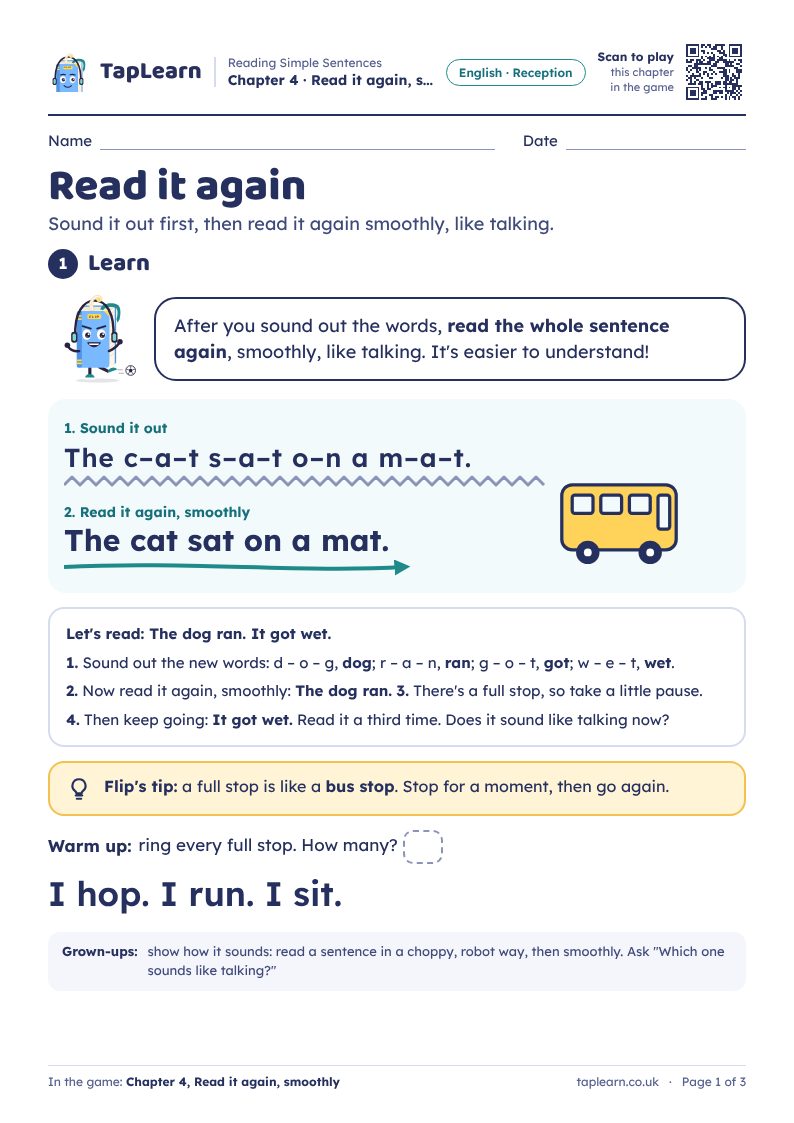
Read It Again is a printable reading fluency worksheet for Reception (ages 4 to 5) that teaches children to read a sentence again smoothly after sounding it out, pausing at each full stop like a bus at a bus stop. It links to the Reception (EYFS) statement on re-reading books to build confidence, fluency and understanding.
What it practises: Learn to re-read a sentence smoothly like talking, by comparing robot and smooth reading, reading one sentence three times, stopping at full stops and hearing a question mark.
This worksheet is for members
Membership opens every chapter of every game and every worksheet, for all your children.
See the plansAlready a member? Log in to print it.
Start with the free one: Left to right (chapter 1).
Print it on A4, in colour or black and white. Do it after the chapter, or before it to see what your child already knows.
What's on the worksheet
Your child sounds out a sentence, then reads it again smoothly like talking, pausing at each full stop. Includes an echo reading activity and an answers sheet.
- Page 1 · Learn
- A sentence sounded out and then read smoothly, a worked example reading "The dog ran. It got wet.", Flip's bus-stop tip for full stops, and a ring-the-full-stops warm-up.
- Page 2 · Try it together
- Echo reading: the grown-up reads a sentence smoothly, the child reads it back like an echo, you read it together, then the child reads it alone, colouring a star each time.
- Page 3 · Practise
- Ring full stops and count sentences, read a little story about Meg's cat again and again, tick sounded out and smooth, add missing full stops, and a challenge.
- Answers sheet
- Every answer, mix-ups like rushing, and re-read-a-favourite and voices ideas.
3 A4 pages and an answers sheet · about 15 minutes
Using it at home
- Read a sentence in a choppy, robot way, then smoothly, and ask "Which one sounds like talking?"
- Re-read your child's school reading book together two or three times. Each read gets smoother and more fun.
- Re-read a sentence in a happy, sleepy or surprised voice. It's still smooth!
Watch out for
- Stopping after sounding out.
- Say, "Great sounding out! Now let's read it again so it sounds like talking."
- Reading straight past full stops.
- Point to each full stop and pause together, like a bus at a bus stop.
- Rushing.
- Smooth isn't the same as fast. A steady, talking pace is just right.
Questions from the worksheet
- Ring every full stop. How many sentences are there? Sam sat. Meg ran. The dog had a nap.
- Read this little story. Then read it again, smoothly: Meg has a cat. The cat can nap on a rug. Meg can pat the cat.
- Two full stops are missing from each line. Write them in: The cat sat on the mat The dog ran
- Leo sounded out every word in "The pig got wet." Then he said, "Done!" What should he do next, and why?
The answers are on the answers sheet, for grown-ups.
National curriculum in England
This worksheet practises these statements from the Reception english programme of study:
- Read aloud simple sentences and books that are consistent with their phonic knowledge, including some common exception words
- Re-read these books to build up their confidence in word reading, their fluency and their understanding and enjoyment
In the classroom
- Use echo reading with a big book: you read, the class echoes.
- Use Practise C in pairs: one sounds out, then both read smoothly.
Questions and answers
Why should children re-read sentences?
Sounding out helps them read the words; reading again smoothly helps them hear what the sentence means and builds confidence.
What is echo reading?
The grown-up reads a sentence smoothly and the child reads it straight back, like an echo.
Does reading smoothly mean reading fast?
No. Smooth reading sounds like talking, at a steady pace, with a pause at each full stop.
 TapLearn