Reading for meaning worksheet for Reception: Read and match
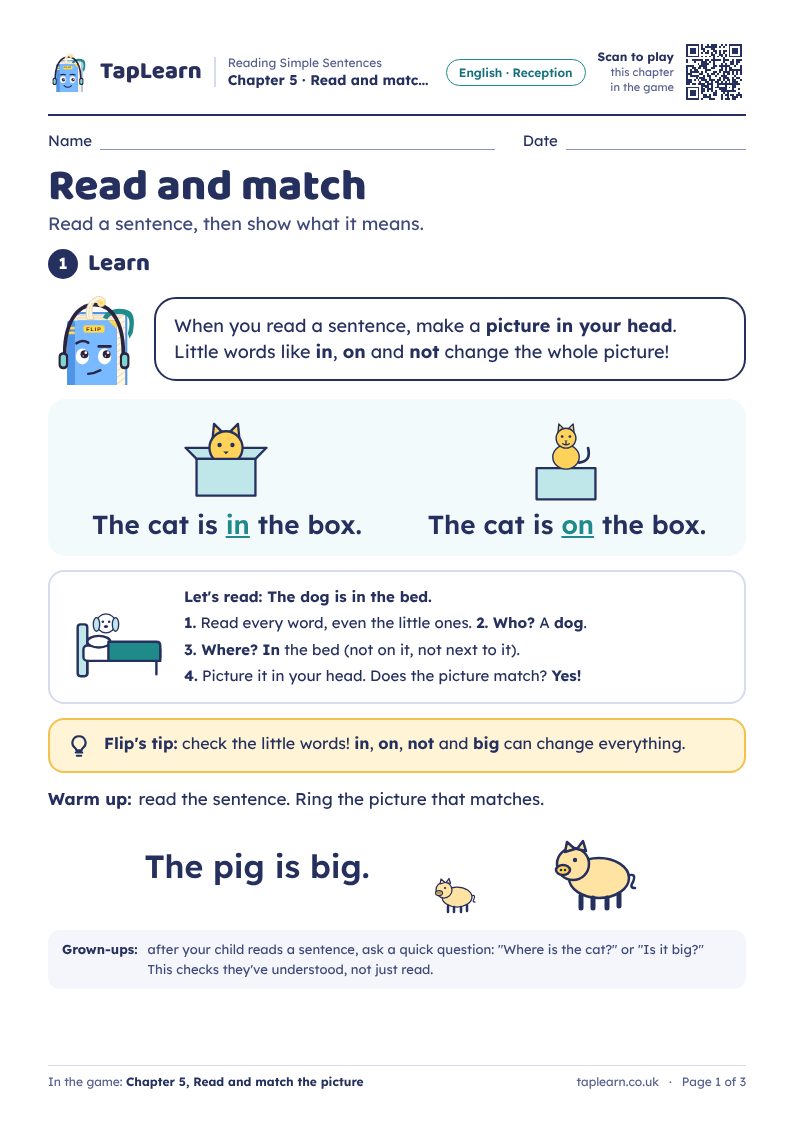
Read and Match is a printable reading for meaning worksheet for Reception (ages 4 to 5) that teaches children to make a picture in their head as they read and to notice little words like in, on and not that change the meaning. It links to the Reception (EYFS) statement on reading aloud simple sentences that match their phonics, including some common exception words.
What it practises: Read simple sentences independently and show what they mean by choosing the matching picture, noticing how words like on, not, big and red change the meaning.
This worksheet is for members
Membership opens every chapter of every game and every worksheet, for all your children.
See the plansAlready a member? Log in to print it.
Start with the free one: Left to right (chapter 1).
Print it on A4, in colour or black and white. Do it after the chapter, or before it to see what your child already knows.
What's on the worksheet
Your child reads a simple sentence and shows what it means by matching it to a picture, noticing little words like in, on and not. Includes an act-it-out game with a soft toy and an answers sheet.
- Page 1 · Learn
- "The cat is in the box" and "on the box" compared, a worked example picturing "The dog is in the bed.", Flip's check-the-little-words tip, and a ring-the-picture warm-up.
- Page 2 · Try it together
- Act it out with Ted: read sentences like "Ted is in the box" and "Ted is not in the box", act each one out with a soft toy, a box and a cup, and check it matches.
- Page 3 · Practise
- Read questions and ring yes or no, read sentences and ring the matching picture, read and draw, and a challenge about the word not.
- Answers sheet
- Every answer, mix-ups like missing in, on and not, and silly-sentence and spot-the-mistake ideas.
3 A4 pages and an answers sheet · about 15 minutes
Using it at home
- After your child reads a sentence, ask a quick question: "Where is the cat?" or "Is it big?" This checks understanding, not just reading.
- In act it out with Ted, act one sentence out wrongly and let your child spot the mistake.
- Write a silly sentence like "The dog is on the bed." and your child reads it, then acts it out or draws it.
Watch out for
- Missing little words like in, on and not.
- Point under every word, then ask, "Where is it?" or "Is it in or not in?"
- Missing describing words like big.
- Ask, "What is the pig like?" before choosing a picture.
- Guessing from the picture.
- Read the sentence first, then look at the pictures.
Questions from the worksheet
- Read each question. Ring yes or no: Can a hen run? Is the sun wet? Can a dog dig? Can a bus sing?
- Read each sentence. Ring the picture that matches: The cat is on the box. The dog is not in the bed.
- Read and draw: A big sun. A bug in a cup.
- Ava read "The cat is not in the box." and ringed a cat in a box. Which little word did she miss?
The answers are on the answers sheet, for grown-ups.
National curriculum in England
This worksheet practises these statements from the Reception english programme of study:
- Read aloud simple sentences and books that are consistent with their phonic knowledge, including some common exception words
- Read simple phrases and sentences made up of words with known letter–sound correspondences and, where necessary, a few exception words
In the classroom
- Act out in, on and not sentences with a class toy and a box.
- Use Practise A as a yes-or-no thumbs vote.
Questions and answers
How can I check my child understands what they read?
Ask a quick question after each sentence, like "Where is the cat?", or ask them to act it out or draw it.
Why do little words like not matter?
Little words change the whole meaning: "The cat is in the box" and "The cat is not in the box" show different pictures.
Should children look at the picture before reading?
Read the sentence first, then look at the pictures, so they don't guess.
 TapLearn