Tricky words worksheet for Reception: Tricky word hunt
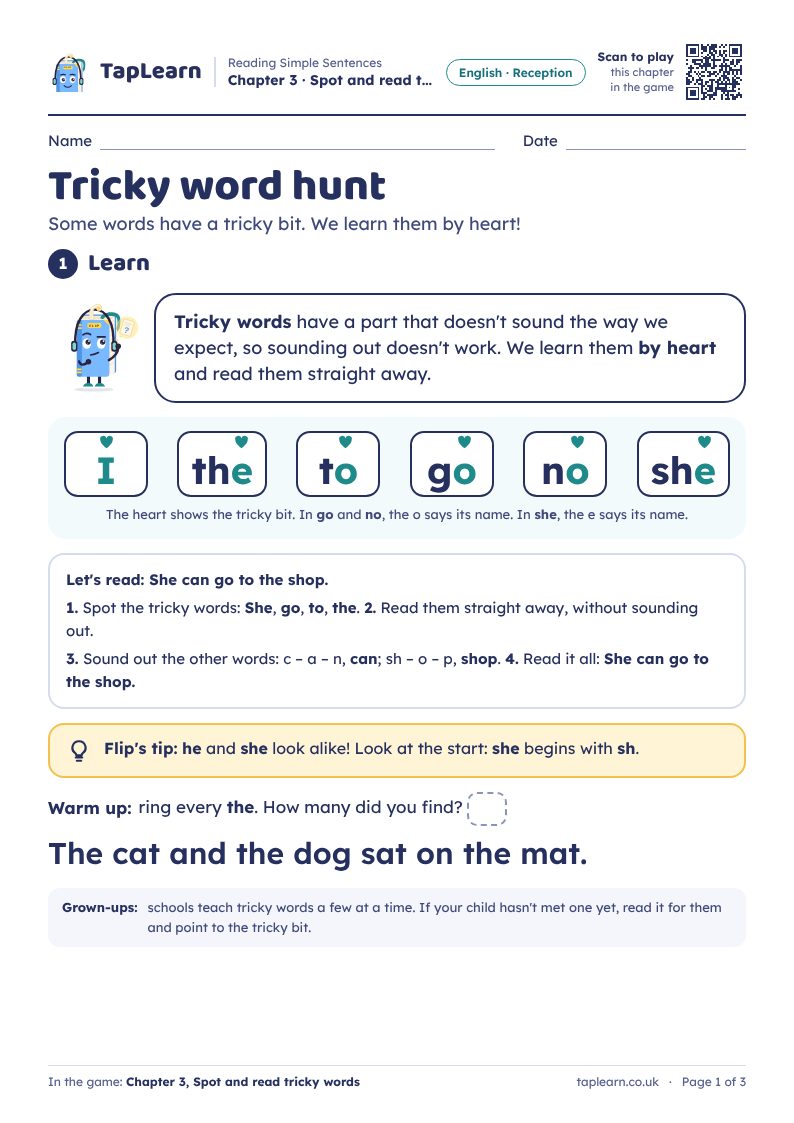
Tricky Word Hunt is a printable tricky words worksheet for Reception (ages 4 to 5) that teaches children to read words like I, the, to, go, no and she straight away, because sounding out doesn't work for their tricky bit. It links to the Reception (EYFS) statement on reading aloud simple sentences that match their phonics, including some common exception words.
What it practises: Learn to read tricky words such as I, go, to, the and was on sight, seeing their tricky bit, then popping the right word from balloons of look-alike words (common exception words).
This worksheet is for members
Membership opens every chapter of every game and every worksheet, for all your children.
See the plansAlready a member? Log in to print it.
Start with the free one: Left to right (chapter 1).
Print it on A4, in colour or black and white. Do it after the chapter, or before it to see what your child already knows.
What's on the worksheet
Your child reads tricky words like I, the, to, go, no and she on sight in simple sentences, and tells he from she. Includes a tricky word hunt in a picture book and an answers sheet.
- Page 1 · Learn
- Six tricky words with the tricky bit marked, a worked example reading "She can go to the shop.", Flip's tip on he and she, and a ring-every-the warm-up.
- Page 2 · Try it together
- Picture book hunt: write I, the, to, go, no and she on paper, pick one and hunt for it on the page of a favourite book, then tally each time you find it.
- Page 3 · Practise
- Ring the tricky words in sentences, join words that are the same, write he or she, and a challenge about sounding out the.
- Answers sheet
- Every answer, mix-ups like he and she, and flash-and-find and sticky-note-hunt ideas.
3 A4 pages and an answers sheet · about 15 minutes
Using it at home
- Schools teach tricky words a few at a time. If your child hasn't met one yet, read it for them and point to the tricky bit.
- In the picture book hunt, point out that The with a capital T is still the.
- Stick tricky words around a room and read each one as you find it.
Watch out for
- Trying to sound out tricky words like the or was.
- Say, "That's a tricky word: we know it by heart," and read it for them if needed.
- Mixing up look-alikes such as he and she, or no and on.
- Look at the first letter together.
- Thinking every word is tricky.
- Most words can be sounded out; only a few need learning by heart.
Questions from the worksheet
- Ring the tricky words in each sentence: I go to bed. She can see the sun. No, he can not hop.
- Draw a line to join the words that are the same: the, she, go, he, to.
- Write he or she: This is Sam. ___ can hop. This is Meg. ___ can run.
- Leo tries to sound out the: "t – h – e". Does that make the word? What should he do instead?
The answers are on the answers sheet, for grown-ups.
National curriculum in England
This worksheet practises these statements from the Reception english programme of study:
- Read aloud simple sentences and books that are consistent with their phonic knowledge, including some common exception words
- Skilled word reading, taught later, involves both the speedy working out of the pronunciation of unfamiliar printed words (decoding) and the speedy recognition of familiar printed words
In the classroom
- Play flash and find: show a tricky word and pupils find it in a big book.
- Use Practise C as a whole-class he-or-she check.
Questions and answers
What are tricky words in Reception?
Tricky words have a part that doesn't sound the way you'd expect, like the, I, to, go, no and she, so children learn them by heart.
Why can't children sound out the?
In the, t and h make one sound (th) and the e doesn't say its usual sound, so it's read straight away.
How can children tell he from she?
Look at the start: she begins with sh.
 TapLearn