Sound buttons worksheet for Reception: Sound it out
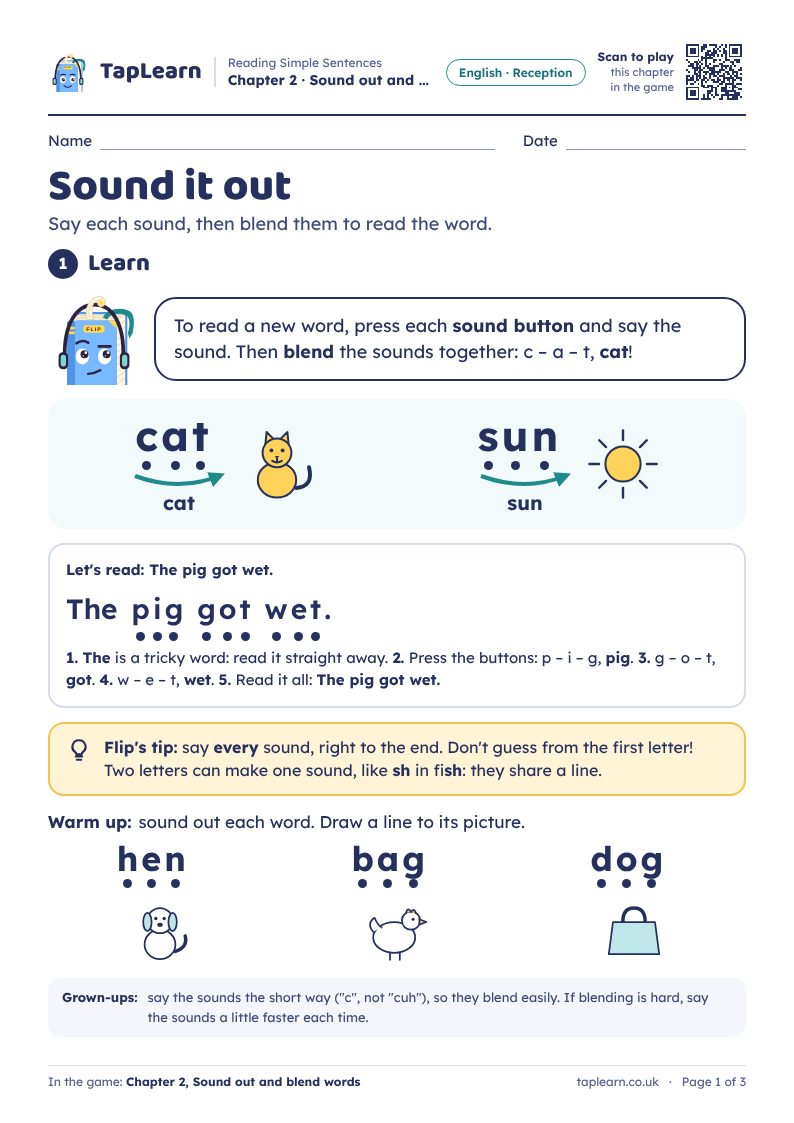
Sound It Out is a printable sound buttons worksheet for Reception (ages 4 to 5) that teaches children to press a button for each sound, say it, and blend the sounds into a word, while reading tricky words like the straight away. It links to the Reception (EYFS) statement on reading simple sentences made of words with known letter sounds.
What it practises: Learn to sound out and blend the words in a sentence, watching each sound light up, then hunting for a spoken word among look-alikes such as cot and cat (sound buttons).
This worksheet is for members
Membership opens every chapter of every game and every worksheet, for all your children.
See the plansAlready a member? Log in to print it.
Start with the free one: Left to right (chapter 1).
Print it on A4, in colour or black and white. Do it after the chapter, or before it to see what your child already knows.
What's on the worksheet
Your child uses sound buttons to sound out and blend the words in simple sentences, listening for every sound, including the middle one. Includes a button sentences activity with pasta or buttons and an answers sheet.
- Page 1 · Learn
- Sound buttons on cat and sun, a worked example reading "The pig got wet.", Flip's tip not to guess from the first letter, and a match-the-picture warm-up.
- Page 2 · Try it together
- Button sentences: read the tricky words first, draw a dot under each sound in the other words and a line under two-letter sounds like sh, put pasta on the dots, press and blend.
- Page 3 · Practise
- Sound out words and ring the matching picture, write the missing middle sound, draw sound buttons and read two sentences, and a challenge about cot and cat.
- Answers sheet
- Every answer, mix-ups like guessing from the first letter, and robot-talk and write-a-sentence ideas.
3 A4 pages and an answers sheet · about 15 minutes
Using it at home
- Say the sounds the short way ("c", not "cuh"), so they blend easily. If blending is hard, say the sounds a little faster each time.
- In button sentences, the two e's in see make one sound, and s and h in fish make one sound, so each gets a line.
- Play robot talk: say a word in sounds, like "d – o – g", and your child blends it and acts it out.
Watch out for
- Guessing a word from its first letter.
- Cover the word and reveal it one letter at a time, so every sound gets said.
- Mixing up the middle sound, reading cot as cat.
- Say the middle sound on its own, then blend the word again.
- Saying "cuh-a-tuh".
- Keep sounds short and pure ("c", "t") so they blend into a word.
Questions from the worksheet
- Draw the sound buttons yourself. Then read the sentence: The dog is in the box.
- Draw the sound buttons yourself. Then read the sentence: Sam can run and hop.
- Leo sees the word cot. He says "cat!" because it starts with c. Is he right? What should he do?
The answers are on the answers sheet, for grown-ups.
National curriculum in England
This worksheet practises these statements from the Reception english programme of study:
- Read simple phrases and sentences made up of words with known letter–sound correspondences and, where necessary, a few exception words
- Skilled word reading, taught later, involves both the speedy working out of the pronunciation of unfamiliar printed words (decoding) and the speedy recognition of familiar printed words
In the classroom
- Play robot talk as a phonics starter: say words in sounds and pupils blend them.
- Use pasta or counters for sound buttons in a guided reading group.
Questions and answers
What are sound buttons?
Sound buttons are dots under each sound in a word. Children press each one, say the sound, then blend the sounds into the word.
What does blending mean in phonics?
Blending means pushing the sounds together to read a word: c – a – t, cat.
Why shouldn't children guess from the first letter?
Lots of words start the same way, like cot and cat. Saying every sound shows which word it is.
 TapLearn