Seed dispersal worksheet for Year 3: How seeds travel
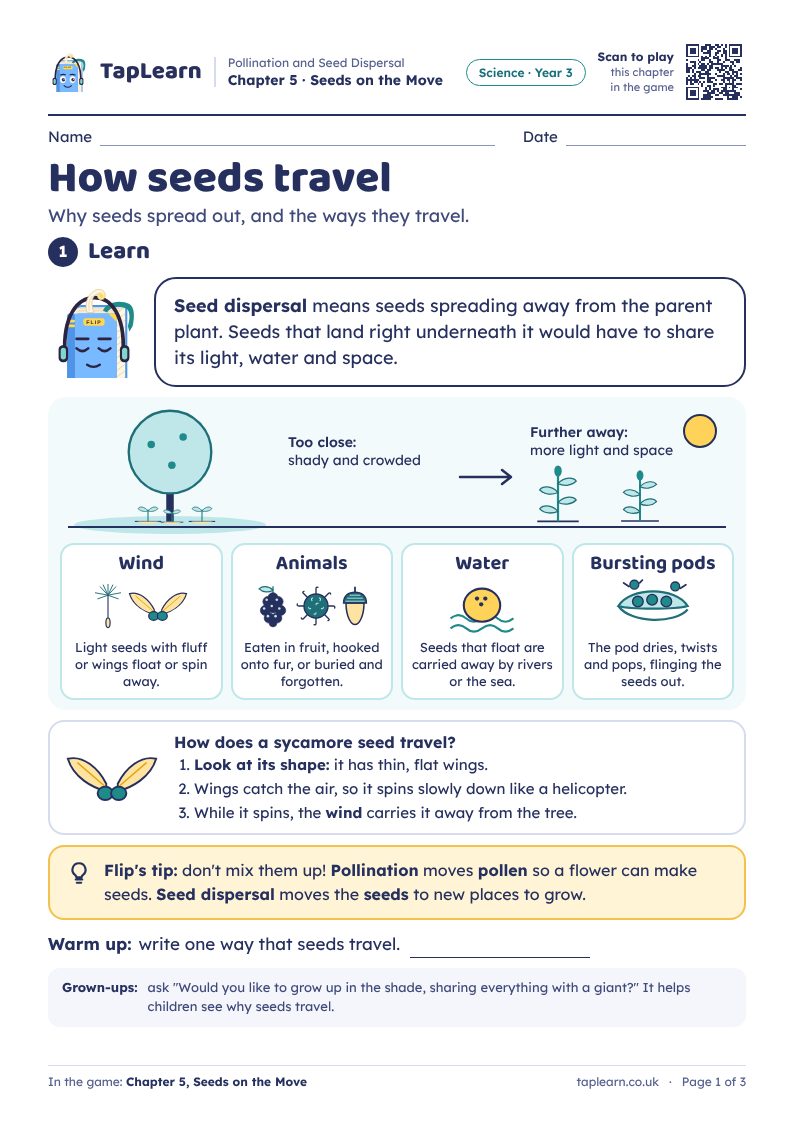
How Seeds Travel is a printable seed dispersal worksheet for Year 3 (ages 7 to 8) that teaches children why seeds spread away from the parent plant and how wind, animals, water and bursting pods carry them. It follows the Year 3 national curriculum in England: explore the part that flowers play in the life cycle of flowering plants, including pollination, seed formation and seed dispersal.
This worksheet is for members
Membership opens every chapter of every game and every worksheet, for all your children.
See the plansAlready a member? Log in to print it.
Start with the free one: The plant life cycle (chapter 1).
Print it on A4, in colour or black and white. Do it after the chapter, or before it to see what your child already knows.
What's on the worksheet
Explain why seeds spread away from the parent plant and how wind, animals, water and bursting pods carry them. With a wind test activity and answers.
- Page 1 · Learn
- A picture of crowded seedlings under a tree beside seedlings in the sun, the four ways seeds travel, and a worked example on the sycamore seed.
- Page 2 · Try it together
- Wind test: drop a dried pea, fluffy cotton wool and tissue above a cup while fanning with a book, and measure how far each lands in hand spans.
- Page 2–3 · Practise
- Match six seeds to how they travel, tick the reasons seeds spread out, sort pollination from seed dispersal, and explain how juicy berries help. Then a challenge about growing next to the parent.
- Answers sheet
- Every answer, what to watch out for (pollination and dispersal mixed up, seeds best under the parent, wrong feature) and a sock walk idea.
3 A4 pages and an answers sheet · about 30 minutes
Using it at home
- Keep the fanning the same for every seed in the wind test, and let your child do the measuring in hand spans.
- When your child isn't sure how a seed travels, ask them to point to its special feature first.
Watch out for
- Mixing up pollination and seed dispersal.
- Ask "Is it pollen or seeds that are moving?" Pollen moving is pollination; seeds moving is dispersal.
- Thinking seeds grow best right next to their parent plant.
- Stand under a tree together: point out the shade, and that the tree's roots take the water.
- Matching a seed to the wrong way of travelling.
- Look at the feature: fluff and wings for wind, hooks for fur, juicy fruit for eating.
Questions from the worksheet
- How does each seed travel? Write wind, animals, water or pops: dandelion, burdock burr, coconut, blackberry, pea pod, sycamore.
- Pollination or seed dispersal? A squirrel buries an acorn and forgets where it is.
- Blackberries are juicy and sweet. How does this help their seeds to travel?
- Mia says, "Seeds grow best right next to their parent plant, where it's safe." Is she right? Explain.
The answers are on the answers sheet, for grown-ups.
National curriculum in England
This worksheet practises this statement from the Year 3 science programme of study:
- Explore the part that flowers play in the life cycle of flowering plants, including pollination, seed formation and seed dispersal
Source: National curriculum in England: science programmes of study (DfE)
In the classroom
- Run the wind test as a fair-test lesson, with groups recording distances in a shared table.
- Use the pollination or dispersal set as a quick true sort with mini-whiteboards: P or D.
Questions and answers
What is seed dispersal?
Seed dispersal is how seeds spread away from the parent plant. They are carried by the wind, by animals, by water or flung out by bursting pods.
Why do seeds need to be dispersed?
Seeds that land under the parent plant must share its light, water and space. Seeds that travel further away have a better chance of growing into strong plants.
More worksheets from Pollination and Seed Dispersal: A Bumblebee Adventure
- Chapter 1: Plant life cycle worksheet: The plant life cycle Free
- Chapter 2: Parts of a flower worksheet Members
- Chapter 3: Pollination worksheet: How pollination works Members
- Chapter 4: Seed formation worksheet: From flower to fruit Members
- Chapter 6: Seed dispersal key worksheet: Seed detectives Members
 TapLearn