Pollination worksheet for Year 3: How pollination works
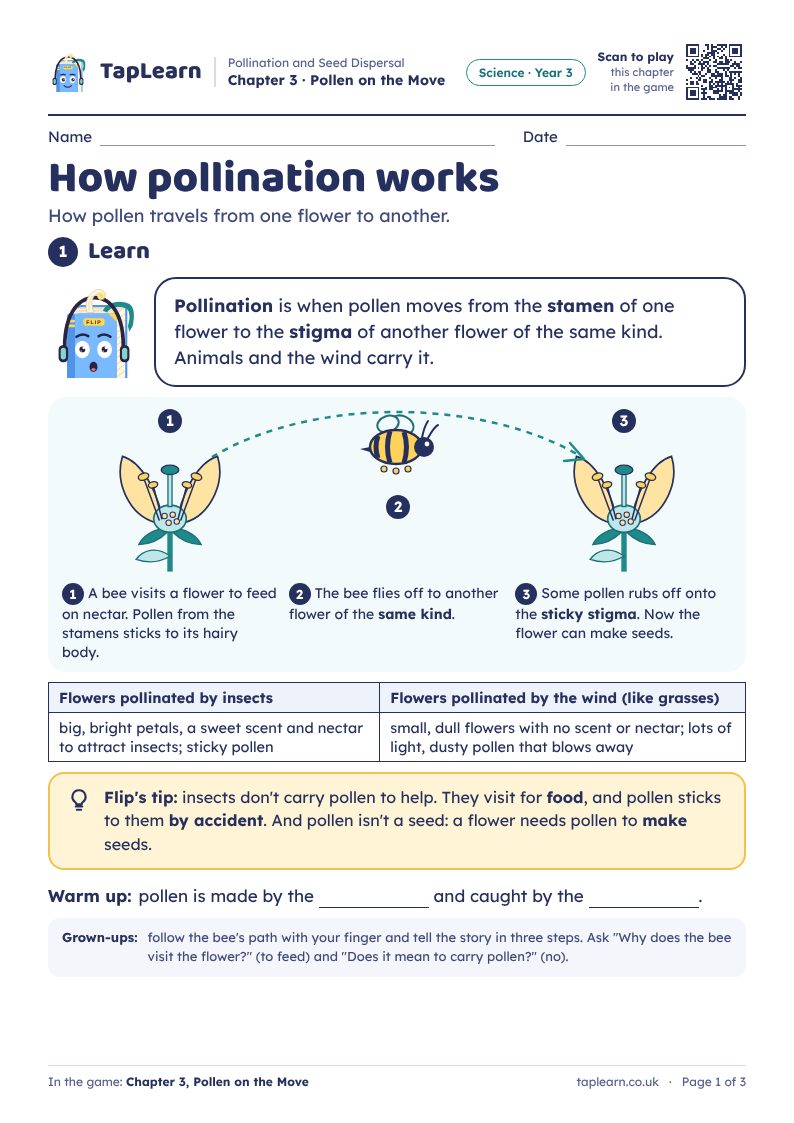
How Pollination Works is a printable pollination worksheet for Year 3 (ages 7 to 8) that teaches children how pollen moves from the stamen of one flower to the stigma of another, carried by animals or the wind. It follows the Year 3 national curriculum in England: explore the part that flowers play in the life cycle of flowering plants, including pollination, seed formation and seed dispersal.
This worksheet is for members
Membership opens every chapter of every game and every worksheet, for all your children.
See the plansAlready a member? Log in to print it.
Start with the free one: The plant life cycle (chapter 1).
Print it on A4, in colour or black and white. Do it after the chapter, or before it to see what your child already knows.
What's on the worksheet
Explain how pollen moves from the stamen of one flower to the stigma of another, carried by insects or the wind. With a flour-and-tape pollen activity and answers.
- Page 1 · Learn
- A bee carrying pollen between two flowers in three steps, a table comparing insect and wind-pollinated flowers, and Flip's tip that insects carry pollen by accident.
- Page 2 · Try it together
- Pollen paws: use flour as pollen and sticky tape as a stigma, then compare how much a fluffy cotton wool bee and a smooth spoon bee carry.
- Page 2–3 · Practise
- Order the steps of pollination, ring the animals that carry pollen, sort insect and wind flowers, and decide true or false. Then a challenge about whether bees help on purpose.
- Answers sheet
- Every answer, what to watch out for (only bees, on purpose, pollen as seeds) and a pollinator-watching idea.
3 A4 pages and an answers sheet · about 30 minutes
Using it at home
- Do Pollen paws on a tray, as flour gets everywhere. It takes about 10 minutes and makes the Practise steps easier to order.
- Ask your child why the bee visits the flower before they start the challenge: the answer (to feed) is the key.
Watch out for
- Thinking only bees carry pollen.
- Name other pollinators: butterflies, moths, beetles and hoverflies, and remember the wind carries pollen for grasses.
- Thinking insects carry pollen on purpose to help the flower.
- Insects visit to feed on nectar and pollen. Pollen sticks to them by accident and rubs off on the next flower.
- Thinking pollen is a kind of seed.
- Pollen is dust from the stamens. It has to reach a stigma before the flower can make seeds.
Questions from the worksheet
- Number the steps of pollination from 1 to 4.
- Ring all the animals that can carry pollen: bee, butterfly, worm, moth, beetle, fish, hoverfly.
- Insect or wind? It makes lots of light, dusty pollen that blows away.
- Grasses are pollinated by the wind. Why do you think they make so much pollen?
- Leo says, "Bees carry pollen on purpose, to help the flowers make seeds." Is he right?
The answers are on the answers sheet, for grown-ups.
National curriculum in England
This worksheet practises this statement from the Year 3 science programme of study:
- Explore the part that flowers play in the life cycle of flowering plants, including pollination, seed formation and seed dispersal
Source: National curriculum in England: science programmes of study (DfE)
In the classroom
- Run Pollen paws as a group demonstration and let pupils predict which bee will carry more pollen.
- Use the insect or wind set as a sorting activity with cards on the table.
Questions and answers
What is pollination?
Pollination is when pollen moves from the stamen of one flower to the sticky stigma of another flower of the same kind. After pollination, the flower can make seeds.
Which animals pollinate flowers?
In the UK, bees, butterflies, moths, beetles and hoverflies all carry pollen between flowers. Some plants, like grasses, are pollinated by the wind instead.
More worksheets from Pollination and Seed Dispersal: A Bumblebee Adventure
- Chapter 1: Plant life cycle worksheet: The plant life cycle Free
- Chapter 2: Parts of a flower worksheet Members
- Chapter 4: Seed formation worksheet: From flower to fruit Members
- Chapter 5: Seed dispersal worksheet: How seeds travel Members
- Chapter 6: Seed dispersal key worksheet: Seed detectives Members
 TapLearn