Plant life cycle worksheet for Year 3: The plant life cycle
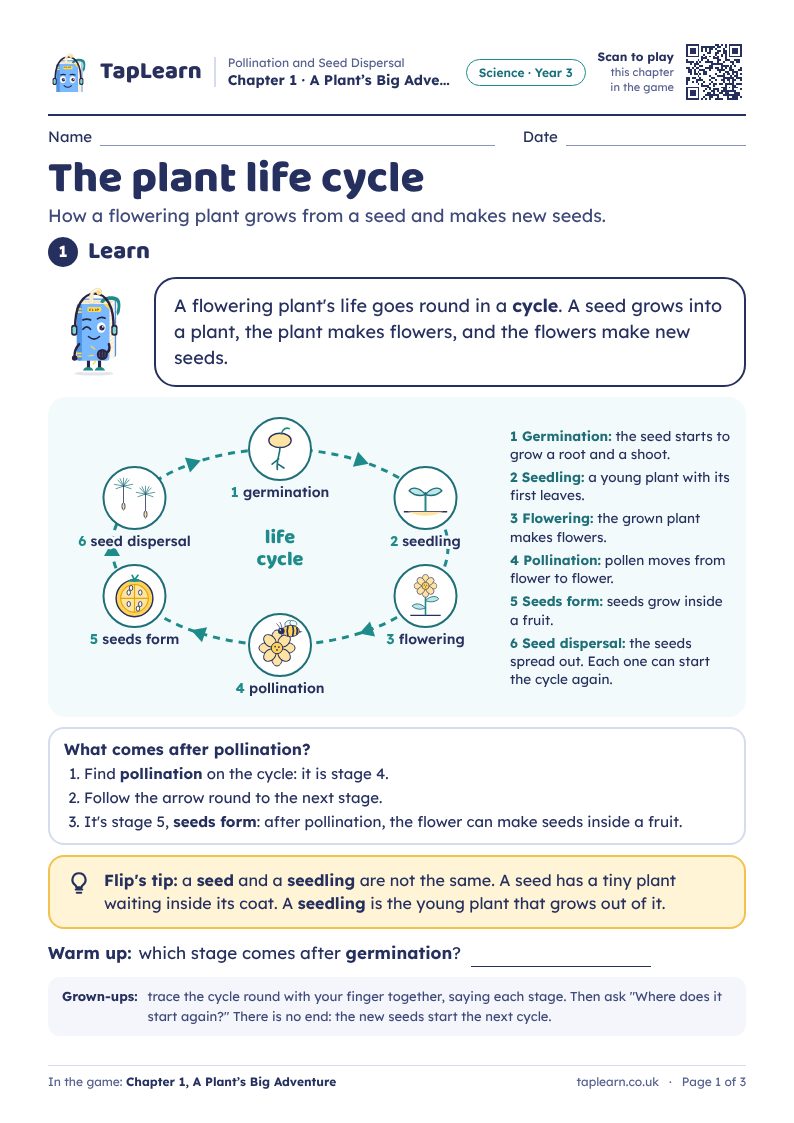
The Plant Life Cycle is a printable plant life cycle worksheet for Year 3 (ages 7 to 8) that teaches children to put the stages of a flowering plant's life in order, from germination to seed dispersal. It follows the Year 3 national curriculum in England: explore the part that flowers play in the life cycle of flowering plants, including pollination, seed formation and seed dispersal.
Free to print, no account needed.
Print it on A4, in colour or black and white. Do it after the chapter, or before it to see what your child already knows.
What's on the worksheet
Put the stages of a flowering plant's life cycle in order, from germination to seed dispersal, and tell a seed from a seedling. With a bean-in-a-bag activity and answers.
- Page 1 · Learn
- A life-cycle wheel with six stages, from germination to seed dispersal, a worked example on what comes after pollination, and Flip's tip on seeds and seedlings.
- Page 2 · Try it together
- Bean in a bag: put dried beans on damp kitchen paper in a clear bag on a window, then draw them on days 1, 3, 5 and 7 to spot germination.
- Page 2–3 · Practise
- Number six picture cards in life-cycle order, match key words to their meanings, fill the gaps, and tell a seed from a seedling. Then a challenge about pollination and seed dispersal.
- Answers sheet
- Every answer, what to watch out for (seed spreading before pollination, seed and seedling mixed up) and quick ideas such as stage spotting on a walk.
3 A4 pages and an answers sheet · about 30 minutes
In the classroom
- Use the six picture cards as a sorting starter: pairs cut them out and order them into a cycle.
- Set up Bean in a bag as a class display and record germination together over a week.
Questions from the worksheet
- Number the stages from 1 to 6 to show the life cycle: seeds form, seedling, seed dispersal, germination, pollination, flowering.
- Match each word to its meaning: germination, seedling, pollination, seed dispersal.
- Fill the gap: new seeds form inside a ___.
- Sam says, "First the seeds spread out, and then the flower is pollinated." Is he right? Explain.
The answers are on the answers sheet, for grown-ups.
National curriculum in England
This worksheet practises this statement from the Year 3 science programme of study:
- Explore the part that flowers play in the life cycle of flowering plants, including pollination, seed formation and seed dispersal
Source: National curriculum in England: science programmes of study (DfE)
Using it at home
- Set up Bean in a bag first: it takes about 10 minutes, and your child can check it each day while you work through the rest of the sheet.
- Trace the life-cycle wheel round with a finger and say each stage aloud before starting the Practise page.
Watch out for
- Putting seed spreading before pollination.
- Ask "Where do the seeds come from?" They form after pollination, so pollination must come first.
- Thinking a seed and a seedling are the same thing.
- A seed is the starting point with a tiny plant waiting inside; a seedling has germinated and has its first leaves.
Questions and answers
What are the stages of a flowering plant's life cycle?
The main stages are germination, seedling, flowering, pollination, seed formation and seed dispersal. The new seeds can then germinate, so the cycle starts again.
What is the difference between a seed and a seedling?
A seed is the start of a new plant, with a tiny plant and a food store inside a tough coat. A seedling is the young plant that grows after germination, with its first root, shoot and leaves.
More worksheets from Pollination and Seed Dispersal: A Bumblebee Adventure
- Chapter 2: Parts of a flower worksheet Members
- Chapter 3: Pollination worksheet: How pollination works Members
- Chapter 4: Seed formation worksheet: From flower to fruit Members
- Chapter 5: Seed dispersal worksheet: How seeds travel Members
- Chapter 6: Seed dispersal key worksheet: Seed detectives Members
 TapLearn