Seed formation worksheet for Year 3: From flower to fruit
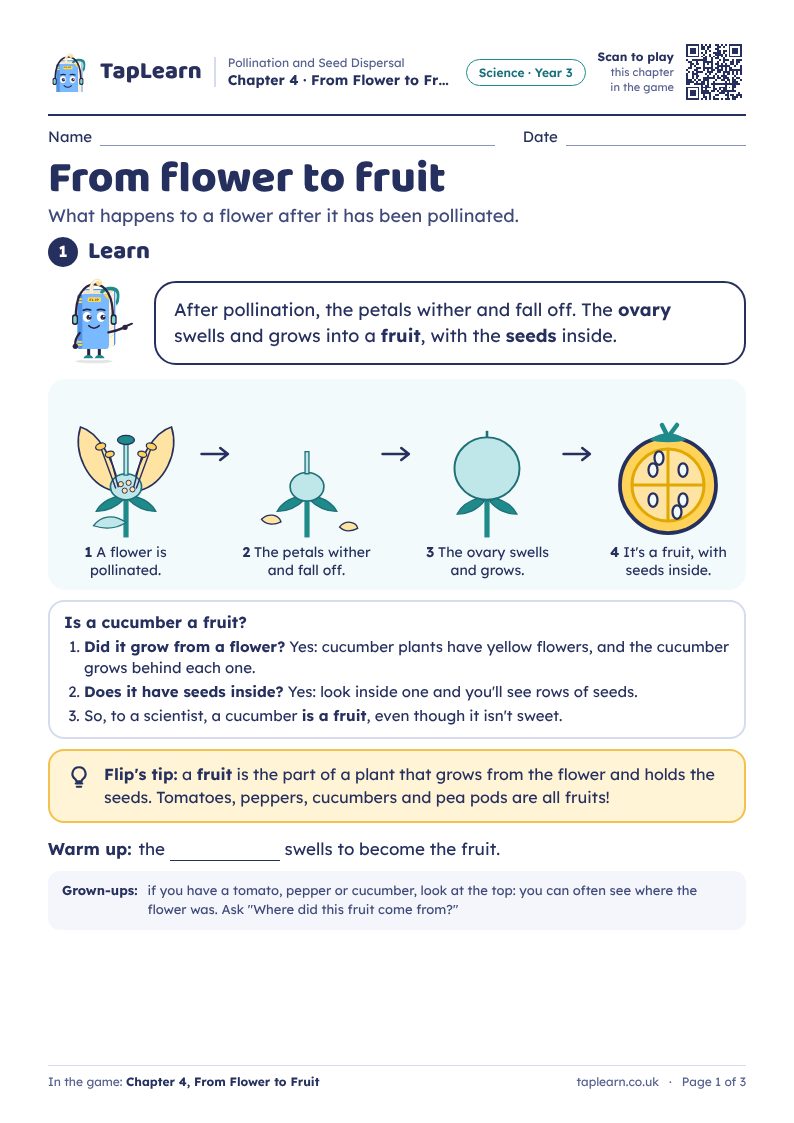
From Flower to Fruit is a printable seed formation worksheet for Year 3 (ages 7 to 8) that teaches children how a pollinated flower's ovary swells into a fruit with seeds inside. It follows the Year 3 national curriculum in England: explore the part that flowers play in the life cycle of flowering plants, including pollination, seed formation and seed dispersal.
This worksheet is for members
Membership opens every chapter of every game and every worksheet, for all your children.
See the plansAlready a member? Log in to print it.
Start with the free one: The plant life cycle (chapter 1).
Print it on A4, in colour or black and white. Do it after the chapter, or before it to see what your child already knows.
What's on the worksheet
Explain how a pollinated flower's ovary swells into a fruit with seeds inside, and tell fruits from other parts of plants we eat. With a kitchen seed hunt and answers.
- Page 1 · Learn
- Four pictures showing a flower losing its petals and its ovary swelling into a fruit, and a worked example: is a cucumber a fruit?
- Page 2 · Try it together
- Kitchen seed hunt: squeeze a cherry tomato, open a pea pod and look at an apple core, a carrot and lettuce, then decide which are fruits.
- Page 2–3 · Practise
- Number four pictures from flower to fruit, ring the fruits, fill the gaps, and explain whether an unpollinated flower can make seeds. Then a challenge about the tomato.
- Answers sheet
- Every answer, what to watch out for (only sweet foods are fruits, seeds without pollination) and ideas such as playing fruit or not at the shops.
3 A4 pages and an answers sheet · about 30 minutes
Using it at home
- Do the seed hunt before a meal with whatever fruit and veg you have; no cutting is needed. It takes about 10 minutes.
- Use two questions whenever your child is unsure: "Did it grow from a flower? Does it hold seeds?"
Watch out for
- Thinking only sweet foods are fruits.
- Ask whether it grew from a flower and holds seeds. Two yeses make it a fruit, like a pepper or a cucumber.
- Thinking a flower can make seeds without being pollinated.
- Go back to the order: pollination first, then the ovary swells and the seeds form.
Questions from the worksheet
- Ring all the fruits: tomato, carrot, cucumber, lettuce, pepper, potato, pea pod, apple.
- Fill the gap: the ___ swells up and grows into a fruit.
- No insects visited this flower, and no pollen reached its stigma. Will it make seeds? Explain.
- Ava says, "A tomato can't be a fruit, because fruits are sweet." Is she right? Explain.
The answers are on the answers sheet, for grown-ups.
National curriculum in England
This worksheet practises this statement from the Year 3 science programme of study:
- Explore the part that flowers play in the life cycle of flowering plants, including pollination, seed formation and seed dispersal
Source: National curriculum in England: science programmes of study (DfE)
In the classroom
- Bring in a tomato, pepper and pea pod for pupils to look inside, then do the ring-the-fruits set.
- Use the tomato challenge as a class debate to finish the lesson.
Questions and answers
How does a flower turn into a fruit?
After pollination, the petals wither and fall off, and the ovary at the bottom of the flower swells. It grows into a fruit, with the seeds inside.
Is a tomato a fruit or a vegetable?
To a scientist, a tomato is a fruit because it grows from a flower and holds seeds. In cooking it is often called a vegetable because it isn't sweet.
More worksheets from Pollination and Seed Dispersal: A Bumblebee Adventure
- Chapter 1: Plant life cycle worksheet: The plant life cycle Free
- Chapter 2: Parts of a flower worksheet Members
- Chapter 3: Pollination worksheet: How pollination works Members
- Chapter 5: Seed dispersal worksheet: How seeds travel Members
- Chapter 6: Seed dispersal key worksheet: Seed detectives Members
 TapLearn