Parts of a flower worksheet for Year 3
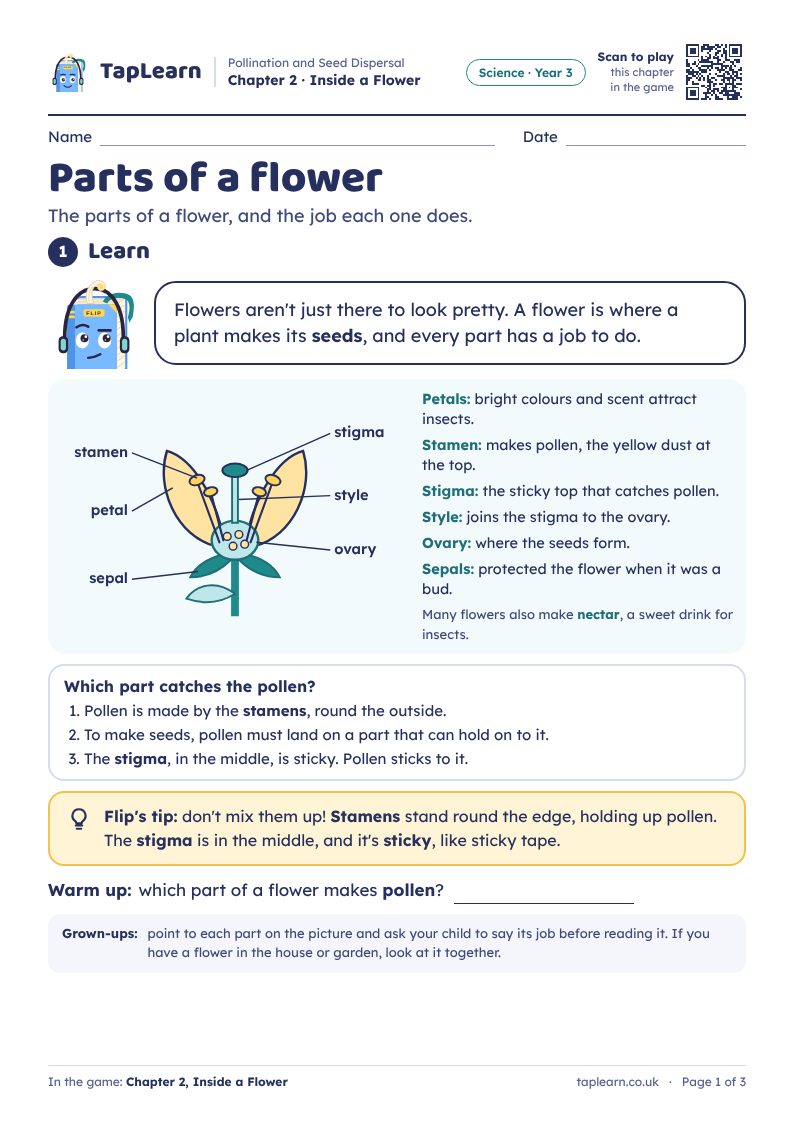
Parts of a Flower is a printable parts of a flower worksheet for Year 3 (ages 7 to 8) that teaches children to name the petals, stamen, stigma, ovary and sepals and say the job each one does. It follows the Year 3 national curriculum in England: explore the part that flowers play in the life cycle of flowering plants, including pollination, seed formation and seed dispersal.
This worksheet is for members
Membership opens every chapter of every game and every worksheet, for all your children.
See the plansAlready a member? Log in to print it.
Start with the free one: The plant life cycle (chapter 1).
Print it on A4, in colour or black and white. Do it after the chapter, or before it to see what your child already knows.
What's on the worksheet
Name the petals, stamen, stigma, style, ovary and sepals, and say the job each part does in making seeds. With a flower detective activity and answers.
- Page 1 · Learn
- A labelled diagram of a flower cut in half, with the job of each part, a worked example on which part catches pollen, and a tip for telling the stamen from the stigma.
- Page 2 · Try it together
- Flower detective: look at a real flower, count its petals and stamens, feel whether the stigma is sticky and find the ovary.
- Page 2–3 · Practise
- Label a flower diagram, match five parts to their jobs, decide true or false, and explain why the stigma is sticky. Then a challenge about what flowers are for.
- Answers sheet
- Every answer, what to watch out for (flowers as decoration, stamen and stigma swapped) and ideas such as a flower hunt and a body flower.
3 A4 pages and an answers sheet · about 30 minutes
Using it at home
- Use a real flower for Try it together if you can: one from a bunch works well. Work on a plate, as pollen can stain.
- Let your child find each part on the real flower before labelling the diagram on the Practise page.
Watch out for
- Thinking flowers are just there to look pretty.
- Ask "What would happen to the plant if it had no flowers?" It couldn't make seeds.
- Mixing up the stamen and the stigma.
- Stamens stand round the edge holding up pollen; the stigma is in the middle and sticky. "Stigma, sticky" helps.
Questions from the worksheet
- Label the flower. Use: petal, stamen, stigma, ovary, sepal.
- Match each part to its job: petal, stamen, stigma, ovary, sepal.
- True or false: the stigma makes pollen.
- Why does the stigma need to be sticky?
- Leo says, "Flowers are only there to make the garden look pretty." Is he right? What are flowers really for?
The answers are on the answers sheet, for grown-ups.
National curriculum in England
This worksheet practises this statement from the Year 3 science programme of study:
- Explore the part that flowers play in the life cycle of flowering plants, including pollination, seed formation and seed dispersal
Source: National curriculum in England: science programmes of study (DfE)
In the classroom
- Give pairs a real flower each for Try it together, then compare petal and stamen counts across the class.
- Use the true or false set as a quick mini-whiteboard check.
Questions and answers
What are the parts of a flower for Year 3?
Year 3 children learn the petals, stamen, stigma, style, ovary and sepals. Petals attract insects, the stamen makes pollen, the stigma catches it, and seeds form in the ovary.
What is the difference between the stamen and the stigma?
The stamen makes pollen and usually stands round the outside of the flower. The stigma is the sticky top in the middle that catches pollen.
More worksheets from Pollination and Seed Dispersal: A Bumblebee Adventure
- Chapter 1: Plant life cycle worksheet: The plant life cycle Free
- Chapter 3: Pollination worksheet: How pollination works Members
- Chapter 4: Seed formation worksheet: From flower to fruit Members
- Chapter 5: Seed dispersal worksheet: How seeds travel Members
- Chapter 6: Seed dispersal key worksheet: Seed detectives Members
 TapLearn