Seed dispersal key worksheet for Year 3: Seed detectives
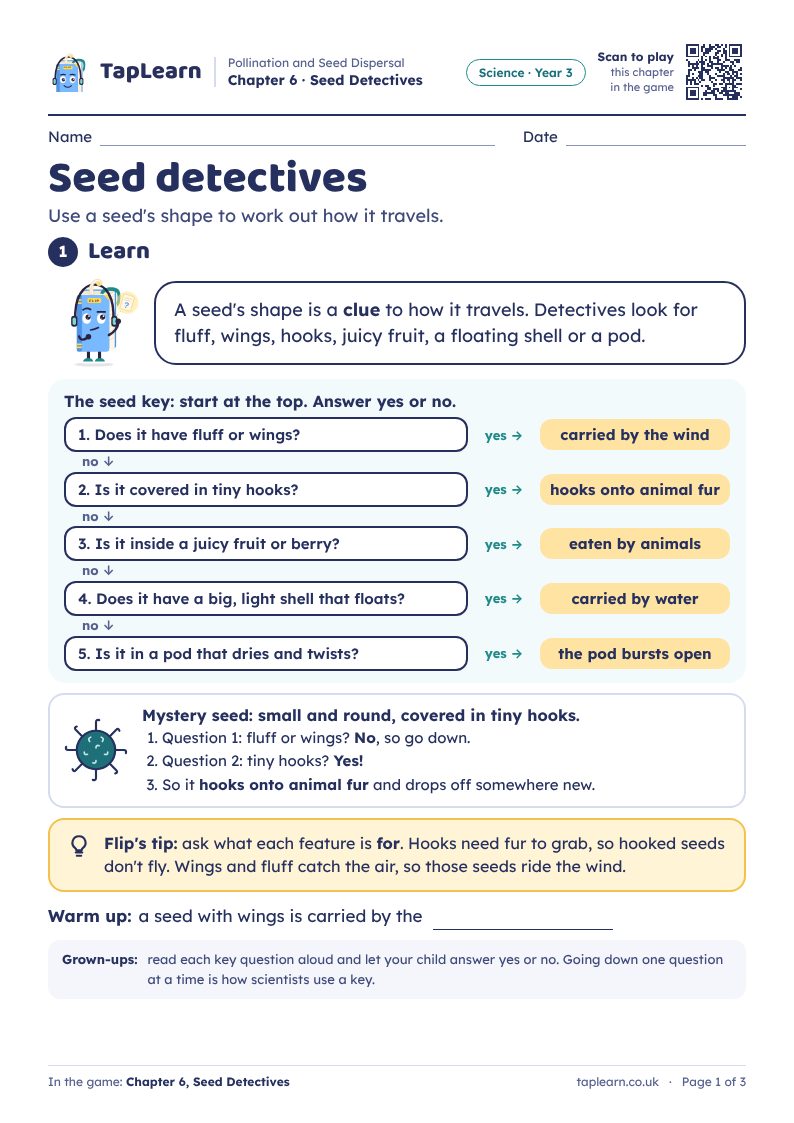
Seed Detectives is a printable seed dispersal key worksheet for Year 3 (ages 7 to 8) that teaches children to use a seed's features and a yes/no key to work out how it travels. It follows the Year 3 national curriculum in England: explore the part that flowers play in the life cycle of flowering plants, including pollination, seed formation and seed dispersal.
This worksheet is for members
Membership opens every chapter of every game and every worksheet, for all your children.
See the plansAlready a member? Log in to print it.
Start with the free one: The plant life cycle (chapter 1).
Print it on A4, in colour or black and white. Do it after the chapter, or before it to see what your child already knows.
What's on the worksheet
Use a yes/no key and each seed's features, such as fluff, wings, hooks and juicy fruit, to work out how it travels. With a design-a-seed activity and answers.
- Page 1 · Learn
- A five-question yes/no seed key, a worked example on a seed covered in hooks, and Flip's tip to ask what each feature is for.
- Page 2 · Try it together
- Design a seed: add cotton wool, a loop of tape or a foil boat to dried beans, then test them against a plain bean by fanning, rolling on a jumper and floating.
- Page 2–3 · Practise
- Use the key on five mystery seeds, ring the odd one out, check Leo's detective notes, and invent a seed for a plant beside a river. Then a challenge about a hooked seed.
- Answers sheet
- Every answer, what to watch out for (hooked seeds in the wind, pollination and dispersal mixed up) and a seed-spotting idea.
3 A4 pages and an answers sheet · about 30 minutes
Using it at home
- Read each key question aloud and let your child answer yes or no, going down one question at a time.
- Design a seed takes about 10 minutes. Tear the foil and tape for your child if needed, and keep a plain bean to compare.
Watch out for
- Matching a seed to the wrong way of travelling, such as thinking hooked seeds blow in the wind.
- Ask "What is this feature for?" and mime it: hooks grab, wings glide.
- Mixing up pollination and seed dispersal.
- The key is about seeds moving to new places, not pollen moving between flowers.
Questions from the worksheet
- Use the seed key to work out how each mystery seed travels: a seed with one thin, flat wing.
- Ring the odd one out: blackberry, cherry, coconut, holly berry.
- Check Leo's notes: "Burdock: it's covered in hooks, so it blows in the wind." Is he right?
- Invent a seed for a plant that grows beside a river. Draw it and label its special feature.
- Ava finds a tiny seed covered in hooks. She says, "It's so light, it must blow in the wind." Is she right?
The answers are on the answers sheet, for grown-ups.
National curriculum in England
This worksheet practises this statement from the Year 3 science programme of study:
- Explore the part that flowers play in the life cycle of flowering plants, including pollination, seed formation and seed dispersal
Source: National curriculum in England: science programmes of study (DfE)
In the classroom
- Give groups a set of real or pictured seeds to run through the key, then share their answers.
- Turn Design a seed into a class challenge: each group designs for wind, fur or water and tests it.
Questions and answers
How can you tell how a seed is dispersed?
Look at its features. Fluff or wings mean wind, hooks mean animal fur, juicy fruit means it is eaten by animals, and a light shell that floats means water.
What is a seed key?
A seed key is a set of yes or no questions about a seed's features. Answering them one at a time leads you to how the seed travels.
More worksheets from Pollination and Seed Dispersal: A Bumblebee Adventure
- Chapter 1: Plant life cycle worksheet: The plant life cycle Free
- Chapter 2: Parts of a flower worksheet Members
- Chapter 3: Pollination worksheet: How pollination works Members
- Chapter 4: Seed formation worksheet: From flower to fruit Members
- Chapter 5: Seed dispersal worksheet: How seeds travel Members
 TapLearn