Irregular past tense verbs worksheet for Year 2: Tricky past verbs
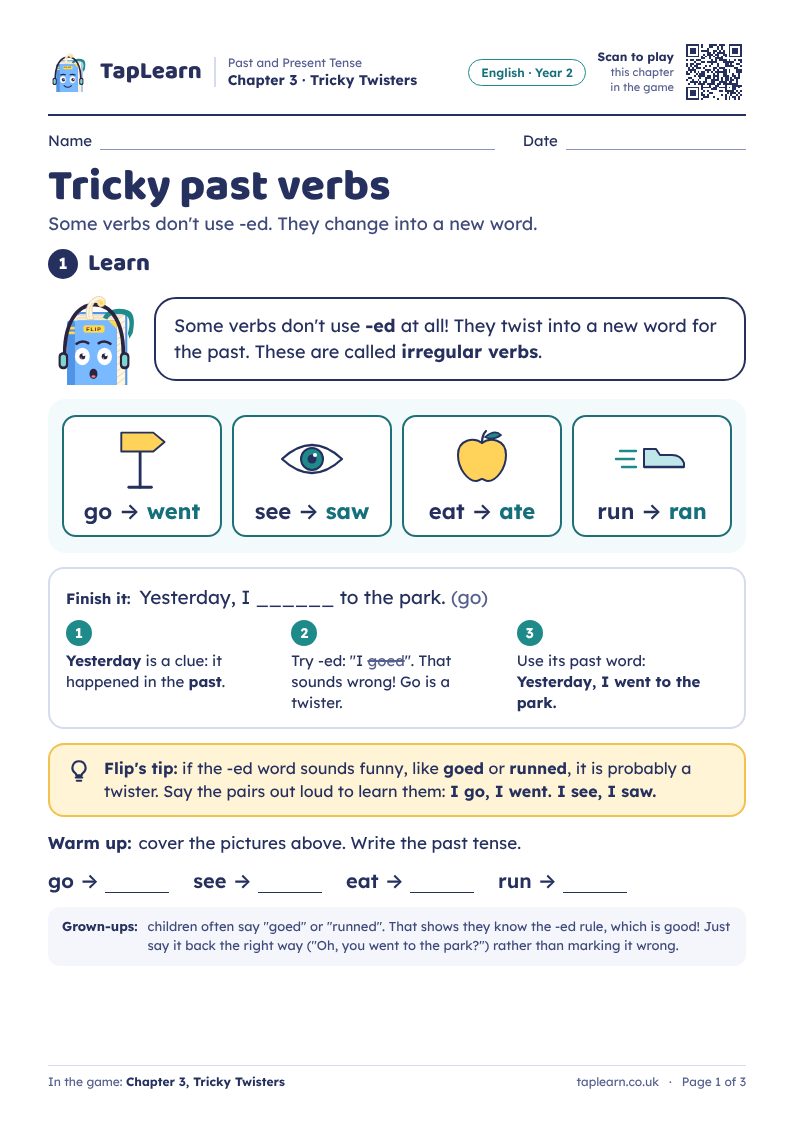
Tricky Past Verbs is a printable irregular past tense verbs worksheet for Year 2 (ages 6 to 7) that teaches children past tense verbs that don't use -ed, such as went, saw, ate and ran. It covers the Year 2 English statement on learning to use the present and past tenses correctly and consistently.
Free to print, no account needed.
Print it on A4, in colour or black and white. Do it after the chapter, or before it to see what your child already knows.
What's on the worksheet
Your child practises irregular past tense verbs that don't use -ed, such as went, saw, ate and ran, and spots mistakes like goed. Includes a twister pairs memory game and an answers sheet.
- Page 1 · Learn
- Four 'twister' pairs like go and went, a worked example showing why goed sounds wrong, Flip's tip to say the pairs aloud, and a warm-up.
- Page 2 · Try it together
- Twister pairs: write 8 verbs and their past tense words on scraps, play a pairs game, and say a sentence with each past word you win. Then match verbs to past tense words.
- Page 3 · Practise
- Ring the right past verb, like ran or runned, write past tense verbs to finish sentences, write about a place you went, and a challenge about I goed.
- Answers sheet
- Every answer, mix-ups like wented or mixing swam and swum, and twister ping-pong and story spotting ideas.
3 A4 pages and an answers sheet · about 25 minutes
Using it at home
- Saying goed or runned shows your child knows the -ed rule. Say it back the right way ("Oh, you went to the park?") rather than marking it wrong.
- For a quicker twister pairs game, use just 4 pairs.
- Play twister ping-pong in the car: you say a verb, your child bats back the past tense.
Watch out for
- Adding -ed to a twister: goed, runned, eated, catched.
- Say the right word back and practise the pair aloud: "catch, caught".
- Adding -ed to the new word too: wented, ated.
- The past word is already past, so it needs nothing more.
- Mixing up sang and sung, or swam and swum.
- For "Yesterday, I…" use sang and swam.
Questions from the worksheet
- Draw a line from each verb to its past tense: give, find, fly, get, say.
- Draw a ring round the right past verb: Last night, we eated / ate soup for tea.
- Write the past tense of the verb: We ___ a song for Gran. (sing)
- Leo says: "I goed to the shop." Is that right? Why do you think Leo said goed?
The answers are on the answers sheet, for grown-ups.
National curriculum in England
This worksheet practises these statements from the Year 2 english programme of study:
- Develop their understanding of the concepts set out in English appendix 2 by: learning how to use the present and past tenses correctly and consistently, including the progressive form
- Develop their understanding of the concepts set out in English appendix 2 by: learning how to use some features of written Standard English
- Text: correct choice and consistent use of present tense and past tense throughout writing
In the classroom
- Play twister pairs in small groups, then collect every pair the class found on a working wall.
- Use Practise B as a quick check, with children reading the corrected sentence aloud.
Questions and answers
What are irregular past tense verbs?
Irregular verbs don't add -ed in the past. They change into a new word, like go and went, see and saw, eat and ate.
Why do children say goed?
They are using the -ed rule, which works for most verbs. Go is irregular, so its past tense is went.
Which irregular verbs do Year 2 children learn?
Common ones on the sheet include went, saw, ate, ran, came, sat, swam, made, had, drank, sang, took, gave, found, flew, got and said.
 TapLearn