Tense consistency worksheet for Year 2: Fixing tense mix-ups
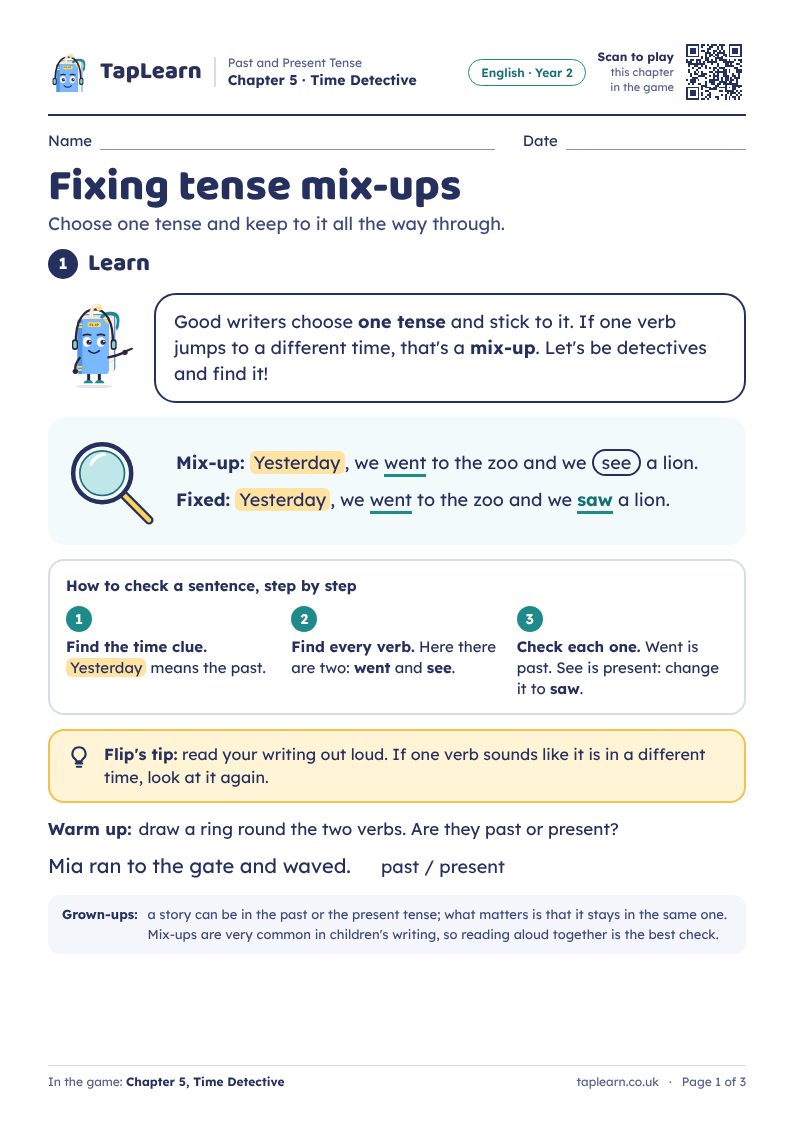
Fixing Tense Mix-Ups is a printable tense consistency worksheet for Year 2 (ages 6 to 7) that teaches children to choose one tense and keep to it by finding the time clue and checking every verb. It covers the Year 2 English statement on correct choice and consistent use of present tense and past tense throughout writing.
Free to print, no account needed.
Print it on A4, in colour or black and white. Do it after the chapter, or before it to see what your child already knows.
What's on the worksheet
Your child keeps writing in one tense: they find the time clue, check every verb and fix mix-ups in sentences and a short story. Includes a story detectives activity with a book from home and an answers sheet.
- Page 1 · Learn
- A mix-up about a zoo trip and its fix, three steps for checking a sentence, Flip's tip to read writing aloud, and a warm-up.
- Page 2 · Try it together
- Story detectives: read a page of a book, find three verbs and decide the book's tense, then the grown-up retells it with a mix-up for your child to catch. Then fix one wrong verb in sentences.
- Page 3 · Practise
- Find and fix three mix-ups in Leo's farm story, write about last weekend and check the verbs, match starts to endings in the same tense, and a challenge.
- Answers sheet
- Every answer, mix-ups like checking only the first verb, and mix-up spotter and read-it-back ideas.
3 A4 pages and an answers sheet · about 25 minutes
Using it at home
- Reading aloud together is a good check, as tense mix-ups are very common in children's writing.
- Most picture books are in the past tense, but some are in the present. Either is fine: the clue is that the author keeps to one.
- At teatime, tell your child about your day and slip in one present tense verb for them to catch.
Watch out for
- Checking only the first verb.
- Mix-ups often hide after "and" or "then". Find every verb.
- Fixing the wrong verb.
- In "Every day, Ava wakes up…", the present is right; "brushed" is the mix-up.
- "Fixing" a twister with -ed, like drinked or feeded.
- Look back at the twister pairs: drank, fed.
Questions from the worksheet
- One verb is in the wrong tense. Draw a ring round it, then write it the right way: Last week, Sam baked a cake and eats it.
- Every day, Ava wakes up and brushed her teeth.
- Leo's story is in the past tense, but it has 3 mix-ups. Ring them, then write them the right way.
- Mia says: "Stories always have to be in the past tense." Is she right? What do you think?
The answers are on the answers sheet, for grown-ups.
National curriculum in England
This worksheet practises these statements from the Year 2 english programme of study:
- Develop their understanding of the concepts set out in English appendix 2 by: learning how to use the present and past tenses correctly and consistently, including the progressive form
- Develop their understanding of the concepts set out in English appendix 2 by: learning how to use some features of written Standard English
- Text: correct choice and consistent use of present tense and past tense throughout writing
In the classroom
- Display a short paragraph with mix-ups and have pairs race to find and fix them.
- Use the story detectives activity with class reading books to find out which tense each is told in.
Questions and answers
What does tense consistency mean?
It means choosing one tense, past or present, and keeping to it all the way through a piece of writing.
Do stories have to be in the past tense?
No. Most stories are in the past, but some are in the present. What matters is keeping to one tense.
How can children check their tenses?
Find the time clue, find every verb and check each one matches. Reading the writing aloud helps catch verbs that jump in time.
 TapLearn