Past and present tense worksheet for Year 2: Yesterday or today?
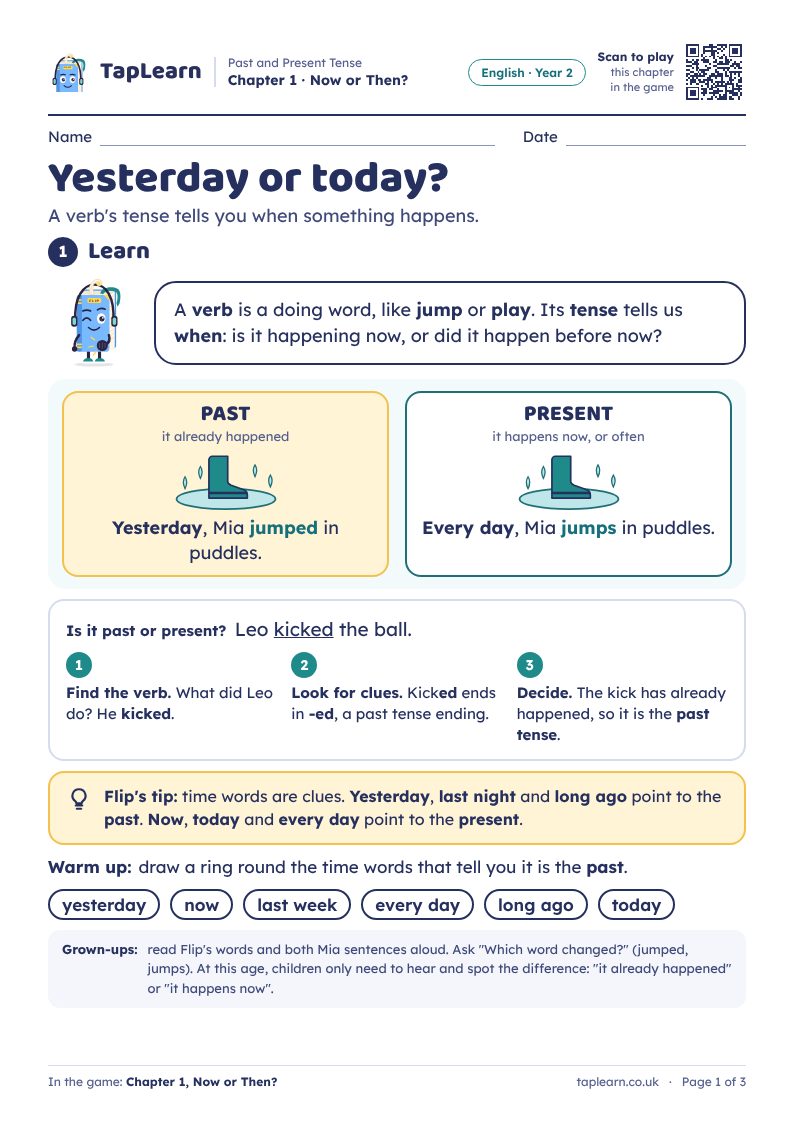
Yesterday or Today? is a printable past and present tense worksheet for Year 2 (ages 6 to 7) that teaches children to find the verb and decide whether it already happened or happens now, using time words as clues. It covers the Year 2 English statement on learning to use the present and past tenses correctly and consistently.
Free to print, no account needed.
Print it on A4, in colour or black and white. Do it after the chapter, or before it to see what your child already knows.
What's on the worksheet
Your child finds the verb in a sentence and decides whether it is in the past or present tense, using time words like yesterday and every day as clues. Includes a step-into-time game with cushions and an answers sheet.
- Page 1 · Learn
- Two Mia sentences show past and present tense, a three-step example deciding the tense of Leo kicked the ball, a tip on time words, and a warm-up.
- Page 2 · Try it together
- Step into time: put PAST and NOW on two cushions, and step onto the right one as the grown-up says sentences, then say each one the other way. Then decide past or present for sentences.
- Page 3 · Practise
- Match present verbs to their past forms, choose the verb that fits a time word, write a sentence about yesterday, and a challenge about Yesterday I walk to the park.
- Answers sheet
- Every answer, mix-ups like not hearing the -ed, and bedtime chat and now-and-then walk ideas.
3 A4 pages and an answers sheet · about 25 minutes
Using it at home
- Read both Mia sentences aloud and ask "Which word changed?" Children only need to hear and spot the difference at this age.
- In step into time, use verbs from your day like wash, cook and help. If your child steps the wrong way, add "yesterday" or "every day" and let them step again.
- At bedtime, ask "What did you do today?" and repeat any slips the right way.
Watch out for
- Mixing up the time clue and the verb.
- "Yesterday" is a clue, but the tense is in the verb. Ask "Which is the doing word?"
- Not hearing the -ed, so writing walk for walked.
- Say it slowly and stretch the end.
- Thinking present only means right now.
- It also covers things that happen often: "Every day, Leo brushes his teeth."
Questions from the worksheet
- Did it already happen? Draw a ring round past or present: Ava painted a red boat.
- Look at the time word. Draw a ring round the verb that fits: Yesterday, Sam walks / walked the dog.
- Write a sentence about something you did yesterday.
- Leo wrote: "Yesterday I walk to the park." Is that right? What would you change?
The answers are on the answers sheet, for grown-ups.
National curriculum in England
This worksheet practises these statements from the Year 2 english programme of study:
- Develop their understanding of the concepts set out in English appendix 2 by: learning how to use the present and past tenses correctly and consistently, including the progressive form
- Develop their understanding of the concepts set out in English appendix 2 by: learning how to use some features of written Standard English
- Text: correct choice and consistent use of present tense and past tense throughout writing
In the classroom
- Play step into time as a whole class, with PAST on one side of the room and NOW on the other.
- Use Practise C as a mini-whiteboard check: children write the verb that fits each time word.
Questions and answers
What is past and present tense in Year 2?
The tense of a verb tells us when something happens. Past tense means it already happened (jumped); present tense means it happens now or often (jumps).
How can children tell if a sentence is past or present?
Find the verb and look for time words. Yesterday and last night point to the past; now, today and every day point to the present.
What is a verb?
A verb is a doing word, like jump, play or kick.
 TapLearn