Adding -ed worksheet for Year 2
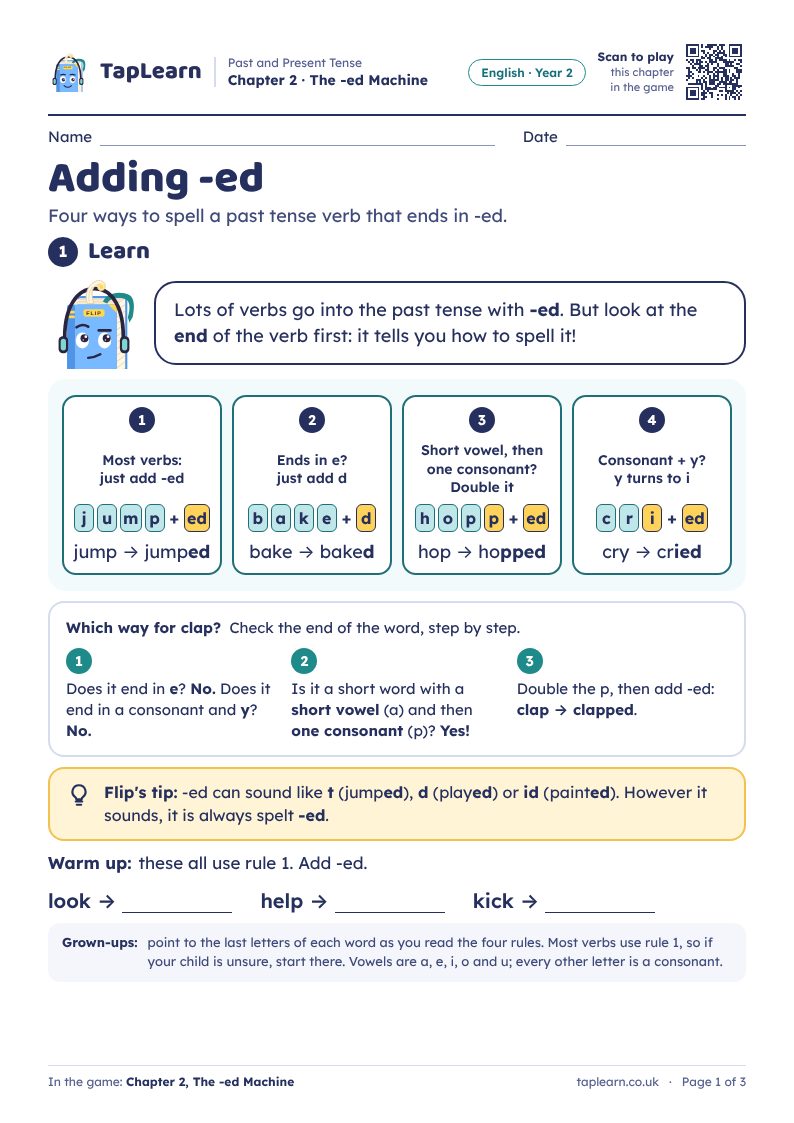
Adding -ed is a printable adding -ed worksheet for Year 2 (ages 6 to 7) that teaches children four spelling rules for past tense verbs: jumped, baked, hopped and cried. It covers the Year 2 English statement on learning to use the present and past tenses correctly and consistently.
Free to print, no account needed.
Print it on A4, in colour or black and white. Do it after the chapter, or before it to see what your child already knows.
What's on the worksheet
Your child learns four ways to spell past tense verbs with -ed: just add -ed (jumped), add d (baked), double the last letter (hopped) or change y to i (cried). Includes a verb sorting activity with bowls and an answers sheet.
- Page 1 · Learn
- The four -ed rules with examples, a step-by-step check for clap, Flip's tip that -ed always has the same spelling however it sounds, and a warm-up.
- Page 2 · Try it together
- Sort the verbs: write 12 verbs on scraps, drop each into the right rule bowl by looking at its ending, say it both ways and write its past tense. Then ring right spellings.
- Page 3 · Practise
- Add -ed to verbs like drop, try and tidy, write past tense verbs to finish sentences, use one in your own sentence, and a challenge about stoped.
- Answers sheet
- Every answer, mix-ups like writing what they hear or doubling too often, and spell-it-aloud and kitchen verb games.
3 A4 pages and an answers sheet · about 25 minutes
Using it at home
- Point to the last letters of each word as you read the four rules. Most verbs use rule 1, so start there if your child is unsure.
- Each bowl in the sorting game should end up with three words. If one lands wrong, ask "What letter does it end with?"
- While cooking, name what you did: chopped, poured, whisked, baked. Ask which one doubled a letter.
Watch out for
- Writing what they hear, like jumpt or playd.
- Say "it can sound like t or d, but it's always spelt -ed."
- Changing every y, as in plaied.
- Play, stay and enjoy keep their y because a vowel comes before it. Only a consonant + y changes: cry, cried.
- Doubling too often, as in shoutted or bakeed.
- Shout and look have two vowels, so no doubling. For bake, the e is already there: just add d.
Questions from the worksheet
- Draw a ring round the right spelling: skipped or skiped, cryed or cried.
- Add -ed. Write the past tense: drop, try, tidy, close.
- Write the verb in the past tense to finish the sentence: The frog ___ into the pond. (hop)
- Ava wrote: "I stoped the ball." Is that right? Which rule should she use?
The answers are on the answers sheet, for grown-ups.
National curriculum in England
This worksheet practises these statements from the Year 2 english programme of study:
- Develop their understanding of the concepts set out in English appendix 2 by: learning how to use the present and past tenses correctly and consistently, including the progressive form
- Develop their understanding of the concepts set out in English appendix 2 by: learning how to use some features of written Standard English
- Text: correct choice and consistent use of present tense and past tense throughout writing
In the classroom
- Run the verb sort as a group activity with four labelled hoops and verb cards.
- Play spell it aloud as a starter: say a verb and children name the rule and spell the past tense.
Questions and answers
What are the rules for adding -ed?
Most verbs just add -ed (jumped). Verbs ending in e add d (baked). Short verbs with a short vowel and one consonant double it (hopped). Consonant + y changes to i (cried).
Why does stop become stopped?
Stop has a short vowel (o) then one consonant (p), so the p doubles before -ed.
Why does play become played, not plaied?
Play has a vowel before the y, so the y stays. Only a consonant + y changes to i, as in cry and cried.
 TapLearn