Parenthesis worksheet for Year 5: Spotting parenthesis
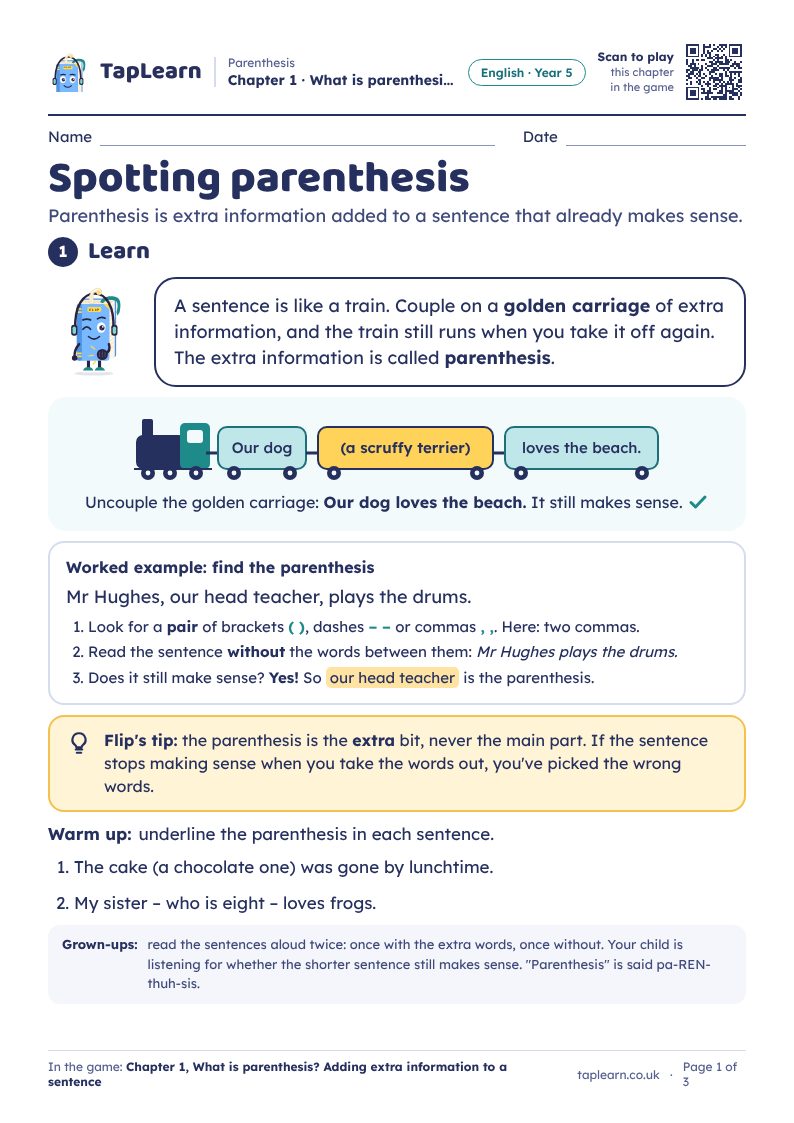
Spotting Parenthesis is a printable parenthesis worksheet for Year 5 (ages 9 to 10) that teaches children that parenthesis is extra information added to a sentence that already makes sense, and to test it by taking it out. It covers the Year 5 statement on using brackets, dashes or commas to indicate parenthesis.
Free to print, no account needed.
Print it on A4, in colour or black and white. Do it after the chapter, or before it to see what your child already knows.
What's on the worksheet
Your child finds the extra information (parenthesis) in a sentence and checks it still makes sense when you take it out. Includes a golden carriage hunt through a book at home and an answers sheet.
- Page 1 · Learn
- Parenthesis as a golden carriage on a sentence train, a worked example finding "our head teacher" between commas, Flip's take-it-out tip, and an underline warm-up.
- Page 2 · Try it together
- Golden carriage hunt: look through a non-fiction book, magazine or leaflet for brackets, dashes or a pair of commas, read each sentence with and without the extra words, and record what they told you.
- Page 3 · Practise
- Underline parenthesis, rewrite sentences without it, decide whether bracketed words are really parenthesis, add your own extra information, and a challenge about list commas.
- Answers sheet
- Every answer, mix-ups like treating every pair of commas as parenthesis, and an add-a-carriage idea.
3 A4 pages and an answers sheet · about 25 minutes
Using it at home
- Read the sentences aloud twice, once with the extra words and once without. "Parenthesis" is said pa-REN-thuh-sis.
- In the hunt, not every pair of commas is parenthesis: list commas are different, and the read-it-without test shows this.
- Say "The bus was late." and your child adds extra information in the middle: "The bus, the number 7, was late."
Watch out for
- Picking the main words instead of the extra ones.
- Ask, "If we lift those words out, is it still a whole sentence?"
- Thinking a sentence breaks when the extra bit goes.
- Read the shorter version aloud together: hearing it usually shows it still works.
- Treating every pair of commas as parenthesis.
- List commas are different, and the take-it-out test sorts them.
Questions from the worksheet
- Underline the parenthesis in each sentence: Leo's bike (a present from Gran) has a very loud bell. Mia, my best friend, lives next door to me.
- Rewrite each sentence without its parenthesis: Ava (who had forgotten her coat) shivered at the bus stop.
- Is the part in brackets really parenthesis? Take it out and read what is left: The cat (sat) on the warm mat. The film (a funny one) made us all laugh.
- Write some extra information in the gap, then write the sentence with your words in brackets: My teacher ___ likes painting.
- Leo reads: Mum bought apples, pears, bananas and grapes. He says, "pears is parenthesis, because it's between two commas." Is he right?
The answers are on the answers sheet, for grown-ups.
National curriculum in England
This worksheet practises these statements from the Years 5–6 english programme of study:
- Indicate grammatical and other features by: using brackets, dashes or commas to indicate parenthesis
- Punctuation: brackets, dashes or commas to indicate parenthesis (Year 5 english)
- Terminology: modal verb, relative pronoun, relative clause, parenthesis, bracket, dash, cohesion, ambiguity (Year 5 english)
In the classroom
- Play add a carriage as a starter: give a short sentence and pupils add parenthesis.
- Use Practise C as a yes-or-no vote with the take-it-out test.
Questions and answers
What is parenthesis in Year 5?
Parenthesis is extra information added to a sentence that already makes sense, marked with a pair of brackets, dashes or commas.
How do you check something is parenthesis?
Take the extra words out and read what's left. If the sentence still makes sense, it's parenthesis.
Are all pairs of commas parenthesis?
No. List commas separate items, and if you take an item out the list doesn't read properly.
More worksheets from Parenthesis: Brackets, Dashes and Commas on a Word Train
- Chapter 2: Brackets worksheet: Using brackets Members
- Chapter 3: Dashes worksheet: Using dashes Members
- Chapter 4: Commas for parenthesis worksheet Members
- Chapter 5: Brackets, dashes or commas worksheet: Brackets, dashes or commas? Members
- Chapter 6: Grammar terminology worksheet: Year 5 grammar words Members
 TapLearn