Grammar terminology worksheet for Year 5: Year 5 grammar words
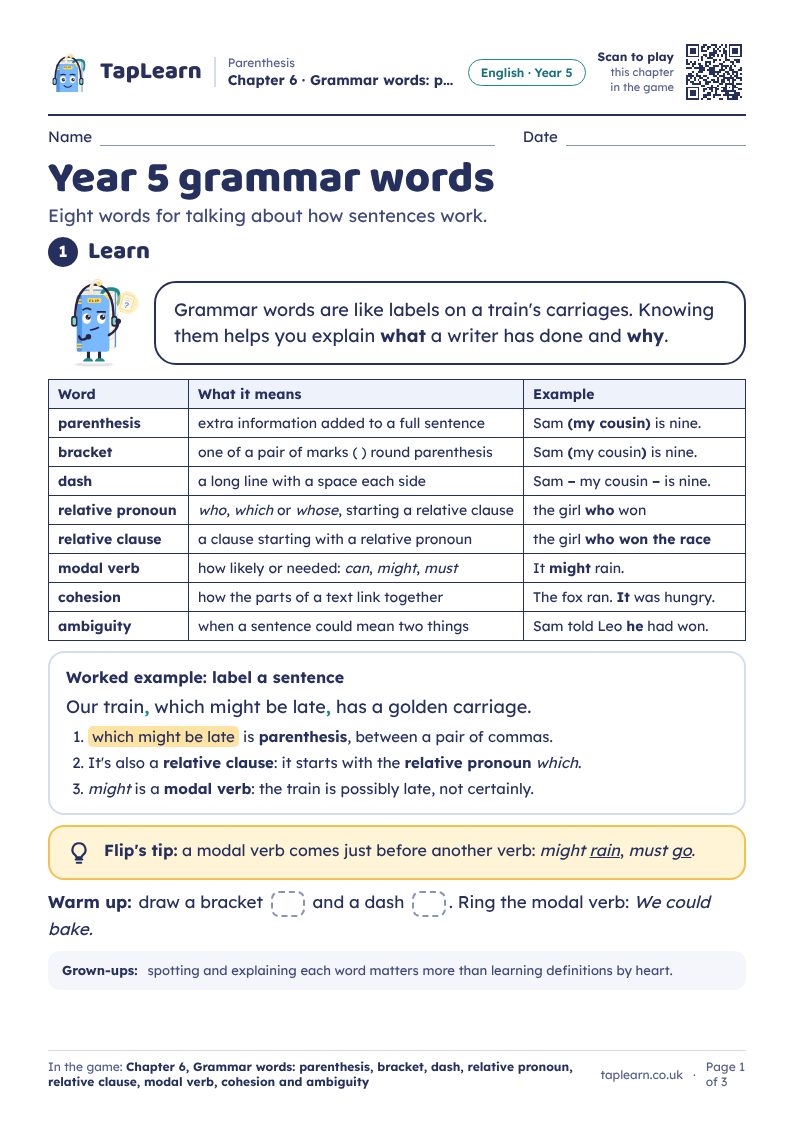
Year 5 Grammar Words is a printable grammar terminology worksheet for Year 5 (ages 9 to 10) that teaches eight words for talking about sentences, from parenthesis, bracket and dash to relative clause, modal verb, cohesion and ambiguity. It covers the Year 5 statement on the terms modal verb, relative pronoun, relative clause, parenthesis, bracket, dash, cohesion and ambiguity.
This worksheet is for members
Membership opens every chapter of every game and every worksheet, for all your children.
See the plansAlready a member? Log in to print it.
Start with the free one: Spotting parenthesis (chapter 1).
Print it on A4, in colour or black and white. Do it after the chapter, or before it to see what your child already knows.
What's on the worksheet
Your child explains and spots eight Year 5 grammar words, from parenthesis and relative clause to modal verb, cohesion and ambiguity. Includes a forecast detectives modal verb hunt and an answers sheet.
- Page 1 · Learn
- A table of eight grammar words with meanings and examples, a worked example labelling a sentence, Flip's tip on modal verbs, and a draw-and-ring warm-up.
- Page 2 · Try it together
- Forecast detectives: listen to or read a weather forecast, tally each modal verb you hear, talk about how sure each one sounds, then make up your own forecast with three modal verbs.
- Page 3 · Practise
- Ring relative pronouns and underline relative clauses, ring modal verbs, match words to meanings, fix an ambiguous sentence, find the word that helps cohesion, and a challenge.
- Answers sheet
- Every answer, mix-ups like bracket and dash, and a sure-o-meter idea.
3 A4 pages and an answers sheet · about 25 minutes
Using it at home
- Spotting and explaining each word matters more than learning definitions by heart.
- In forecast detectives, there's room to disagree about likely and possible. The point is noticing that will sounds surer than might.
- Say "We ___ have pizza tonight" with will, might, could and must. Which is surest?
Watch out for
- Mixing up bracket and dash.
- Brackets are curved ( ); a dash is a straight line.
- Mixing up relative pronouns with other words.
- Who and which are relative pronouns when they start a clause about a noun, not in a question like "Who is there?"
- Mixing up modal verbs with other verbs.
- A modal verb comes before another verb and changes how sure or necessary it is: in "might go", might is the modal verb.
Questions from the worksheet
- Ring the relative pronoun. Underline the whole relative clause: The girl who won the race shook my hand. The man whose dog barks all night lives next door.
- Ring the modal verb in each sentence: We might go to the park later. You must wear a helmet on your bike. It could snow tomorrow.
- Sam told Leo he had won. Why is this sentence ambiguous? Rewrite it so the meaning is clear.
- The fox crept closer. It was hungry. Which word links these sentences and helps cohesion? What does it stand for?
- Ava says, "In The dog, which was muddy, ran inside, the word which is a modal verb." Is she right? Explain.
The answers are on the answers sheet, for grown-ups.
National curriculum in England
This worksheet practises this statement from the Year 5 english programme of study:
- Terminology: modal verb, relative pronoun, relative clause, parenthesis, bracket, dash, cohesion, ambiguity
In the classroom
- Display the eight-word table and label a class sentence together.
- Use the sure-o-meter as a starter for modal verbs.
Questions and answers
What is a modal verb?
A modal verb shows how likely or necessary something is, like can, might, will or must. It comes just before another verb: might rain.
What does cohesion mean?
Cohesion is how the parts of a text link together, for example using it to refer back to the fox in "The fox ran. It was hungry."
What is ambiguity?
Ambiguity is when a sentence could mean two things, like "Sam told Leo he had won" (who won?).
More worksheets from Parenthesis: Brackets, Dashes and Commas on a Word Train
- Chapter 1: Parenthesis worksheet: Spotting parenthesis Free
- Chapter 2: Brackets worksheet: Using brackets Members
- Chapter 3: Dashes worksheet: Using dashes Members
- Chapter 4: Commas for parenthesis worksheet Members
- Chapter 5: Brackets, dashes or commas worksheet: Brackets, dashes or commas? Members
 TapLearn