Brackets worksheet for Year 5: Using brackets
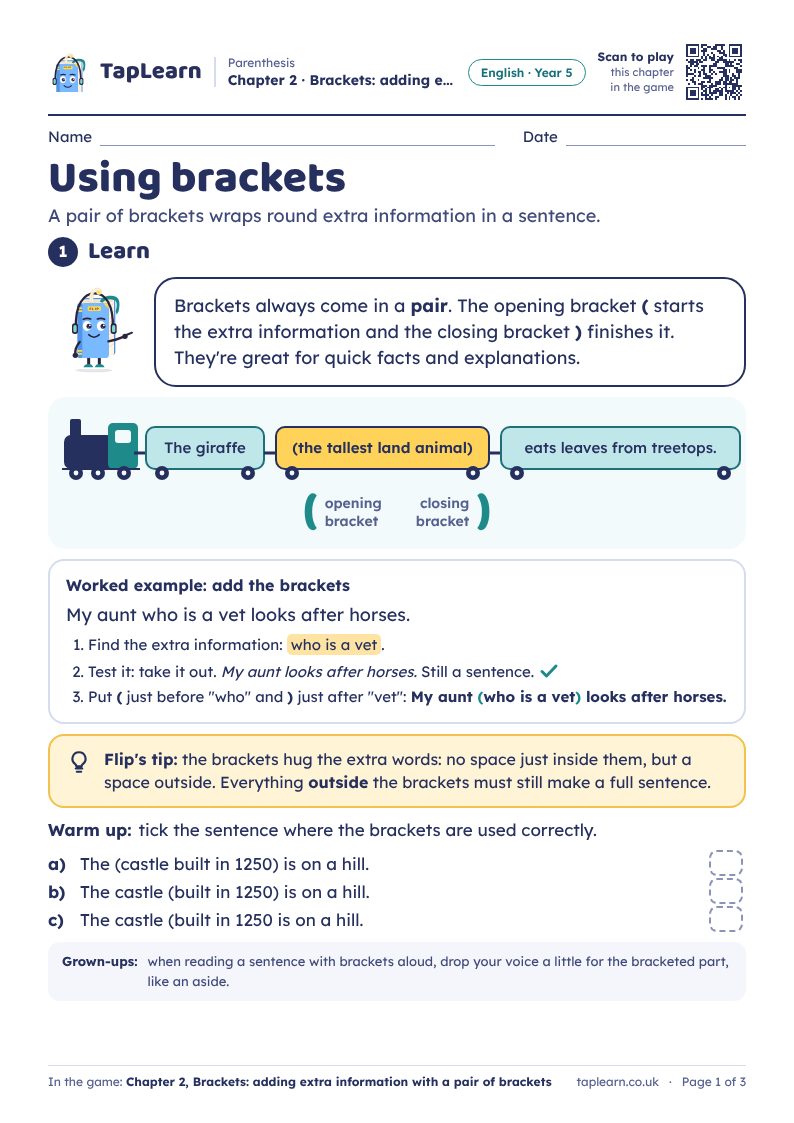
Using Brackets is a printable brackets worksheet for Year 5 (ages 9 to 10) that teaches children that brackets come in a pair, with the opening bracket starting the extra information and the closing bracket finishing it. It covers the Year 5 statement on using brackets, dashes or commas to indicate parenthesis.
This worksheet is for members
Membership opens every chapter of every game and every worksheet, for all your children.
See the plansAlready a member? Log in to print it.
Start with the free one: Spotting parenthesis (chapter 1).
Print it on A4, in colour or black and white. Do it after the chapter, or before it to see what your child already knows.
What's on the worksheet
Your child puts a pair of brackets round extra information, fixes sentences with a missing or misplaced bracket, and writes their own. Includes a family fact file activity and an answers sheet.
- Page 1 · Learn
- Opening and closing brackets labelled, a worked example adding brackets round "who is a vet", Flip's tip that brackets hug the extra words, and a tick-the-correct-sentence warm-up.
- Page 2 · Try it together
- Family fact file: choose three people, pets or toys, say a short sentence about each, add a fact in brackets, and read it aloud with a quieter aside voice for the bracketed part.
- Page 3 · Practise
- Add brackets to sentences, tick and copy the correct one, match sentences to extra information and add brackets, write about a place you like, and a challenge about one bracket.
- Answers sheet
- Every answer, mix-ups like brackets round the wrong words, and a bracket-spotting idea.
3 A4 pages and an answers sheet · about 25 minutes
Using it at home
- When reading a sentence with brackets aloud, drop your voice a little for the bracketed part, like an aside.
- In the fact file, check for two brackets each time and cover the bracketed part with a finger: the rest should still make sense.
- Look for brackets on food packets, signs or in a recipe book and read them aloud.
Watch out for
- Using only one bracket.
- Say "open, close", like a door: whatever opens must close.
- Putting brackets round the wrong words.
- Cover the bracketed part with a finger: what's left must still be a full sentence.
- Using a hyphen or one comma instead.
- Dashes can work too, but they also come in a pair, and a short hyphen isn't a dash.
Questions from the worksheet
- Add a pair of brackets to each sentence: The Moon about 384,000 km away travels round the Earth. Penguins birds that cannot fly are excellent swimmers.
- Tick the one correct sentence: The library (open until six) is next to the park. The library (open until six is next to the park. The (library open until six) is next to the park.
- Write a sentence about a place you like. Add a fact about it in brackets.
- Sam wrote: The bus (number 42 was late again. He says, "One bracket is enough." Is he right? Explain, then write the sentence correctly.
The answers are on the answers sheet, for grown-ups.
National curriculum in England
This worksheet practises these statements from the Years 5–6 english programme of study:
- Indicate grammatical and other features by: using brackets, dashes or commas to indicate parenthesis
- Punctuation: brackets, dashes or commas to indicate parenthesis (Year 5 english)
- Terminology: modal verb, relative pronoun, relative clause, parenthesis, bracket, dash, cohesion, ambiguity (Year 5 english)
In the classroom
- Read sentences aloud with an aside voice for the brackets as a starter.
- Use Practise C as a matching task in pairs.
Questions and answers
How do you use brackets for parenthesis?
Put an opening bracket just before the extra information and a closing bracket just after it: My aunt (who is a vet) looks after horses.
Do brackets always come in a pair?
Yes. The second bracket shows where the extra information ends.
Where do the spaces go with brackets?
No space just inside the brackets, but a space outside them.
More worksheets from Parenthesis: Brackets, Dashes and Commas on a Word Train
- Chapter 1: Parenthesis worksheet: Spotting parenthesis Free
- Chapter 3: Dashes worksheet: Using dashes Members
- Chapter 4: Commas for parenthesis worksheet Members
- Chapter 5: Brackets, dashes or commas worksheet: Brackets, dashes or commas? Members
- Chapter 6: Grammar terminology worksheet: Year 5 grammar words Members
 TapLearn