Brackets, dashes or commas worksheet for Year 5: Brackets, dashes or commas?
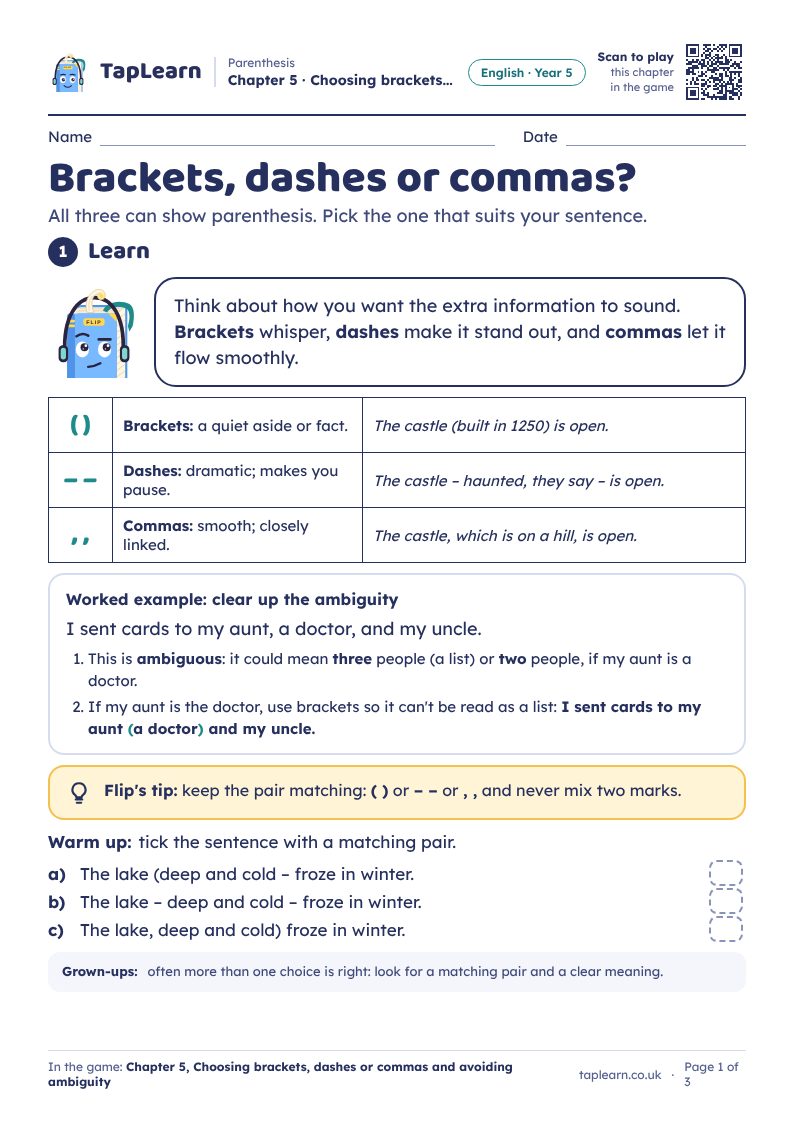
Brackets, Dashes or Commas? is a printable brackets, dashes or commas worksheet for Year 5 (ages 9 to 10) that teaches children that brackets whisper, dashes make extra information stand out and commas let it flow, and to keep each pair matching. It covers the Year 5 statement on using brackets, dashes or commas to indicate parenthesis.
This worksheet is for members
Membership opens every chapter of every game and every worksheet, for all your children.
See the plansAlready a member? Log in to print it.
Start with the free one: Spotting parenthesis (chapter 1).
Print it on A4, in colour or black and white. Do it after the chapter, or before it to see what your child already knows.
What's on the worksheet
Your child chooses brackets, dashes or commas to suit a sentence, keeps each pair matching, and uses punctuation to avoid ambiguity. Includes a three-ways-to-say-it activity and an answers sheet.
- Page 1 · Learn
- The three choices with their effects and examples, a worked example clearing up an ambiguous sentence with brackets, Flip's matching-pair tip, and a tick-the-matching-pair warm-up.
- Page 2 · Try it together
- Three ways to say it: make up one sentence about your home with extra information, write it with brackets, dashes and commas, read each aloud and choose the calmest and most dramatic.
- Page 3 · Practise
- Fix mixed-up pairs, add the marks shown for each effect, rewrite ambiguous sentences with brackets or dashes, write a storm sentence with dashes, and a challenge about effects.
- Answers sheet
- Every answer, mix-ups like a bracket closed with a dash, and a mark-detective idea.
3 A4 pages and an answers sheet · about 25 minutes
Using it at home
- Often more than one choice is right: look for a matching pair and a clear meaning.
- In three ways to say it, it's fine to disagree about which sounds calmest; talk about why.
- When reading, ask "Why did the writer choose dashes here?"
Watch out for
- Mixing marks in a pair, like a bracket closed with a dash.
- Ask, "What did you open with?"
- Using commas that cause ambiguity, especially next to a list.
- Brackets or dashes make it clear the words are extra information.
- Swapping the effects.
- Read the same sentence aloud three ways so your child can hear the difference.
Questions from the worksheet
- Each sentence has a mixed-up pair. Write it again with a matching pair: My gran (who is ninety – still rides a bike.
- Add the marks shown: Dashes for drama: The door slowly creaking open revealed a tiny kitten.
- Leo invited Sam, the captain, and Mia to his party. How many people might be invited? Rewrite it with brackets to show that Sam is the captain.
- Write one sentence of your own about a storm, with extra information in a pair of dashes. Say why dashes suit it.
The answers are on the answers sheet, for grown-ups.
National curriculum in England
This worksheet practises these statements from the Years 5–6 english programme of study:
- Indicate grammatical and other features by: using brackets, dashes or commas to indicate parenthesis
- Punctuation: brackets, dashes or commas to indicate parenthesis (Year 5 english)
- Terminology: modal verb, relative pronoun, relative clause, parenthesis, bracket, dash, cohesion, ambiguity (Year 5 english)
In the classroom
- Read one sentence three ways as a class and vote on the effect.
- Use Practise C to discuss ambiguity in pairs.
Questions and answers
How do you choose between brackets, dashes and commas?
Think about the effect: brackets for a quiet aside, dashes to make it stand out, commas to keep it flowing.
Can you mix brackets and dashes in one pair?
No. Keep the pair matching: ( ) or – – or , ,.
How can parenthesis cause ambiguity?
Commas next to a list can make extra information look like another item. Brackets or dashes make the meaning clear.
 TapLearn