Commas for parenthesis worksheet for Year 5
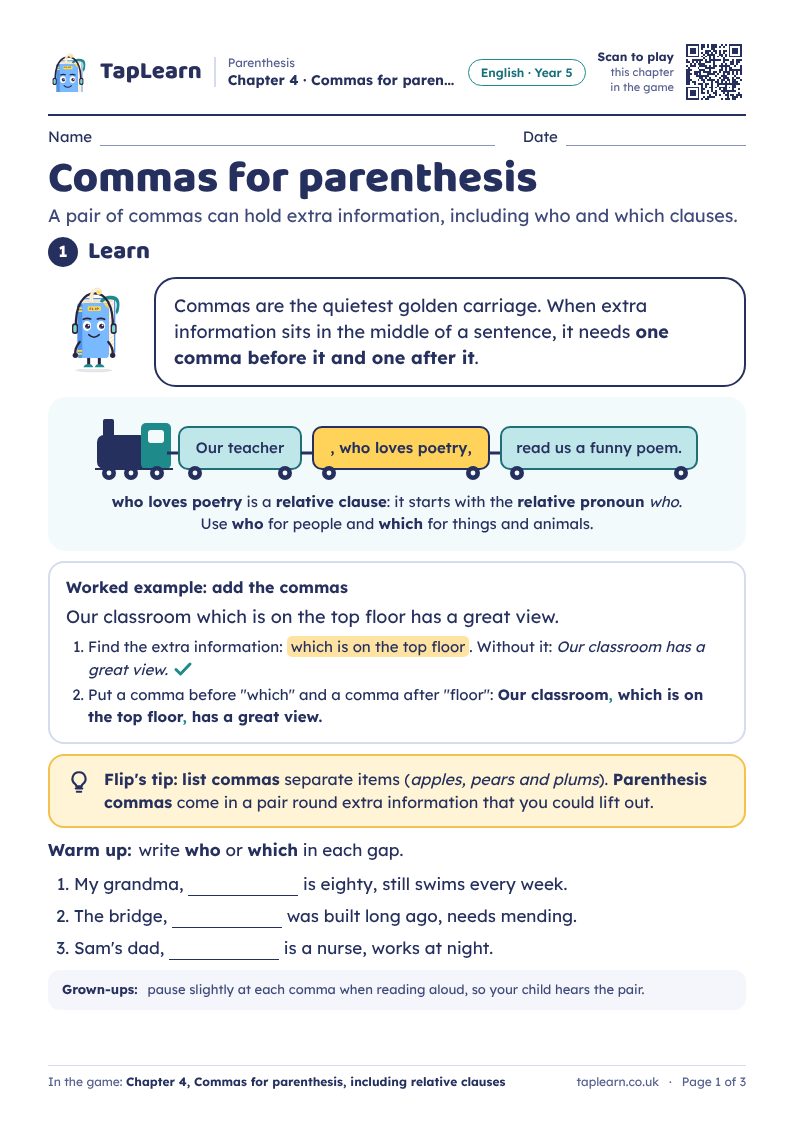
Commas for Parenthesis is a printable commas for parenthesis worksheet for Year 5 (ages 9 to 10) that teaches children to put one comma before and one after extra information, including relative clauses starting with who or which. It covers the Year 5 statement on using brackets, dashes or commas to indicate parenthesis.
This worksheet is for members
Membership opens every chapter of every game and every worksheet, for all your children.
See the plansAlready a member? Log in to print it.
Start with the free one: Spotting parenthesis (chapter 1).
Print it on A4, in colour or black and white. Do it after the chapter, or before it to see what your child already knows.
What's on the worksheet
Your child uses a pair of commas round extra information, including who and which relative clauses, and tells them apart from list commas. Includes a slot-in clauses game and an answers sheet.
- Page 1 · Learn
- A pair of commas round "who loves poetry", who for people and which for things, a worked example with "which is on the top floor", Flip's tip on list commas, and a who-or-which warm-up.
- Page 2 · Try it together
- Slot-in clauses: the grown-up writes a sentence with a gap, the child writes a who or which clause with a comma at each end, slots it in and reads the whole sentence, then swap.
- Page 3 · Practise
- Add pairs of commas, write L or P for list or parenthesis commas, tick and fix sentences, add a who or which clause, and a challenge about one comma.
- Answers sheet
- Every answer, mix-ups like forgetting the second comma, and a who-or-which idea.
3 A4 pages and an answers sheet · about 25 minutes
Using it at home
- Pause slightly at each comma when reading aloud, so your child hears the pair.
- In slot-in clauses, use who for people and which for things and animals, and check there's a comma before and after.
- Point at things around you and your child adds a clause: "The kettle, which is noisy, …"
Watch out for
- Using only one comma.
- The second comma is the one most often forgotten. Ask, "Where does the extra bit end?"
- Putting commas round the wrong words.
- Lift out the words between the commas: the rest must still be a sentence.
- Mixing up list commas and parenthesis commas.
- A list joins items with and at the end; parenthesis can be lifted out.
Questions from the worksheet
- Add a pair of commas to each sentence: My cousin who lives in Wales is coming to stay. Ava's hamster which is called Nibbles escaped again.
- List commas or parenthesis commas? Write L or P: I packed a towel, a drink, sun cream and a hat. Our neighbour, a retired pilot, waved to us.
- Tick the correct sentence. Rewrite the other two correctly: My sister, who loves maths won the quiz. The film, which lasted three hours, was exciting.
- Couple on a relative clause. Write a who or which clause in the gap, with a comma at each end: My best friend ___ makes me laugh.
- Sam says, "You only need one comma for parenthesis, like this: Our dog, who is very old sleeps all day." Is he right?
The answers are on the answers sheet, for grown-ups.
National curriculum in England
This worksheet practises these statements from the Years 5–6 english programme of study:
- Indicate grammatical and other features by: using brackets, dashes or commas to indicate parenthesis
- Punctuation: brackets, dashes or commas to indicate parenthesis (Year 5 english)
- Terminology: modal verb, relative pronoun, relative clause, parenthesis, bracket, dash, cohesion, ambiguity (Year 5 english)
In the classroom
- Use slot-in clauses with sentence strips as a group task.
- Use Practise B as an L-or-P card sort.
Questions and answers
How do you use commas for parenthesis?
Put one comma before the extra information and one after it: Our classroom, which is on the top floor, has a great view.
What is a relative clause?
A relative clause starts with a relative pronoun like who or which and adds information about a noun: the teacher, who loves poetry, …
When do you use who or which?
Use who for people and which for things and animals.
More worksheets from Parenthesis: Brackets, Dashes and Commas on a Word Train
- Chapter 1: Parenthesis worksheet: Spotting parenthesis Free
- Chapter 2: Brackets worksheet: Using brackets Members
- Chapter 3: Dashes worksheet: Using dashes Members
- Chapter 5: Brackets, dashes or commas worksheet: Brackets, dashes or commas? Members
- Chapter 6: Grammar terminology worksheet: Year 5 grammar words Members
 TapLearn