Mass and capacity worksheet for Year 3: Kilograms and litres
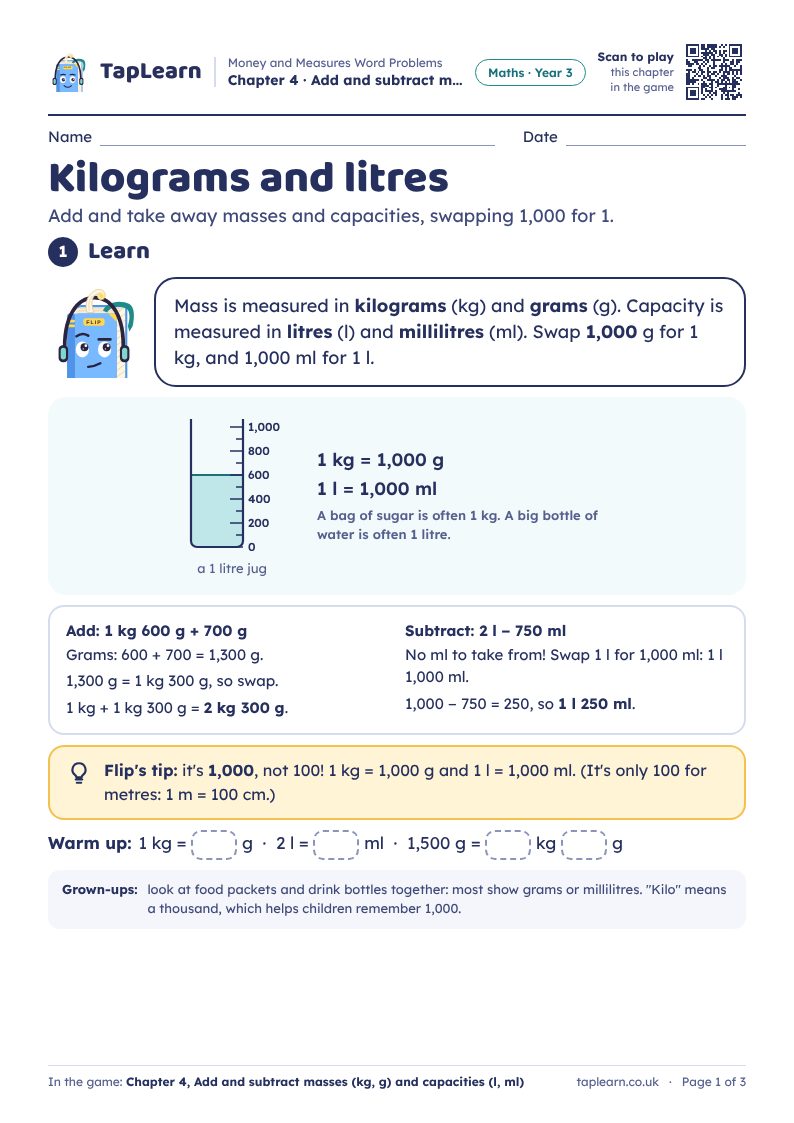
Kilograms and Litres is a printable mass and capacity worksheet for Year 3 (ages 7 to 8) that teaches children that 1 kg is 1,000 g and 1 l is 1,000 ml, and to swap 1,000 for 1 when adding and taking away. It covers the Year 3 maths statement to measure, compare, add and subtract lengths (m/cm/mm), mass (kg/g) and volume or capacity (l/ml).
This worksheet is for members
Membership opens every chapter of every game and every worksheet, for all your children.
See the plansAlready a member? Log in to print it.
Start with the free one: Adding pounds and pence (chapter 1).
Print it on A4, in colour or black and white. Do it after the chapter, or before it to see what your child already knows.
What's on the worksheet
Your child adds and subtracts masses in kg and g and capacities in l and ml, knowing 1 kg = 1,000 g and 1 l = 1,000 ml, and reads a measuring jug. Includes a weigh-and-pour activity and an answers sheet.
- Page 1 · Learn
- 1 kg = 1,000 g and 1 l = 1,000 ml, worked examples for 1 kg 600 g + 700 g and 2 l − 750 ml, Flip's tip that it's 1,000 not 100, and a conversion warm-up.
- Page 2 · Try it together
- Weigh and pour: weigh two packets and add the masses, check on the scales, then pour 500 ml of water into a jug, pour some into a cup and work out how much you poured.
- Page 3 · Practise
- Read measuring jugs, fill conversion gaps, add and take away masses and capacities with swaps, solve a juice jug problem, ring the bigger amount, and a challenge about 1 kg 50 g.
- Answers sheet
- Every answer, mix-ups like thinking 1 kg is 100 g, and heavier-or-lighter and bottle-talk ideas.
3 A4 pages and an answers sheet · about 25 minutes
In the classroom
- Set up a weighing and pouring station with scales and jugs for small groups.
- Use Practise E as a quick compare-the-amounts check.
Questions from the worksheet
- Fill the gaps: 2 kg 400 g = ___ g; 1,250 ml = ___ l ___ ml.
- Add or take away. Swap when you need to: 2 kg 600 g + 800 g; 3 kg − 400 g; 2 l 500 ml − 700 ml.
- A jug holds 1 litre of juice. Ava pours out 350 ml, then another 400 ml. How much juice is left in the jug?
- Leo says, "1 kg 50 g is the same as 150 g." Is he right? How many grams is it really?
The answers are on the answers sheet, for grown-ups.
National curriculum in England
This worksheet practises this statement from the Year 3 maths programme of study:
- Measure, compare, add and subtract: lengths (m/cm/mm); mass (kg/g); volume/capacity (l/ml)
Source: National curriculum in England: mathematics programmes of study (DfE)
Using it at home
- Look at food packets and drink bottles together: most show grams or millilitres. "Kilo" means a thousand.
- Do the pouring over the sink. If the scales show kg with a point, read the grams on the label instead.
- Ask how many 500 ml bottles make 1 litre, and how many make 2 litres.
Watch out for
- Thinking 1 kg is 100 g, or 1 l is 100 ml.
- Look at a 1 kg bag: its label says 1,000 g. It's only 100 for metres.
- Not swapping, like writing 2 kg 1,300 g.
- Any 1,000 g makes another kilogram.
- Taking the smaller from the bigger in 2 l 500 ml − 700 ml.
- Break 1 l into 1,000 ml: 1 l 1,500 ml − 700 ml.
Questions and answers
How many grams are in a kilogram?
There are 1,000 g in 1 kg, so 1 kg 300 g is 1,300 g.
How many millilitres are in a litre?
There are 1,000 ml in 1 litre, so 1 l 250 ml is 1,250 ml.
What is the difference between mass and capacity?
Mass is how heavy something is, measured in kg and g. Capacity is how much a container holds, measured in litres and millilitres.
 TapLearn