Money and measures word problems worksheet for Year 3: Market day problems
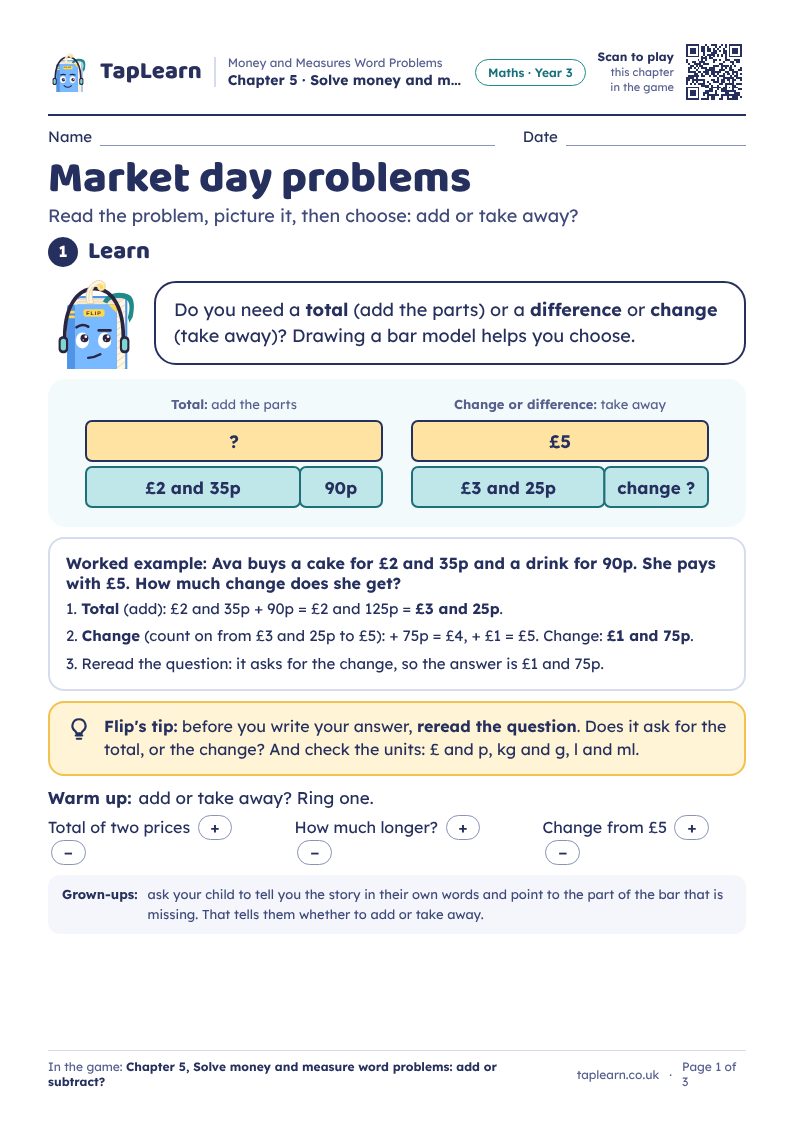
Market Day Problems is a printable money and measures word problems worksheet for Year 3 (ages 7 to 8) that teaches children to picture a problem as a bar model and decide if they need a total or a difference. It covers the Year 3 maths statements on giving change in pounds and pence and on adding and subtracting lengths, masses and capacities.
This worksheet is for members
Membership opens every chapter of every game and every worksheet, for all your children.
See the plansAlready a member? Log in to print it.
Start with the free one: Adding pounds and pence (chapter 1).
Print it on A4, in colour or black and white. Do it after the chapter, or before it to see what your child already knows.
What's on the worksheet
Your child chooses whether to add or subtract in money and measuring word problems, using bar models, including finding a total and then the change. Includes a shopping list activity and an answers sheet.
- Page 1 · Learn
- Bar models for a total and for change, a worked example finding the total for a cake and a drink and then the change from 5 pounds, Flip's tip to reread the question and check units, and a warm-up.
- Page 2 · Try it together
- Shopping list maths: choose two things from a receipt or shopping list, add the costs, pretend to pay and count on to find the change, then ask a measuring question too.
- Page 3 · Practise
- Ring + or − before working out, then solve problems about apples and pears, a book, a bucket of water and a plant and pot, and a challenge about stopping after the first step.
- Answers sheet
- Every answer, mix-ups like adding 600 ml to 2 l to get 602, and real-shopping and kitchen-question ideas.
3 A4 pages and an answers sheet · about 25 minutes
Using it at home
- Ask your child to tell you the story in their own words and point to the missing part of the bar. That shows whether to add or take away.
- In shopping list maths, let your child decide add or take away before calculating, and say why.
- In the kitchen, ask: "This bottle holds 1 l. We've used about 400 ml. How much is left?"
Watch out for
- Choosing the wrong operation.
- Draw the bar: is the missing part the whole, or a piece?
- Stopping after the first step, finding the total but not the change.
- Reread the question at the end.
- Mixing units, like adding 600 ml to 2 l to get 602.
- Write both in ml, or keep litres and millilitres apart.
Questions from the worksheet
- Don't work them out yet! Ring + or −: A melon weighs 1 kg 200 g. A pineapple weighs 900 g. How much heavier is the melon?
- A bucket holds 5 l of water. Sam uses 1 l 300 ml to water the plants. How much water is left?
- Leo buys a plant for 1 pound 45p and a pot for 2 pounds 80p. He pays with 5 pounds. How much change?
- Ava buys a cake for 1 pound 60p and juice for 85p. She pays with 5 pounds. She says the answer is 2 pounds 45p. Is she right? What did she forget?
The answers are on the answers sheet, for grown-ups.
National curriculum in England
This worksheet practises these statements from the Year 3 maths programme of study:
- Add and subtract amounts of money to give change, using both £ and p in practical contexts
- Measure, compare, add and subtract: lengths (m/cm/mm); mass (kg/g); volume/capacity (l/ml)
Source: National curriculum in England: mathematics programmes of study (DfE)
In the classroom
- Use Practise A as a no-calculating sorting task: pairs decide + or − and explain why.
- Have pairs write their own two-step market problem for another pair to solve.
Questions and answers
How do you know whether to add or subtract in a word problem?
Draw a bar model. If you need the whole, or total, add the parts. If you need a piece, a difference or the change, take away.
What is a two-step money problem?
It needs two calculations, like finding the total cost of two things and then the change from the money paid.
Why check the units in measuring problems?
Units like l and ml are different. 2 l + 600 ml is 2 l 600 ml, not 602.
 TapLearn