Giving change worksheet for Year 3: Counting on for change
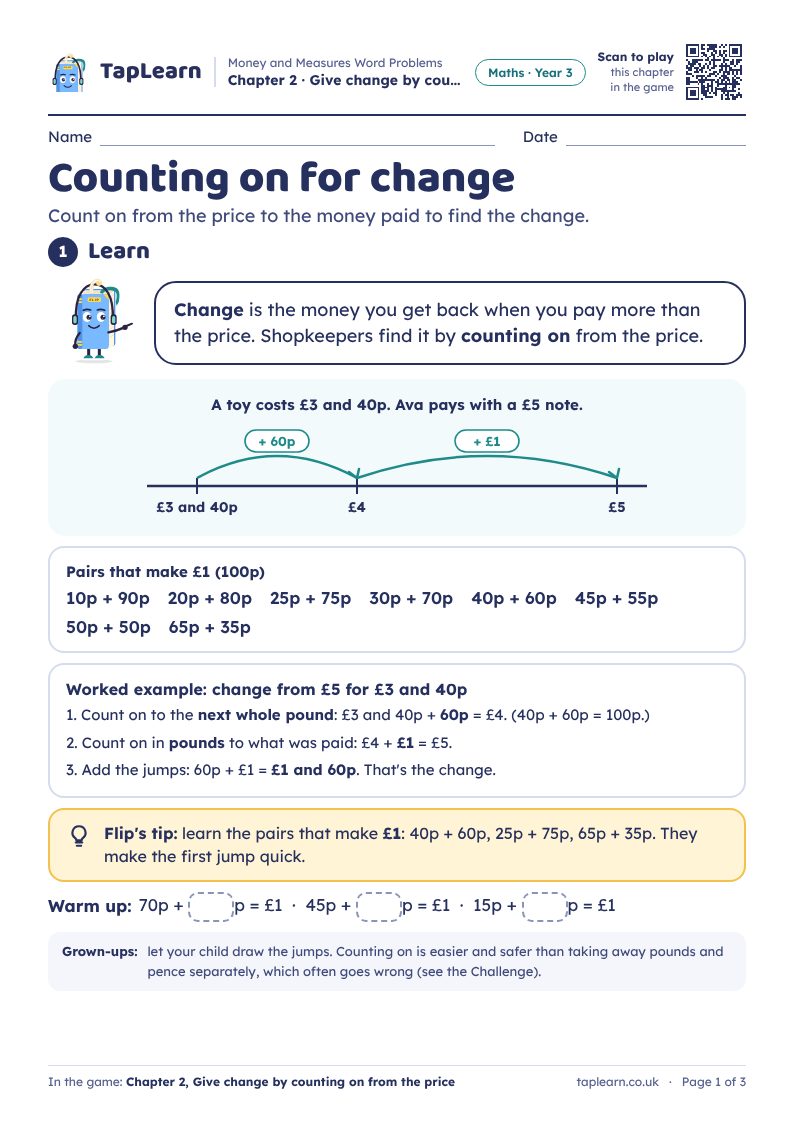
Counting On for Change is a printable giving change worksheet for Year 3 (ages 7 to 8) that teaches children to count on from the cost to the next whole pound, then in pounds to the money paid. It covers the Year 3 maths statement to add and subtract amounts of money to give change, using both pounds and pence in practical contexts.
This worksheet is for members
Membership opens every chapter of every game and every worksheet, for all your children.
See the plansAlready a member? Log in to print it.
Start with the free one: Adding pounds and pence (chapter 1).
Print it on A4, in colour or black and white. Do it after the chapter, or before it to see what your child already knows.
What's on the worksheet
Your child works out change from 1, 5 and 10 pounds by counting on from the cost, using pairs that make a pound and jumps on a line. Includes a play shops activity and an answers sheet.
- Page 1 · Learn
- A toy costing 3 pounds 40p paid for with a 5 pound note, pairs that make a pound, a worked example counting on to 1 pound 60p change, Flip's tip, and a make-a-pound warm-up.
- Page 2 · Try it together
- Play shops: the grown-up puts a cost under 5 pounds on a toy, the child pays with a 5 pound note, and you count on together to find the change, then swap shopkeeper.
- Page 3 · Practise
- Join pairs that make a pound, work out change from 1, 5 and 10 pounds with jumps, spot Ava's mistake about her scarf change, and a challenge about taking pounds from pounds.
- Answers sheet
- Every answer, mix-ups like forgetting the whole pounds, and coin-shop and quick-pairs ideas.
3 A4 pages and an answers sheet · about 25 minutes
In the classroom
- Run play shops in pairs with play money, switching shopkeeper each round.
- Use quick pairs to a pound as a mental maths starter.
Questions from the worksheet
- Draw a line to join pairs that make a pound: 30p, 45p, 85p, 65p, 20p with 35p, 70p, 80p, 15p, 55p.
- Work out the change: cost 64p, paid 1 pound; cost 2 pounds 75p, paid 5 pounds; cost 6 pounds 30p, paid 10 pounds.
- Ava buys a scarf for 2 pounds 80p. She pays with 5 pounds. She says her change is 20p. Is she right? What did she forget?
The answers are on the answers sheet, for grown-ups.
National curriculum in England
This worksheet practises this statement from the Year 3 maths programme of study:
- Add and subtract amounts of money to give change, using both £ and p in practical contexts
Source: National curriculum in England: mathematics programmes of study (DfE)
Using it at home
- Let your child draw the jumps. Counting on is easier and safer than taking away pounds and pence separately.
- In play shops, hand the change over as you count on: "2 pounds 30p… 70p makes 3 pounds… 4, 5."
- Say an amount like 35p and let your child say what makes it up to a pound.
Watch out for
- Slips with pairs that make a pound, like 65p + 45p.
- Practise the pairs and check: 65p + 35p = 100p.
- Forgetting the whole pounds, giving 60p instead of 1 pound 60p.
- Ask "Have we got all the way to what was paid?"
- Taking away pounds and pence separately.
- Counting on from the cost avoids this mistake.
Questions and answers
How do you work out change by counting on?
Count on from the cost to the next whole pound, then in pounds to the money paid, and add the jumps. From 3 pounds 40p to 5 pounds is 60p + 1 pound.
Why is counting on better than taking away for change?
Taking pounds from pounds and pence from pence often goes wrong. Counting on from the cost keeps the steps simple.
Which pairs of coins make a pound?
Pairs like 40p + 60p, 25p + 75p and 65p + 35p each make 100p, or 1 pound.
 TapLearn