Adding and subtracting lengths worksheet for Year 3: Metres and centimetres
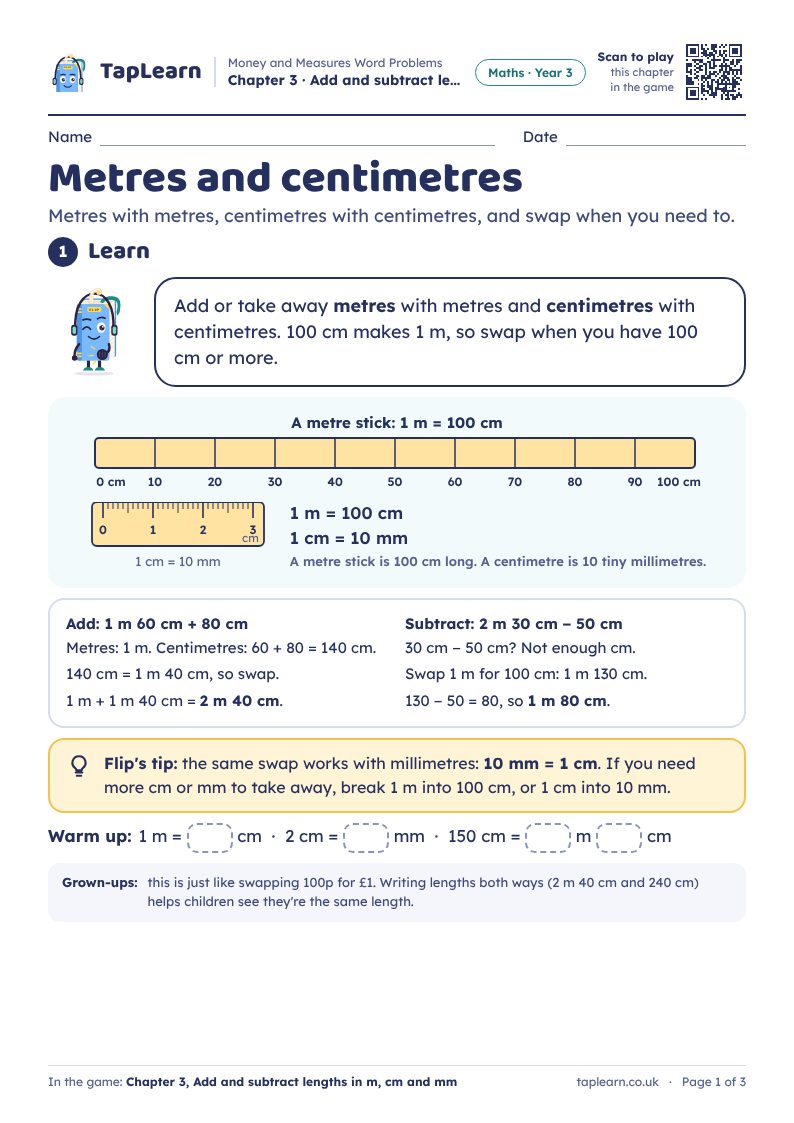
Metres and Centimetres is a printable adding and subtracting lengths worksheet for Year 3 (ages 7 to 8) that teaches children to keep metres with metres and centimetres with centimetres, swapping when they reach 100 cm. It covers the Year 3 maths statement to measure, compare, add and subtract lengths (m/cm/mm), mass (kg/g) and volume or capacity (l/ml).
This worksheet is for members
Membership opens every chapter of every game and every worksheet, for all your children.
See the plansAlready a member? Log in to print it.
Start with the free one: Adding pounds and pence (chapter 1).
Print it on A4, in colour or black and white. Do it after the chapter, or before it to see what your child already knows.
What's on the worksheet
Your child adds and subtracts lengths in metres, centimetres and millimetres, swapping 100 cm for 1 m and 10 mm for 1 cm, and reads a ruler. Includes a tape measure activity and an answers sheet.
- Page 1 · Learn
- A metre stick showing 1 m = 100 cm and 1 cm = 10 mm, worked examples for 1 m 60 cm + 80 cm and 2 m 30 cm − 50 cm, Flip's tip on breaking 1 m into 100 cm, and a warm-up.
- Page 2 · Try it together
- Tape measure match: measure a book, a spoon and a shoe in centimetres, add two lengths, lay them end to end to check, then find how much longer one is.
- Page 3 · Practise
- Measure lines in cm and mm, convert lengths, add and take away lengths with swaps, solve a ribbon problem, order lengths, and a challenge about 2 m + 50 cm.
- Answers sheet
- Every answer, mix-ups like writing 1 m 120 cm, and guess-and-check and steps-to-the-door ideas.
3 A4 pages and an answers sheet · about 25 minutes
Using it at home
- Writing lengths both ways, like 2 m 40 cm and 240 cm, helps children see they're the same length.
- For the tape measure match, line up the end of the thing with 0, not with the end of the tape.
- Guess the length of a table or bed in m and cm, then measure it.
Watch out for
- Not swapping, like writing 1 m 120 cm.
- Ask "Is there another metre hiding in the centimetres?"
- Mixing units, so 2 m + 50 cm = 52 cm.
- Change both to cm first if it helps: 2 m is 200 cm.
- Taking away the wrong way round.
- If there aren't enough cm to take away, break 1 m into 100 cm first.
Questions from the worksheet
- Fill the gaps: 300 cm = ___ m; 4 m 25 cm = ___ cm; 45 mm = ___ cm ___ mm.
- Add or take away. Swap when you need to: 2 m 75 cm + 50 cm; 2 m 30 cm − 60 cm; 9 cm 2 mm − 4 mm.
- Leo buys 2 m 50 cm of red ribbon and 1 m 75 cm of blue ribbon. How much ribbon altogether? How much longer is the red ribbon?
- Mia says 2 m + 50 cm = 52 cm. Is she right? What is the real length?
The answers are on the answers sheet, for grown-ups.
National curriculum in England
This worksheet practises this statement from the Year 3 maths programme of study:
- Measure, compare, add and subtract: lengths (m/cm/mm); mass (kg/g); volume/capacity (l/ml)
Source: National curriculum in England: mathematics programmes of study (DfE)
In the classroom
- Run tape measure match in pairs with classroom objects, recording totals and differences.
- Use Practise E as a mini-whiteboard ordering task, converting to cm first.
Questions and answers
How many centimetres are in a metre?
There are 100 cm in 1 m, and 10 mm in 1 cm.
How do you add lengths in metres and centimetres?
Add metres to metres and centimetres to centimetres. If the centimetres reach 100 or more, swap 100 cm for 1 m.
How do you subtract when there aren't enough centimetres?
Break 1 m into 100 cm. 2 m 30 cm − 50 cm becomes 1 m 130 cm − 50 cm, which is 1 m 80 cm.
 TapLearn