Adding money worksheet for Year 3: Adding pounds and pence
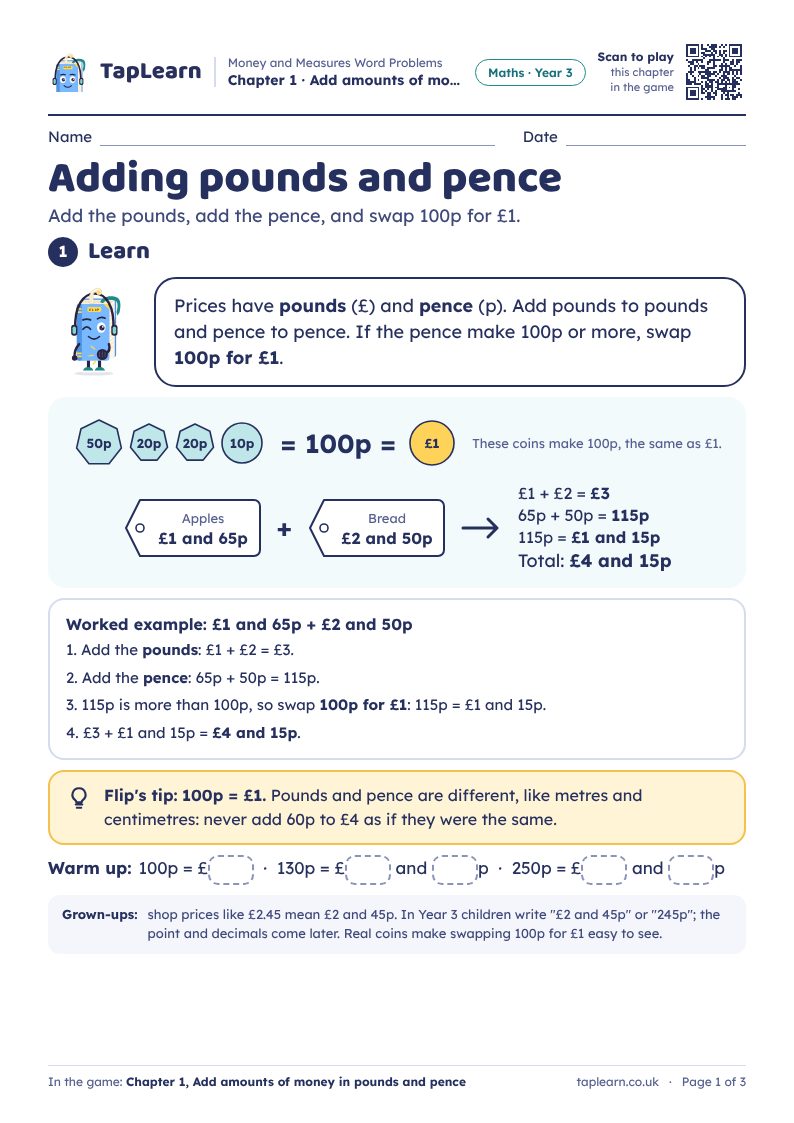
Adding Pounds and Pence is a printable adding money worksheet for Year 3 (ages 7 to 8) that teaches children to add the pounds, add the pence, and swap 100p for 1 pound when the pence reach 100p or more. It covers the Year 3 maths statement to add and subtract amounts of money to give change, using both pounds and pence in practical contexts.
Free to print, no account needed.
Print it on A4, in colour or black and white. Do it after the chapter, or before it to see what your child already knows.
What's on the worksheet
Your child adds amounts of money in pounds and pence, swapping 100p for 1 pound, by counting coins and totalling market stall costs. Includes a kitchen shop activity and an answers sheet.
- Page 1 · Learn
- Coins that make 100p, a worked example adding 1 pound 65p and 2 pounds 50p to make 4 pounds 15p, Flip's tip that pounds and pence are different units, and a swapping warm-up.
- Page 2 · Try it together
- Kitchen shop: write cost labels for 6 things from the cupboard, the grown-up picks two to buy, and the child adds them, pounds first then pence, checking with real coins.
- Page 3 · Practise
- Add up coins, add amounts and swap 100p for a pound, total apples, jam, cheese and flowers at a market stall, decide true or false, and a challenge about 2 pounds 120p.
- Answers sheet
- Every answer, mix-ups like reading 205p as 2 pounds 50p, and pocket-pairs and receipt-check ideas.
3 A4 pages and an answers sheet · about 25 minutes
In the classroom
- Set up a class shop with real or play coins and have pairs add the cost of two items.
- Use the true-or-false statements in Practise D as a quick show-of-hands check.
Questions from the worksheet
- Add. Swap 100p for a pound when you can: 60p + 55p; 1 pound 80p + 2 pounds 45p; 3 pounds 65p + 90p.
- Market stall. Find the total cost of the apples (85p) and jam (1 pound 60p).
- True or false? 150p = 1 pound 50p. 4 pounds + 60p = 64p. 205p = 2 pounds 50p.
- Mia adds 1 pound 70p and 1 pound 50p. She writes 2 pounds 120p. Is that right? How else could she write it?
The answers are on the answers sheet, for grown-ups.
National curriculum in England
This worksheet practises this statement from the Year 3 maths programme of study:
- Add and subtract amounts of money to give change, using both £ and p in practical contexts
Source: National curriculum in England: mathematics programmes of study (DfE)
Using it at home
- Shop labels like 2.45 mean 2 pounds and 45p. In Year 3 children write it as pounds and pence, or as 245p; decimals come later.
- In the kitchen shop, ask "Will the pence make more than a pound?" before adding. Amounts like 75p and 60p are good for practising the swap.
- Pick two lines on a receipt and add them together in your heads.
Watch out for
- Leaving 100p or more in the pence, like 2 pounds 120p.
- Ask "Can we make another pound from these pennies?"
- Adding pounds and pence as the same thing, so 4 pounds + 60p = 64p.
- Say it aloud: "four pounds and sixty pence".
- Misreading pence with a 0, like 205p.
- 205p is 2 pounds and 5p, not 2 pounds and 50p.
Questions and answers
How do you add pounds and pence?
Add the pounds, then add the pence. If the pence make 100p or more, swap 100p for 1 pound.
How many pence are in a pound?
There are 100 pence in 1 pound, so 115p is the same as 1 pound and 15p.
How do Year 3 children write money?
In Year 3 children write amounts as pounds and pence, such as 2 pounds and 45p, or as 245p. Writing money with a decimal point comes later.
More worksheets from Money and Measures Word Problems: A Market Day Adventure
- Chapter 2: Giving change worksheet: Counting on for change Members
- Chapter 3: Adding and subtracting lengths worksheet: Metres and centimetres Members
- Chapter 4: Mass and capacity worksheet: Kilograms and litres Members
- Chapter 5: Money and measures word problems worksheet: Market day problems Members
 TapLearn