CVC words worksheet for Reception: Reading words
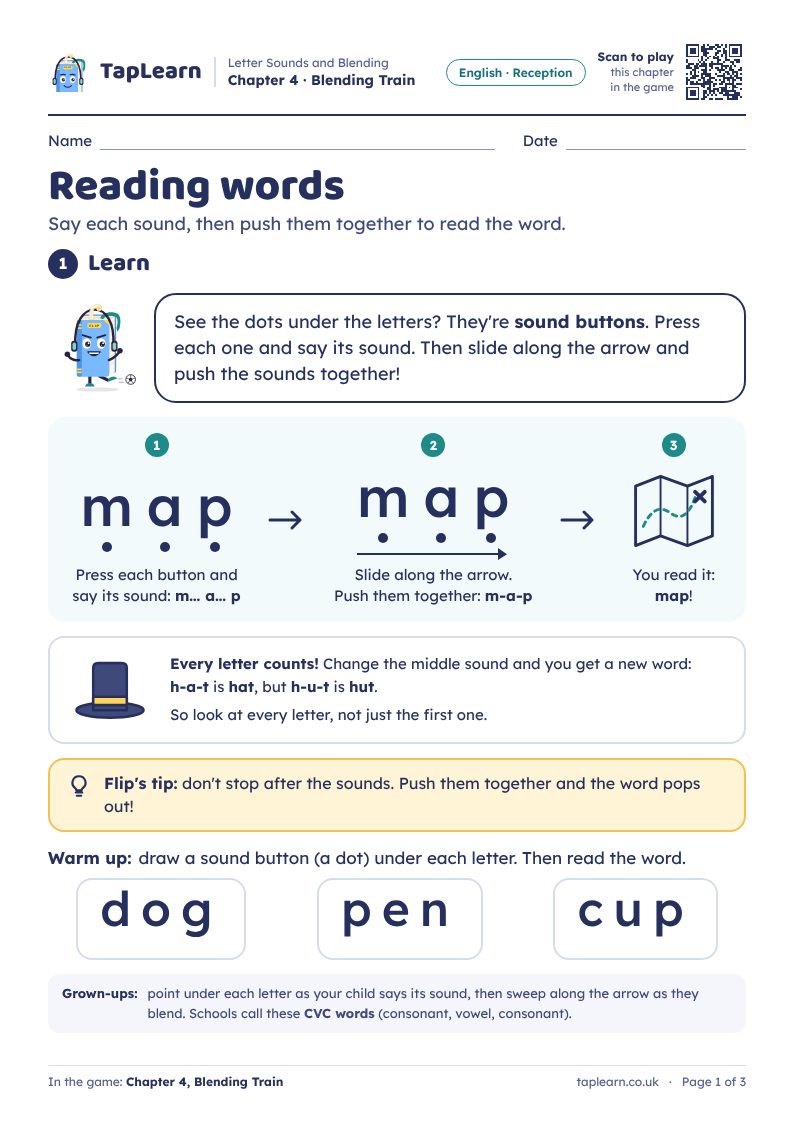
Reading Words is a printable CVC words worksheet for Reception (ages 4 to 5) that teaches children to read words like map, dog and sun by pressing sound buttons and blending the sounds. It links to the EYFS framework in England for Reception, where children read words consistent with their phonic knowledge by sound-blending.
Free to print, no account needed.
▶ Play chapter 4 in the game · How the sound buttons and blending works
Print it on A4, in colour or black and white. Do it after the chapter, or before it to see what your child already knows.
What's on the worksheet
Read simple CVC words like sun, map and dog with sound buttons: say each sound, then blend. With a word train to hop along and read at home, and answers.
- Page 1 · Learn
- How sound buttons work: press each dot, say its sound, slide along the arrow and blend, plus why every letter counts (hat and hut). Warm-up: add sound buttons to dog, pen and cup.
- Page 2 · Try it together
- Word train: write CVC words on paper carriages, hop along reading each one with sound buttons, then find the real thing at home and put it on its carriage.
- Page 3 · Practise
- Read and draw log and bug, match words to pictures, ring the right word for a picture from choices like hut, hat and hit, and Leo's "duck for dog" challenge.
- Answers sheet
- All answers, three mix-ups to watch for, and fridge-word and finger-button games.
3 A4 pages and an answers sheet · about 20 minutes
Using it at home
- Point under each letter as your child says its sound, then sweep along the arrow as they blend.
- If your child guesses from the first letter, cover the word and show it one letter at a time.
Watch out for
- Guessing from the first letter (duck for dog).
- Cover the word and reveal it one letter at a time.
- Mixing up the middle sound (hut for hat, pin for pen).
- Say just the middle sound together and point to it: the vowels sound alike to young ears.
- Saying the sounds but not blending them.
- Say them again faster and sweep the arrow: "c-a-t, cat!"
Questions from the worksheet
- Read the word. Draw it in the box.
- Read the word. Draw a line to its picture.
- Look at the picture. Read the words. Ring the right one: hut, hat or hit?
- Leo looks at the d and says, "Duck!" Is he right? How can he check?
The answers are on the answers sheet, for grown-ups.
National curriculum in England
This worksheet practises these statements from the Reception english programme of study:
- Skilled word reading, taught later, involves both the speedy working out of the pronunciation of unfamiliar printed words (decoding) and the speedy recognition of familiar printed words
- Say a sound for each letter in the alphabet and at least 10 digraphs
- Read words consistent with their phonic knowledge by sound-blending
- Read individual letters by saying the sounds for them
- Blend sounds into words, so that they can read short words made up of known letter–sound correspondences
In the classroom
- Lay a word train across the carpet and let pupils take turns hopping and reading a carriage each.
- Pairs build CVC words with magnetic letters, then swap one letter to make a new word.
Questions and answers
What are CVC words?
CVC words are short words made of a consonant, a vowel and a consonant, like cat, map and dog. They are usually the first words children read by blending in Reception.
What are sound buttons?
Sound buttons are dots drawn under each letter of a word. Children press each one and say its sound, then slide along and blend the sounds to read the word.
 TapLearn