Reading simple sentences worksheet for Reception: Little sentences
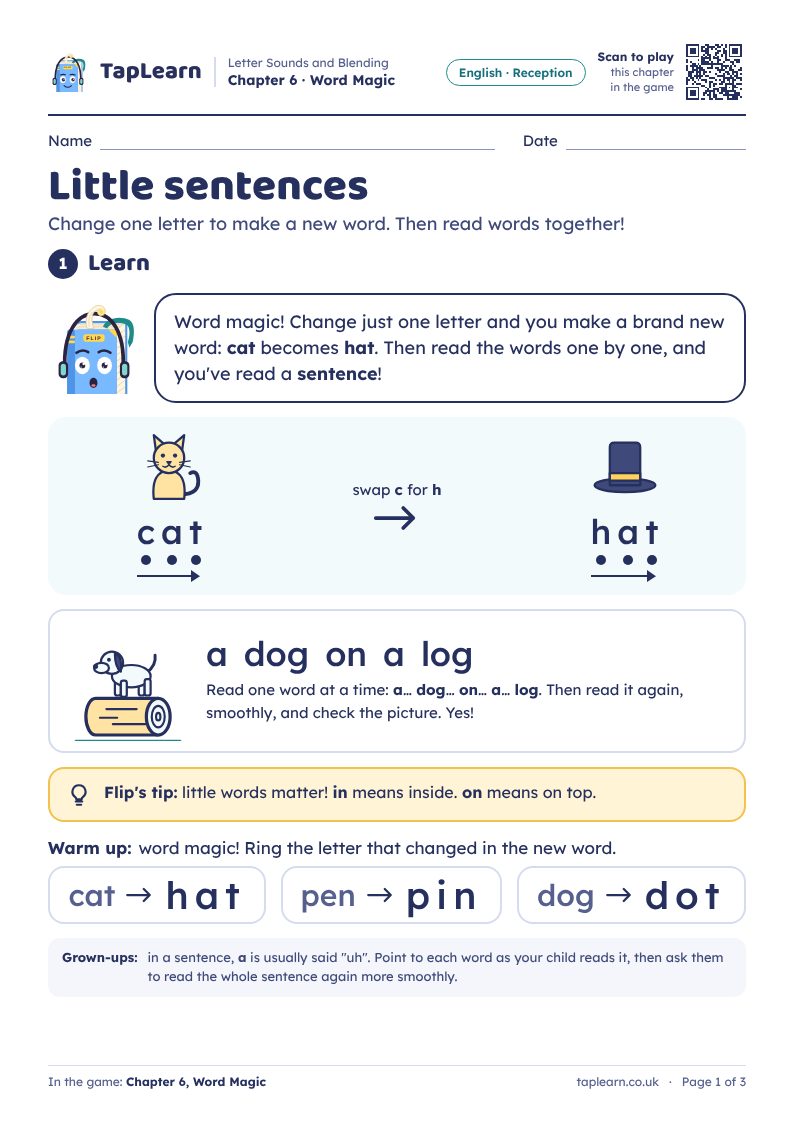
Little Sentences is a printable reading worksheet for Reception (ages 4 to 5) that teaches children to change one letter to make a new word and read short sentences like a dog on a log. It links to the EYFS framework in England for Reception, where children blend sounds into words so that they can read short words made up of known letter–sound correspondences.
Free to print, no account needed.
Print it on A4, in colour or black and white. Do it after the chapter, or before it to see what your child already knows.
What's on the worksheet
Swap one letter to make a new word, then read short sentences like a dog on a log and match them to pictures, minding in and on. With an in-or-on game to act out, and answers.
- Page 1 · Learn
- Word magic, where cat becomes hat, then reading a dog on a log one word at a time and checking the picture. Warm-up: ring the letter that changed in pen and pin.
- Page 2 · Try it together
- In or on? Read sentences like a pen in a cup and a sock on a box from paper scraps, act each one out with real things, then make up a silly one.
- Page 3 · Practise
- Ring the picture that matches a sentence, word magic swaps like cat to hat and sun to bun, finish sentences with in or on, and Sam's fox-on-a-box challenge.
- Answers sheet
- All answers, four mix-ups to watch for, and toy caption and word chain ideas.
3 A4 pages and an answers sheet · about 20 minutes
Using it at home
- Point to each word as your child reads it, then ask them to read the whole sentence again more smoothly.
- If in and on get mixed up, read the little word on its own and act it out with your hand: inside the cup, on top of the cup.
Watch out for
- Mixing up in and on.
- Read the little word on its own, then act it out with a toy and a cup.
- Guessing the sentence from the picture.
- Cover the pictures, read the words first, then look.
- Reading the old word in word magic (cat for hat).
- Point to the new first letter and say its sound before blending.
Questions from the worksheet
- Read the sentence. Ring the picture that matches: a cat in a box.
- Word magic! Swap c for h in cat. Write the new letter and read the new word.
- Look at the picture. Finish the sentence: write in or on.
- Sam reads a fox on a box and draws a picture. Is his picture right? What should he change?
The answers are on the answers sheet, for grown-ups.
National curriculum in England
This worksheet practises these statements from the Reception english programme of study:
- Skilled word reading, taught later, involves both the speedy working out of the pronunciation of unfamiliar printed words (decoding) and the speedy recognition of familiar printed words
- Say a sound for each letter in the alphabet and at least 10 digraphs
- Read words consistent with their phonic knowledge by sound-blending
- Read individual letters by saying the sounds for them
- Blend sounds into words, so that they can read short words made up of known letter–sound correspondences
In the classroom
- Set up the in-or-on game as a group activity, with pupils reading a caption card and placing objects to match.
- Word chain warm-up: say a word and change one sound each time: cat, hat, hot, hop, mop.
Questions and answers
How do Reception children start reading sentences?
They read one word at a time, blending each simple word, then read the sentence again smoothly and check it makes sense. Short captions like a cat in a box are a good start.
Why does a sound like "uh" in a sentence?
In a sentence, the word a is usually said "uh" rather than "ay". Both are fine for children learning to read.
 TapLearn