Letter sounds s, a, t, p, i, n worksheet for Reception: Letter sounds
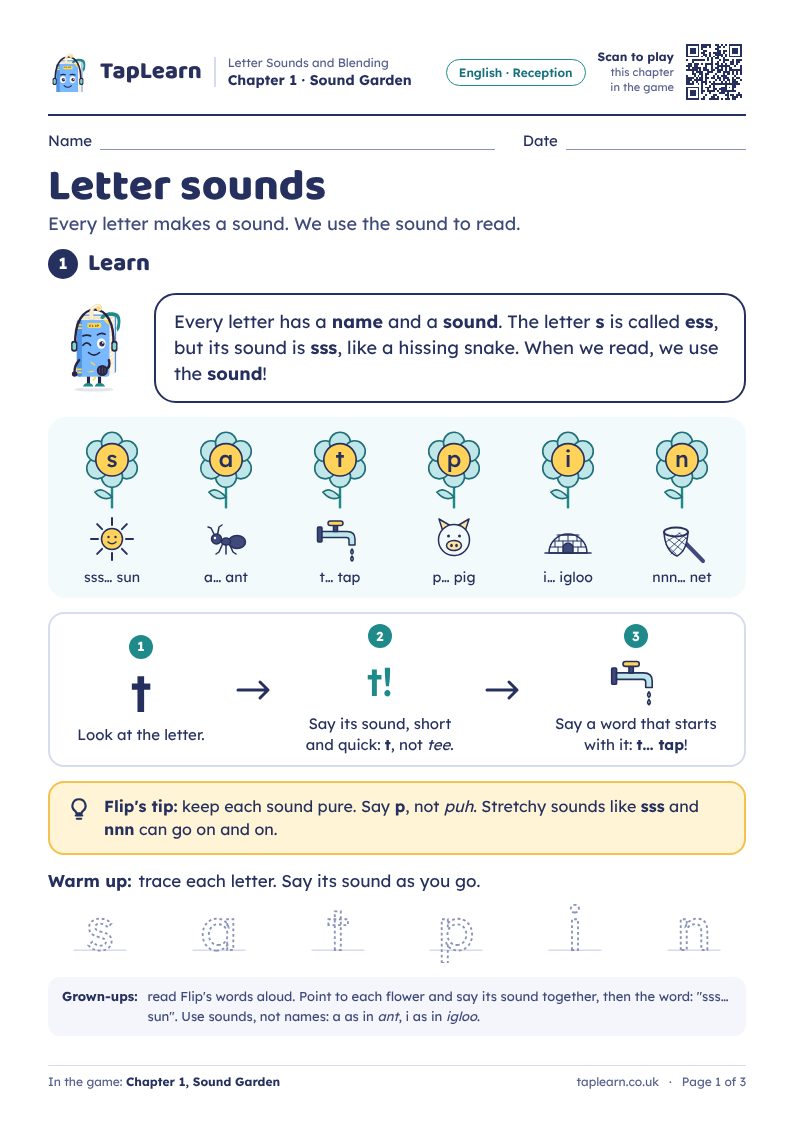
Letter Sounds is a printable phonics worksheet for Reception (ages 4 to 5) that teaches children the sounds for s, a, t, p, i and n and how a letter's sound differs from its name. It links to the EYFS framework in England for Reception, where children read individual letters by saying the sounds for them.
Free to print, no account needed.
Print it on A4, in colour or black and white. Do it after the chapter, or before it to see what your child already knows.
What's on the worksheet
Say the sounds for s, a, t, p, i and n, tell a letter's name from its sound, and find the letter for a sound you hear. With a hide-and-find sound hunt round the home, and answers.
- Page 1 · Learn
- Each of the six letters with its sound and a word (sss… sun, a… ant), and Flip's tip on keeping sounds pure. Warm-up: trace each letter while saying its sound.
- Page 2 · Try it together
- Sound hunt: hide six letter scraps around the room, find one, say its sound, then hunt for something at home that starts with it and draw it.
- Page 3 · Practise
- Ring the letter for a sound the grown-up says, match sounds to pictures, sort stretchy and bouncy sounds, write the letter you hear, and Mia's name-or-sound challenge.
- Answers sheet
- All answers, four mix-ups to watch for, and sound-of-the-day and back-writing games.
3 A4 pages and an answers sheet · about 20 minutes
Using it at home
- Use sounds, not letter names, all the way through: a as in ant, i as in igloo. Keep each sound short, so say p, not puh.
- For a and i in the sound hunt, an apple, an insect toy or an ink pen all work. If your child picks a word that ends with the sound, say it slowly together.
Watch out for
- Mixing up b, d and p, which are the same shape turned round.
- Say the sound as you trace the letter together.
- Saying letter names like "tee" or "pee" instead of sounds.
- Praise the knowledge, then ask, "What sound does it make?"
- Adding an extra "uh" (tuh, puh).
- Keep sounds short: c-a-t joins into cat, but "cuh-a-tuh" doesn't.
Questions from the worksheet
- Listen to the sound. Draw a ring round its letter.
- Say the sound. Can you stretch it like a snake, or is it short like a bouncing ball?
- Listen to the sound. Write its letter.
- Mia points to this letter and says, "This says ess!" Is that its name or its sound? What sound does it make when we read?
The answers are on the answers sheet, for grown-ups.
National curriculum in England
This worksheet practises these statements from the Reception english programme of study:
- Skilled word reading, taught later, involves both the speedy working out of the pronunciation of unfamiliar printed words (decoding) and the speedy recognition of familiar printed words
- Say a sound for each letter in the alphabet and at least 10 digraphs
- Read words consistent with their phonic knowledge by sound-blending
- Read individual letters by saying the sounds for them
- Blend sounds into words, so that they can read short words made up of known letter–sound correspondences
In the classroom
- Hide the six letters around the classroom for a group sound hunt, with each group collecting one object per sound.
- Quick check: say a sound and pupils hold up the matching letter card.
Questions and answers
What are the first letter sounds taught in Reception?
Many phonics programmes in England start with s, a, t, p, i and n, because they make lots of simple words like sat, pin and tap. Children learn the sound each letter makes, not its name.
What is the difference between a letter's name and its sound?
A letter's name is what we call it in the alphabet, like ess for s. Its sound is what it says when we read, like sss, and that is what children use to blend words.
 TapLearn