Oral blending worksheet for Reception: Robot talk
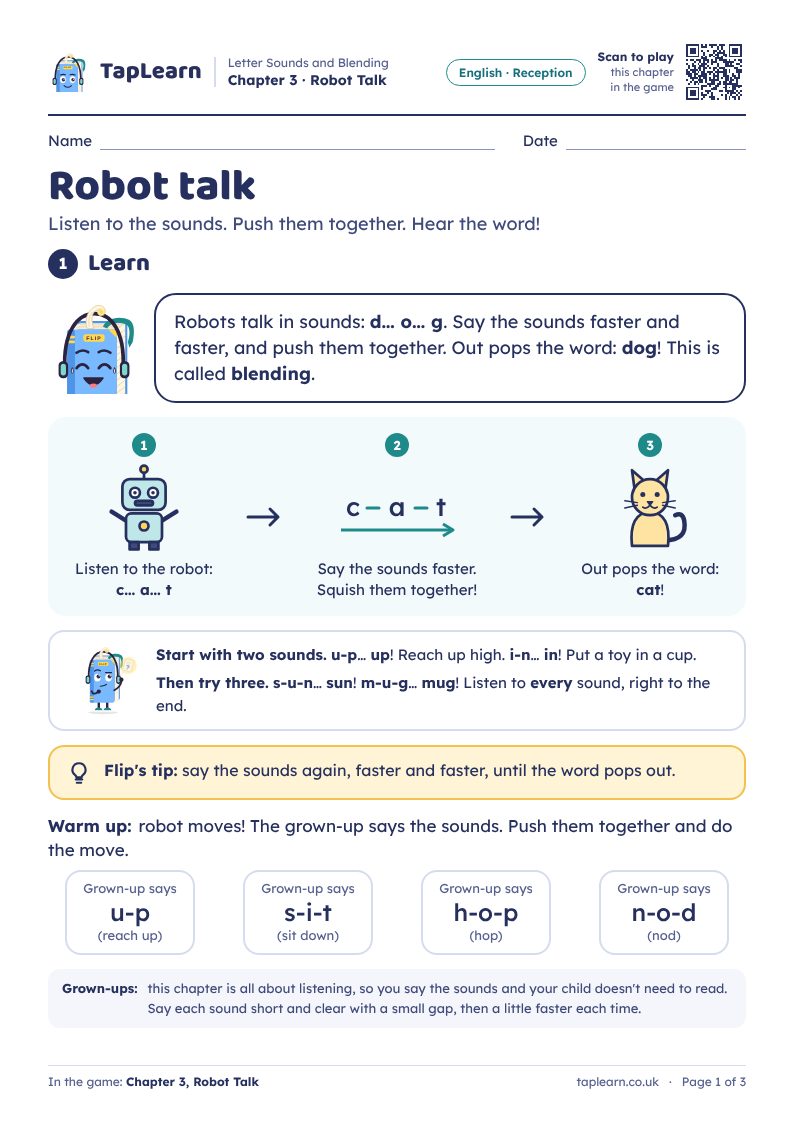
Robot Talk is a printable oral blending worksheet for Reception (ages 4 to 5) that teaches children to listen to sounds said one at a time, like d-o-g, and push them together to hear the word. It links to the EYFS framework in England for Reception, where children blend sounds into words so that they can read short words.
Free to print, no account needed.
Print it on A4, in colour or black and white. Do it after the chapter, or before it to see what your child already knows.
What's on the worksheet
Oral blending: listen to sounds said one at a time, like d-o-g, and push them together to hear the word. With a robot treasure hunt to play together, and answers.
- Page 1 · Learn
- How robot talk works: c… a… t, faster and faster, until cat pops out, starting with two-sound words like up and in. Warm-up: blend robot moves like h-o-p and do them.
- Page 2 · Try it together
- Robot treasure hunt: the grown-up says "Find the s… o… ck!", the child blends and picks it up, then they swap and the child talks like a robot.
- Page 3 · Practise
- Listen and draw words like bed and sun, ring the picture for d-o-g or f-o-x, a robot tick-or-cross check, and Ava's "duck for d-o-g" challenge.
- Answers sheet
- All answers, four mix-ups to watch for, and robot day and robot Simon says games.
3 A4 pages and an answers sheet · about 15 minutes
Using it at home
- This sheet is all about listening, so you say the sounds and your child doesn't need to read. Keep each sound short, with a small gap.
- If your child guesses from the first sound only, say all the sounds again a little faster and ask what they heard at the end.
Watch out for
- Guessing from the first sound (duck for d-o-g).
- Say all the sounds again and ask, "What did you hear at the end?"
- Long gaps between sounds that make blending hard.
- Say the sounds again closer together, then closer still.
- Finding bouncy sounds harder than stretchy ones.
- Start with words like s-u-n, m-u-m and f-a-n.
Questions from the worksheet
- Listen to the robot. Draw the word in the box.
- Listen to the robot. Ring the right picture.
- Robot check! Is the word right? Ring the tick or the cross.
- The robot says d… o… g. Ava shouts, "Duck!" Is she right? Which sounds did she forget to listen to?
The answers are on the answers sheet, for grown-ups.
National curriculum in England
This worksheet practises these statements from the Reception english programme of study:
- Skilled word reading, taught later, involves both the speedy working out of the pronunciation of unfamiliar printed words (decoding) and the speedy recognition of familiar printed words
- Say a sound for each letter in the alphabet and at least 10 digraphs
- Read words consistent with their phonic knowledge by sound-blending
- Read individual letters by saying the sounds for them
- Blend sounds into words, so that they can read short words made up of known letter–sound correspondences
In the classroom
- Robot Simon says as a carpet game: "Simon says touch your l-e-g."
- Use the robot moves warm-up as a quick movement break between phonics activities.
Questions and answers
What is oral blending?
Oral blending is hearing separate sounds, like c-a-t, and pushing them together to say the word, cat. It is done by listening, before children read the letters.
Why do Reception children learn robot talk?
Robot talk, saying a word one sound at a time, practises oral blending. Children who can blend sounds they hear find it easier to blend sounds when they start reading words.
 TapLearn