Digraphs worksheet for Reception: Letter buddies
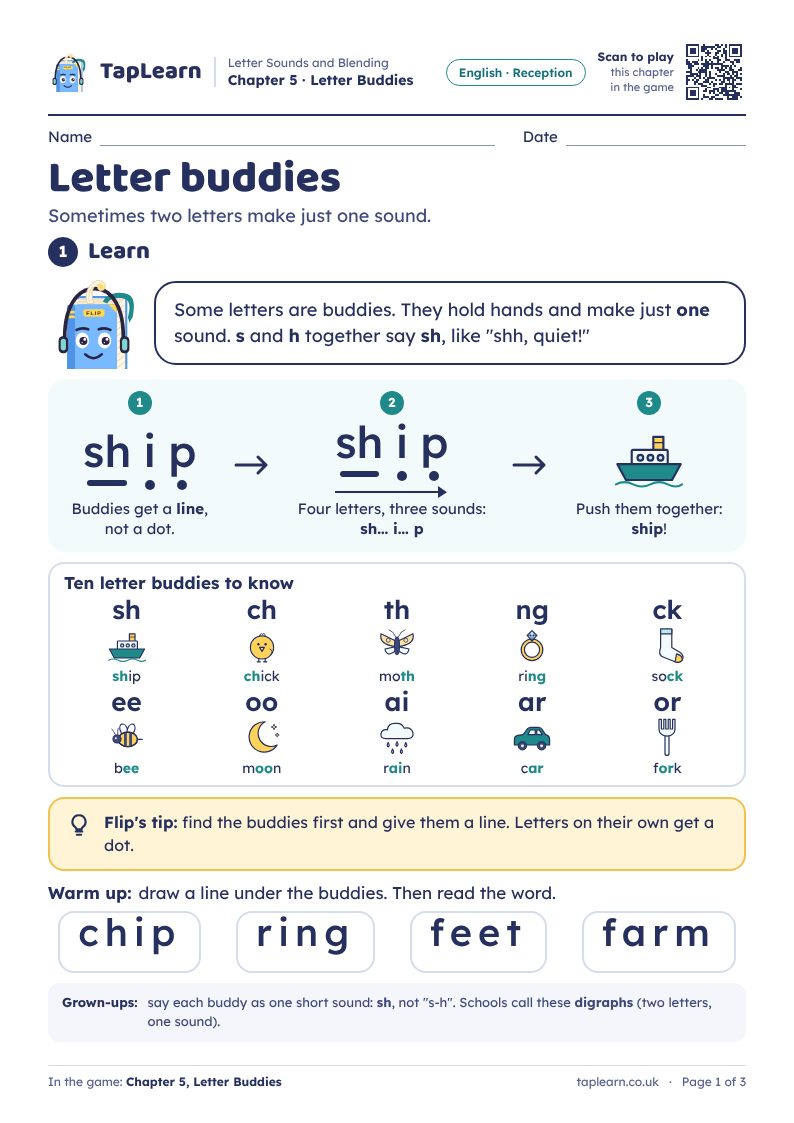
Letter Buddies is a printable digraphs worksheet for Reception (ages 4 to 5) that teaches children ten letter pairs that make one sound, such as sh, ch, ee and ar, and how to read words like ship and car. It links to the EYFS framework in England for Reception, where children say a sound for each letter in the alphabet and at least 10 digraphs.
Free to print, no account needed.
Print it on A4, in colour or black and white. Do it after the chapter, or before it to see what your child already knows.
What's on the worksheet
Read ten letter pairs that make one sound (sh, ch, th, ng, ck, ee, oo, ai, ar, or) and words like ship, fish and car. With a buddy hunt in a picture book or food packets, and answers.
- Page 1 · Learn
- How buddies like sh hold hands to make one sound, with a line instead of a dot, and the ten buddies with a word each. Warm-up: underline the buddies in chip, feet and farm.
- Page 2 · Try it together
- Buddy hunt: search a picture book or kitchen food packets for the ten letter buddies, mark each one you find, and see which buddy turns up most.
- Page 3 · Practise
- Ring the buddy for a sound you hear, match buddy words to pictures, draw sound buttons and count the sounds in duck, feet, chain and torch, and Mia's s-h-i-p challenge.
- Answers sheet
- All answers, four points to watch for, and buddy actions and sound-spotting ideas.
3 A4 pages and an answers sheet · about 20 minutes
Using it at home
- Say each buddy as one short sound, sh not "s-h", and let your child draw the buddy lines themselves.
- In real books buddies sometimes make a different sound (oo in book and moon), so just enjoy spotting them and read the word aloud.
Watch out for
- Splitting the buddies (s-h-i-p, or f-e-e-t for feet).
- Ask, "Can you see any letters holding hands?" and draw the line together.
- Counting letters, not sounds.
- Count the buttons, not the letters: torch has 5 letters but 3 sounds.
- Saying "f" or "v" for th.
- That's normal at first: show how th is said with the tongue between the teeth.
Questions from the worksheet
- Listen to the sound. Draw a ring round its letter buddy.
- Read the buddy word. Draw a line to its picture.
- Draw the sound buttons: a line for buddies, a dot for the others. How many sounds?
- Mia reads this word as s… h… i… p. Is she right? How many sounds are in ship?
The answers are on the answers sheet, for grown-ups.
National curriculum in England
This worksheet practises these statements from the Reception english programme of study:
- Skilled word reading, taught later, involves both the speedy working out of the pronunciation of unfamiliar printed words (decoding) and the speedy recognition of familiar printed words
- Say a sound for each letter in the alphabet and at least 10 digraphs
- Read words consistent with their phonic knowledge by sound-blending
- Read individual letters by saying the sounds for them
- Blend sounds into words, so that they can read short words made up of known letter–sound correspondences
In the classroom
- Teach a buddy action for each digraph (finger on lips for sh, a choo-choo train for ch) and use them in a quick-fire recap.
- Hand out picture books for a timed buddy hunt in pairs.
Questions and answers
What is a digraph in phonics?
A digraph is two letters that make one sound, like sh in ship or ee in bee. In Reception, children learn to read at least 10 of them.
Which digraphs are on this worksheet?
The sheet covers sh, ch, th, ng, ck, ee, oo, ai, ar and or, each with a word such as ship, chick, moon and car.
 TapLearn