Understanding poems worksheet for Year 2: Picture the poem
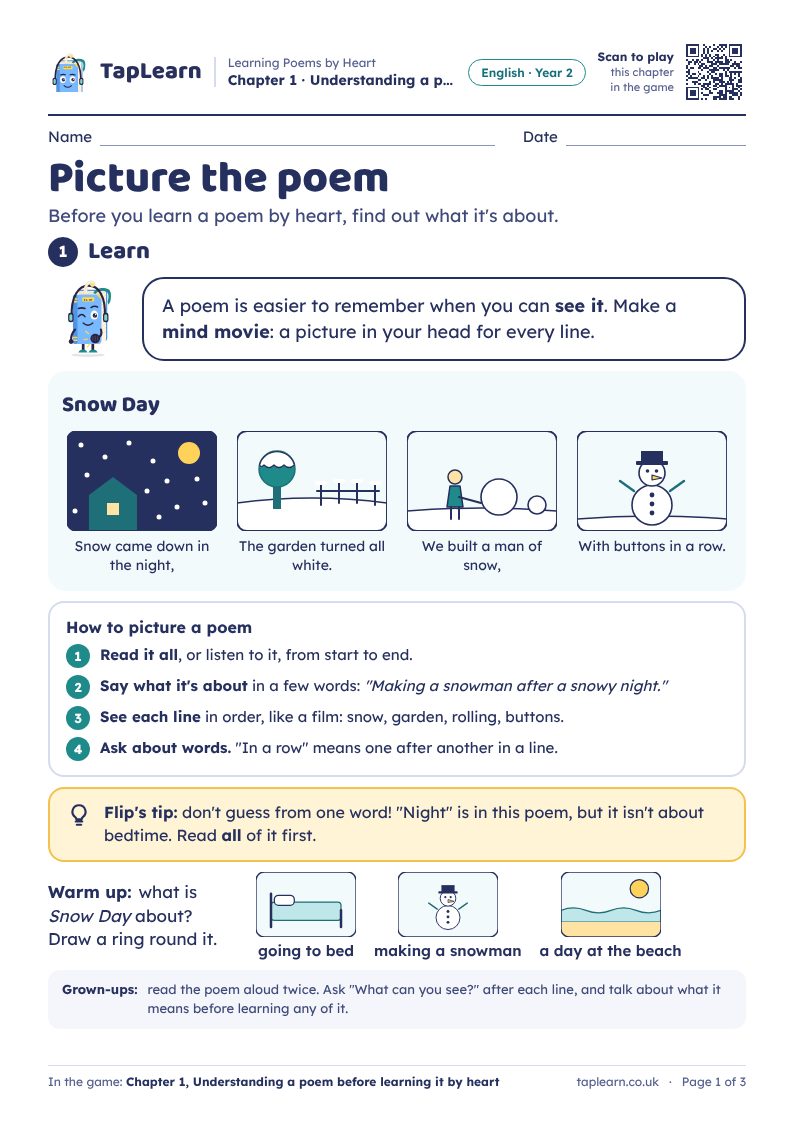
Picture the Poem is a printable understanding poems worksheet for Year 2 (ages 6 to 7) that teaches children to read a whole poem, say what it's about and make a mind movie with a picture for every line. It covers the Year 2 English reading statement on building up a repertoire of poems learnt by heart, appreciating these and reciting some with intonation that makes the meaning clear.
What it practises: Children listen to 'Rain' by Robert Louis Stevenson, say what it is about, explain a phrase and build a mind movie of its pictures in the same order as the lines.
Free to print, no account needed.
Print it on A4, in colour or black and white. Do it after the chapter, or before it to see what your child already knows.
What's on the worksheet
Your child finds out what a poem is about before learning it: reading the whole poem, picturing each line in order and checking tricky words. Includes a mind movie drawing activity and an answers sheet.
- Page 1 · Learn
- The poem Snow Day with a picture for each line, four steps for picturing a poem, Flip's tip not to guess from one word, and a what-is-it-about warm-up.
- Page 2 · Try it together
- Mind movie: listen to a short poem read twice, close your eyes and picture each line, draw one picture per line in order, act out a line for the grown-up to guess, then say it together.
- Page 3 · Practise
- Order muddled pictures for My Kite, ring what My Seed is about, choose what tumbled means, draw a mind movie for one line, say what a poem is about, and a challenge.
- Answers sheet
- Every answer, mix-ups like guessing from one word, and mime-it and in-one-sentence ideas.
3 A4 pages and an answers sheet · about 20 minutes
Using it at home
- Read the poem aloud twice, ask "What can you see?" after each line, and talk about what it means before learning any of it.
- In the mind movie, the pictures don't need to be neat. What matters is that each matches its line and they're in order.
- Read a short poem line by line while your child acts out each line.
Watch out for
- Guessing from one word, like "night means bedtime".
- Ask "Does that fit the whole poem?" and read it all again.
- Putting pictures in the wrong order.
- Read one line, find its picture, then the next. Ask "What happens first? And then?"
- Saying the sounds without the meaning.
- If your child can say a line but can't tell you what it means, picture it together before learning more.
Questions from the worksheet
- What is My Seed about? Draw a ring round it: growing a flower, a drink, a sunny day out.
- In My Kite, what does tumbled mean? Ring it: flew up higher; fell down, turning over and over; sang a song.
- Tell a grown-up what My Kite is about. Then write it in a few words.
- Sam learnt My Kite by saying the sounds again and again. He thinks "tumbled down below" means the kite went up higher. Is he right? Why does it help to know what the words mean?
The answers are on the answers sheet, for grown-ups.
National curriculum in England
This worksheet practises this statement from the Year 2 english programme of study:
- Develop pleasure in reading, motivation to read, vocabulary and understanding by: continuing to build up a repertoire of poems learnt by heart, appreciating these and reciting some, with appropriate intonation to make the meaning clear
In the classroom
- Read a class poem twice and have children draw a mind movie strip, one box per line.
- Use mime it as a warm-up: one child acts a line and the class guesses which one.
Questions and answers
Why should children understand a poem before learning it by heart?
A poem is easier to remember when you can picture it. Knowing what the words mean helps the lines come back in the right order.
What is a mind movie?
A mind movie is a picture in your head for every line of a poem, like a film that plays in order.
How do you work out what a poem is about?
Read or listen to the whole poem, then say what it's about in a few words. Don't guess from just one word.
 TapLearn