Memorising poems worksheet for Year 2: Vanishing words
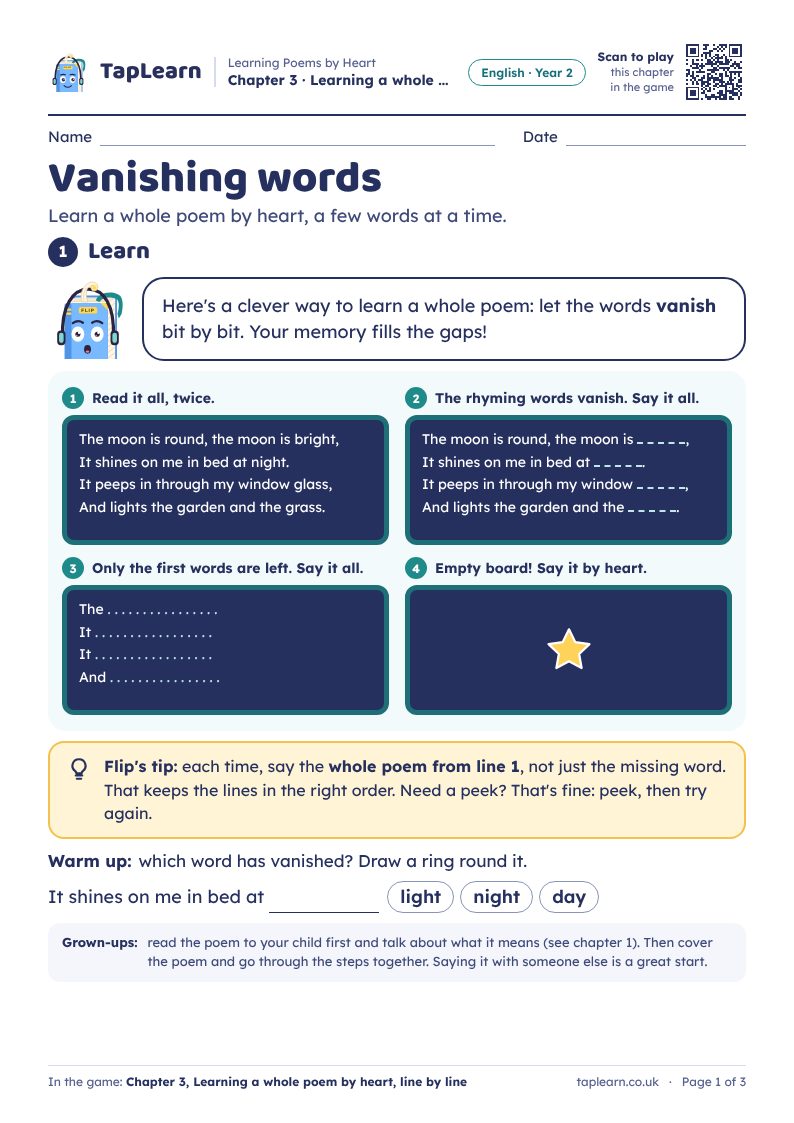
Vanishing Words is a printable memorising poems worksheet for Year 2 (ages 6 to 7) that teaches children to learn a poem as its words disappear bit by bit, saying the whole poem from line 1 each time. It covers the Year 2 English reading statement on building up a repertoire of poems learnt by heart, appreciating these and reciting some with intonation that makes the meaning clear.
What it practises: In the Vanishing Words game, words disappear from a chalkboard round by round: children fill gaps, recall lines from their first word, put lines in order and finally recite 'Rain' from memory.
This worksheet is for members
Membership opens every chapter of every game and every worksheet, for all your children.
See the plansAlready a member? Log in to print it.
Start with the free one: Picture the poem (chapter 1).
Print it on A4, in colour or black and white. Do it after the chapter, or before it to see what your child already knows.
What's on the worksheet
Your child learns a whole poem by heart as its words vanish a few at a time, then says the lines in the right order with the right words. Includes a cover-a-word activity and an answers sheet.
- Page 1 · Learn
- The Moon poem in four steps as its words vanish, from the full poem to an empty board, Flip's tip to say the whole poem from line 1 each time, and a missing-word warm-up.
- Page 2 · Try it together
- Cover a word: write a short poem in big letters, read it twice, cover one word with a button and say the whole poem, then keep covering words until you can say it by heart.
- Page 3 · Practise
- Fill in vanished words, put the lines of Hide and Seek in order, ring the real word over sound-alikes like peeps and sleeps, say The Moon by heart, and a challenge about line order.
- Answers sheet
- Every answer, mix-ups like only saying the gaps, and take-turns and bedtime-poem ideas.
3 A4 pages and an answers sheet · about 20 minutes
Using it at home
- Read the poem first and talk about what it means, then cover it and go through the steps together.
- In cover a word, cover the rhyming words last: they're the easiest to remember. A quick peek is fine.
- Take turns: you say line 1, your child says line 2, and so on.
Watch out for
- Saying the lines in the wrong order.
- Ask "What comes first?" and picture the poem as a film. Start again from line 1 each time.
- Swapping sound-alike words, like sleeps for peeps.
- Ask "Does the moon sleep or peep? What do you see?" The meaning helps pick the right word.
- Only saying the missing words.
- Saying the whole poem every time is what makes it stick.
Questions from the worksheet
- The lines of Hide and Seek are muddled up. Write 1, 2, 3, 4 to put them in order.
- Ring the word that is really in The Moon: It sleeps / peeps in through my window glass.
- Cover the poem. Say The Moon to a grown-up. Tick each line you said in the right place.
- Leo says The Moon with lines 1 and 2 swapped. He says, "All the words are there, so it's fine." Is he right? What would you tell him?
The answers are on the answers sheet, for grown-ups.
National curriculum in England
This worksheet practises this statement from the Year 2 english programme of study:
- Develop pleasure in reading, motivation to read, vocabulary and understanding by: continuing to build up a repertoire of poems learnt by heart, appreciating these and reciting some, with appropriate intonation to make the meaning clear
In the classroom
- Display a class poem on the board and rub out a few words at a time as the class recites it.
- Use the muddled Hide and Seek lines as a sequencing task with sentence strips.
Questions and answers
How do vanishing words help you learn a poem?
As words disappear a few at a time, your memory fills the gaps, until you can say the whole poem from an empty board.
Why say the whole poem each time?
Saying it from line 1 every time keeps the lines in the right order and makes the poem stick.
Does the order of lines in a poem matter?
Yes. A poem tells things in order, so swapping lines changes it, even if all the words are there.
 TapLearn