Reciting with intonation worksheet for Year 2: Poem voices
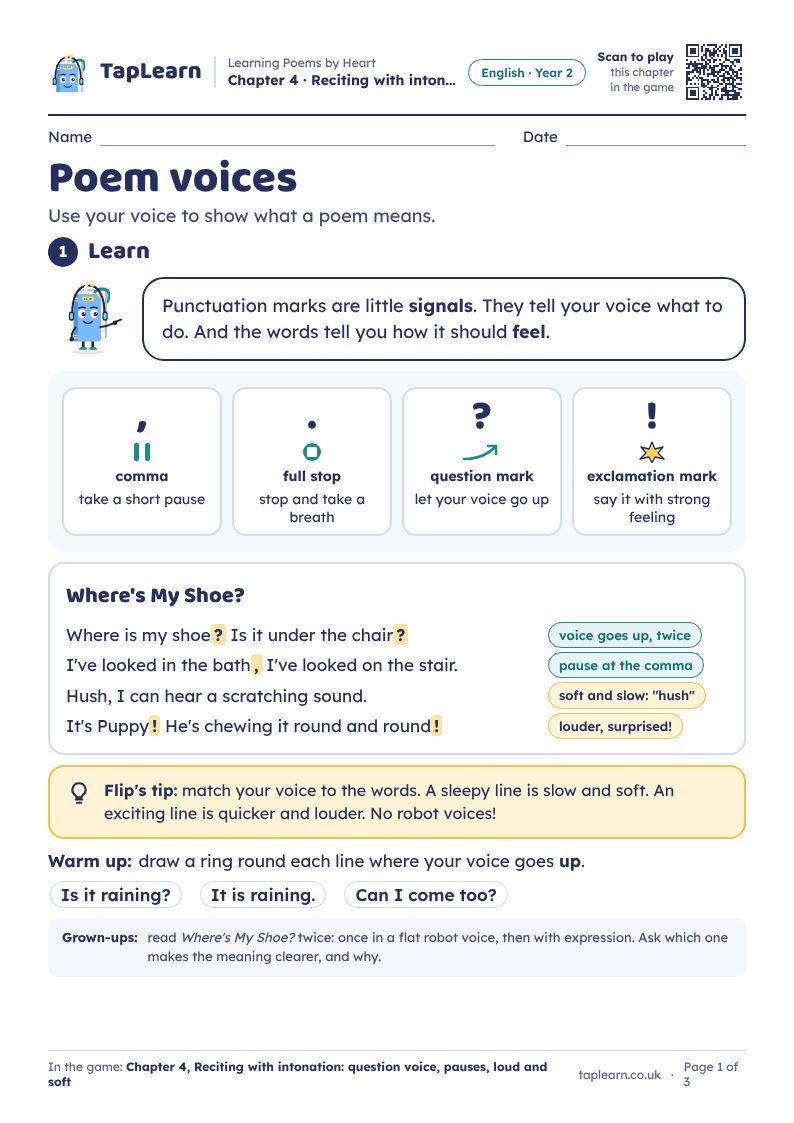
Poem Voices is a printable reciting with intonation worksheet for Year 2 (ages 6 to 7) that teaches children that punctuation tells their voice what to do and the words tell them how it should feel. It covers the Year 2 English reading statement on building up a repertoire of poems learnt by heart, appreciating these and reciting some with intonation that makes the meaning clear.
What it practises: Children compare a flat robot voice with an expressive one, watch a voice line rise for questions, pause at commas and choose whisper, worried or loud voices to match the meaning of each line.
This worksheet is for members
Membership opens every chapter of every game and every worksheet, for all your children.
See the plansAlready a member? Log in to print it.
Start with the free one: Picture the poem (chapter 1).
Print it on A4, in colour or black and white. Do it after the chapter, or before it to see what your child already knows.
What's on the worksheet
Your child recites a poem with a voice that shows the meaning: going up for questions, pausing at commas, stopping at full stops, and loud or soft to match the words. Includes a robot-or-real voice game and an answers sheet.
- Page 1 · Learn
- What a comma, full stop, question mark and exclamation mark tell your voice, the poem Where's My Shoe? marked up, Flip's tip to match your voice to the words, and a warm-up.
- Page 2 · Try it together
- Robot or real?: write voices like whisper, sleepy and robot on scraps, pick one and say a line in that voice, decide if it matches, then say it in the voice that fits best.
- Page 3 · Practise
- Match lines to voices, ring what your voice should do at each mark, choose loud or soft, mark pauses and rising voice on a line, and a challenge about a loud "hush".
- Answers sheet
- Every answer, mix-ups like a flat sing-song voice, and echo-me and wonder-voice ideas.
3 A4 pages and an answers sheet · about 20 minutes
Using it at home
- Read Where's My Shoe? once in a flat robot voice and once with expression, and ask which makes the meaning clearer.
- In robot or real?, a silly voice that doesn't match is a great way to show why matching matters.
- Say a line with expression and let your child echo it the same way.
Watch out for
- Using a flat or sing-song voice on every line.
- Try one line as a robot, then as a storyteller, and talk about the difference.
- Rushing past the punctuation marks.
- Point to each comma, full stop and question mark as your child says the line.
- Using a voice that doesn't match, like shouting a sleepy line.
- Ask "What is happening here? How should it sound?"
Questions from the worksheet
- Which voice fits each line? The baby is fast asleep. Hooray, it's my birthday! Who is knocking at my door?
- Look at the mark. What should your voice do? Can you see the moon? Red, yellow, green and blue.
- Loud or soft? Ring the voice that matches the words: The lion roared! The mouse crept by.
- Ava says the line "Hush, the baby is sleeping." in a big, loud voice. Is that a good voice for it? What voice would you use, and why?
The answers are on the answers sheet, for grown-ups.
National curriculum in England
This worksheet practises this statement from the Year 2 english programme of study:
- Develop pleasure in reading, motivation to read, vocabulary and understanding by: continuing to build up a repertoire of poems learnt by heart, appreciating these and reciting some, with appropriate intonation to make the meaning clear
In the classroom
- Play robot or real? as a class, with children voting thumbs up or down for each voice.
- Mark up a class poem together with pause lines and rising arrows before reciting it.
Questions and answers
What is intonation in reading poems?
Intonation is how your voice rises, falls, pauses and changes to show what the words mean, like going up for a question.
What should your voice do at punctuation marks?
Pause at a comma, stop at a full stop, go up at a question mark, and say it with strong feeling at an exclamation mark.
How do you choose a voice for a line of a poem?
Match it to the words: a sleepy line is slow and soft, and an exciting line is quicker and louder.
 TapLearn