Performing poetry worksheet for Year 2: My poem show
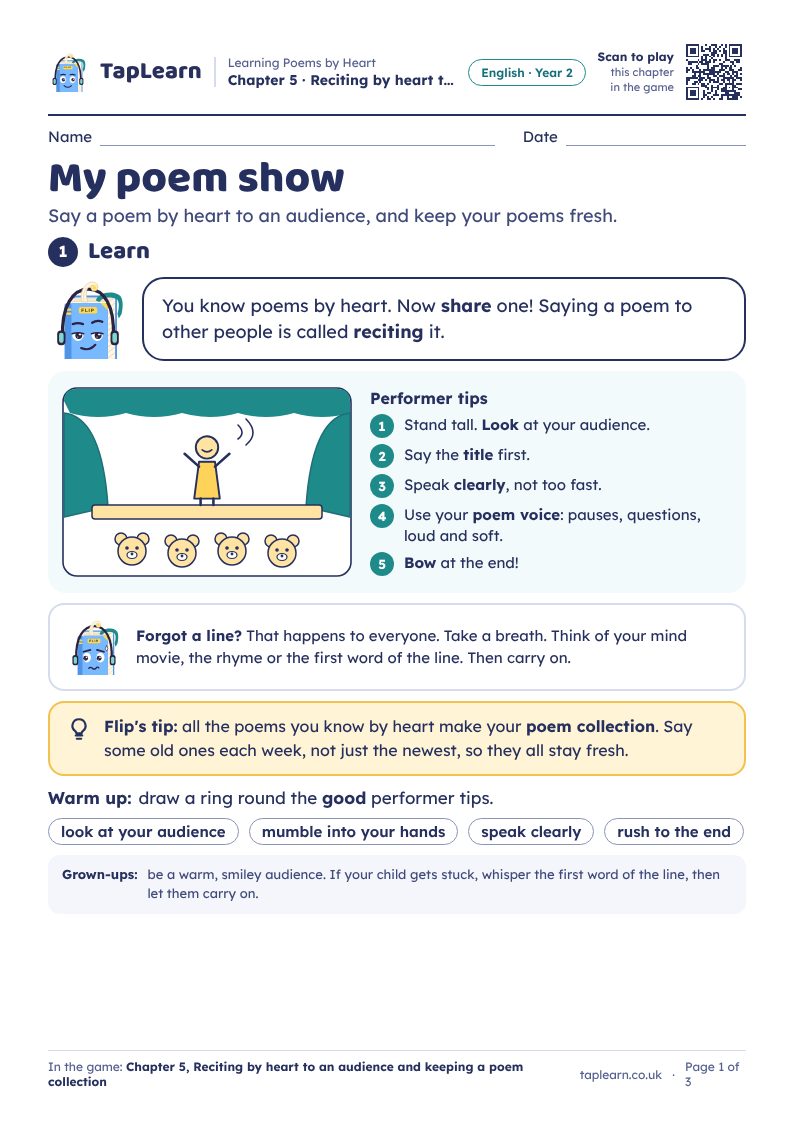
My Poem Show is a printable performing poetry worksheet for Year 2 (ages 6 to 7) that teaches children performer tips for reciting a poem by heart, what to do if they forget a line, and how to keep their poem collection fresh. It covers the Year 2 English reading statement on building up a repertoire of poems learnt by heart, appreciating these and reciting some with intonation that makes the meaning clear.
What it practises: Children learn performer tips, choose a poem from their trunk, practise with first-word prompts and recite it on stage, then learn what a repertoire is and how to keep old poems fresh.
This worksheet is for members
Membership opens every chapter of every game and every worksheet, for all your children.
See the plansAlready a member? Log in to print it.
Start with the free one: Picture the poem (chapter 1).
Print it on A4, in colour or black and white. Do it after the chapter, or before it to see what your child already knows.
What's on the worksheet
Your child recites a poem by heart to an audience with a clear, meaningful voice, and keeps a growing collection of poems fresh by saying them again. Includes a poem show to put on at home and an answers sheet.
- Page 1 · Learn
- Five performer tips from standing tall to bowing, what to do if you forget a line, Flip's tip on keeping a poem collection fresh, and a ring-the-good-tips warm-up.
- Page 2 · Try it together
- Put on a poem show: choose a poem your child knows by heart, set up a stage and an audience of family or toys, say the title and the poem, bow, and hear one thing the audience liked.
- Page 3 · Practise
- Mark up Little Snail for performance, put its lines in order, list the poems you know by heart and your favourite, choose how Mia keeps poems fresh, and a challenge about forgetting.
- Answers sheet
- Every answer, mix-ups like a rushed voice when nervous, and poem-swap and video-call ideas.
3 A4 pages and an answers sheet · about 25 minutes
Using it at home
- Be a warm, smiley audience. If your child gets stuck, whisper the first word of the line and let them carry on.
- Keep the poem show fun and calm, with no score, and praise one real thing, like how quiet they went for a sleepy line.
- Recite a poem you learnt as a child, and let your child recite one of theirs.
Watch out for
- Learning a poem once and moving on.
- Poems fade unless they're said again. Keep a few old favourites going.
- Muddling lines or swapping words under pressure.
- Practise once before the show using first-word clues.
- Using a flat or rushed voice when nervous.
- Remind your child to slow down and use their poem voice.
Questions from the worksheet
- Get Little Snail ready for your show: draw a line at each comma, an arrow where your voice goes up, and ring the words to say softly and slowly.
- Cover page 2. Write 1, 2, 3, 4 to put the lines of Little Snail in order.
- Mia knows 4 poems by heart. How can she keep them all fresh? Ring it: only say the newest one; say some old ones each week too; never say them again.
- In his poem show, Leo forgets line 3. He stops and says, "I can't do it!" What could help him remember the line and carry on?
The answers are on the answers sheet, for grown-ups.
National curriculum in England
This worksheet practises this statement from the Year 2 english programme of study:
- Develop pleasure in reading, motivation to read, vocabulary and understanding by: continuing to build up a repertoire of poems learnt by heart, appreciating these and reciting some, with appropriate intonation to make the meaning clear
In the classroom
- Hold a weekly class poetry show where children recite a poem from their collection.
- Keep a class poem collection display and revisit older poems regularly.
Questions and answers
What does reciting a poem mean?
Reciting a poem means saying it from memory to other people, using a clear voice that shows what the words mean.
What should a child do if they forget a line?
Take a breath and think of the mind movie, the rhyme or the first word of the line, then carry on. Forgetting is normal.
What is a poem collection or repertoire?
It's all the poems a child knows by heart. Saying some old ones each week keeps them all fresh.
 TapLearn