Woodwind instruments worksheet for Years 3–6: The woodwind family
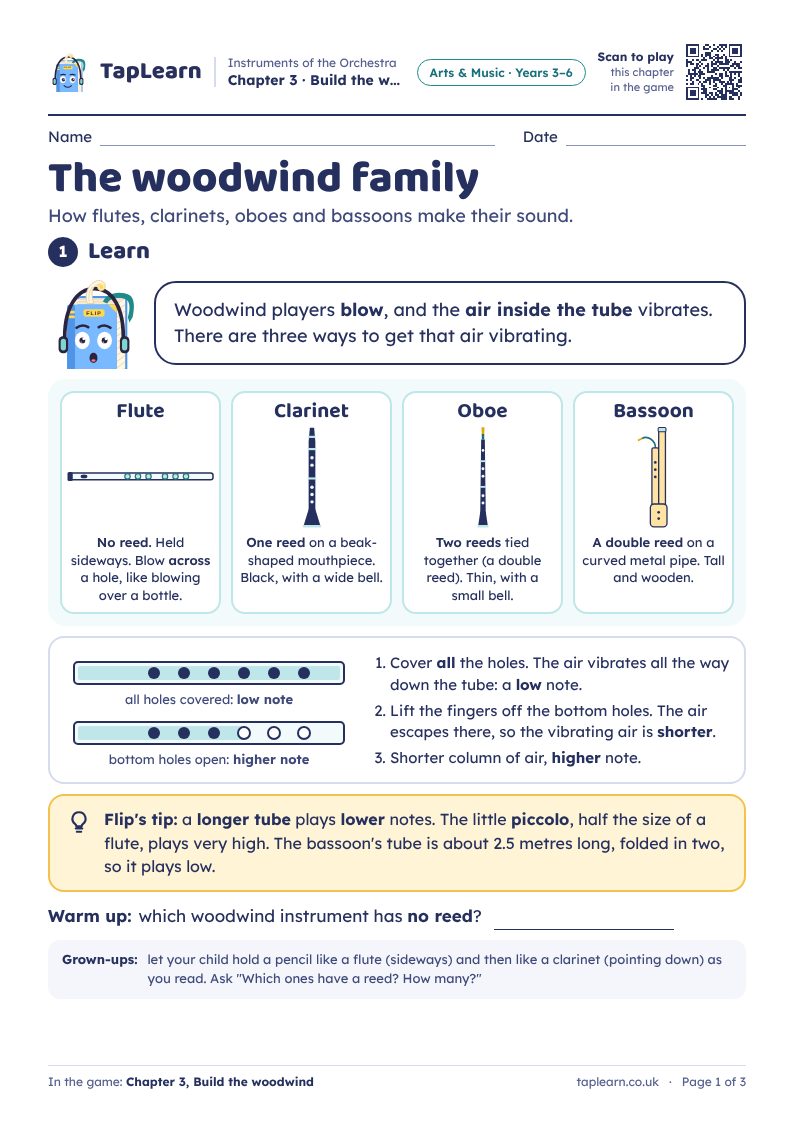
The Woodwind Family is a printable woodwind instruments worksheet for Years 3 to 6 (ages 7 to 11) that teaches how blowing makes the air in a tube vibrate and how to recognise the flute, clarinet, oboe and bassoon. It supports the national curriculum in England for KS2 music: listen with attention to detail and recall sounds with increasing aural memory.
This worksheet is for members
Membership opens every chapter of every game and every worksheet, for all your children.
See the plansAlready a member? Log in to print it.
Start with the free one: The four families (chapter 1).
Print it on A4, in colour or black and white. Do it after the chapter, or before it to see what your child already knows.
What's on the worksheet
Learn how blowing makes the air in a tube vibrate, tell the flute, clarinet, oboe and bassoon apart, and see why covering holes or a longer tube plays lower. With a bottle band and answers.
- Page 1 · Learn
- The flute (no reed), clarinet (one reed), oboe and bassoon (double reeds) with clues to tell them apart, and a diagram showing why opening finger holes makes a higher note.
- Page 2 · Try it together
- Bottle band: put different amounts of water in three plastic bottles, blow across the tops, and order them from low to high.
- Page 2–3 · Practise
- Name five woodwind instruments from pictures, order them from highest to lowest, tick how each starts its sound, and ring higher or lower. Then a challenge about the metal flute.
- Answers sheet
- Every answer, notes on covering holes and telling the clarinet from the oboe, and a Peter and the Wolf listening idea.
3 A4 pages and an answers sheet · about 30 minutes
Using it at home
- Do the bottle band over a towel or at the sink. Blowing across a bottle takes a few tries, so have a go yourself first.
- Let your child hold a pencil like a flute (sideways) and like a clarinet (pointing down) to remember how each one is held.
Watch out for
- Mixing up which woodwind instruments play high and low notes.
- The longer the tube, the lower the notes: the piccolo plays highest and the bassoon lowest.
- Thinking that covering more holes makes the note higher.
- Covering holes makes the column of air longer, so the note goes lower. Lifting fingers shortens it.
- Mixing up the clarinet and the oboe.
- Look at the top and bottom: the clarinet has a beak-shaped mouthpiece and wide bell; the oboe has a thin double reed and small bell.
Questions from the worksheet
- Write these in order from the highest notes to the lowest: bassoon, piccolo, clarinet, flute.
- How does each instrument get the air vibrating: blow across an edge, one reed or a double reed?
- Ring the right word: cover all the holes and the note is higher / lower.
- The oboe and the bassoon both use a double reed. Why does the bassoon play much lower notes?
The answers are on the answers sheet, for grown-ups.
National curriculum in England
This worksheet practises these statements from the Years 3–6 music programme of study:
- Listen with attention to detail and recall sounds with increasing aural memory
- Appreciate and understand a wide range of high-quality live and recorded music drawn from different traditions and from great composers and musicians
Source: National curriculum in England: music programmes of study (DfE)
In the classroom
- Play short clips of each woodwind instrument and have pupils hold up the matching picture card from Practise A.
- Try the bottle band as a group demonstration, with pupils predicting each note before it's played.
Questions and answers
What instruments are in the woodwind family?
The main woodwind instruments in an orchestra are the flute, piccolo, clarinet, oboe and bassoon. They are all played by blowing, which makes the air inside the tube vibrate.
What is the difference between a single reed and a double reed?
A single reed is one thin, flat reed that vibrates against the mouthpiece, as on a clarinet. A double reed is two reeds tied together that vibrate against each other, as on an oboe or bassoon.
More worksheets from Instruments of the Orchestra: Build It, Then Conduct It
- Chapter 1: Families of the orchestra worksheet: The four families Free
- Chapter 2: String instruments worksheet: The string family Members
- Chapter 4: Brass instruments worksheet: The brass family Members
- Chapter 5: Tuned and untuned percussion worksheet: The percussion family Members
- Chapter 6: Orchestra seating plan worksheet: Conduct the orchestra Members
 TapLearn