Orchestra seating plan worksheet for Years 3–6: Conduct the orchestra
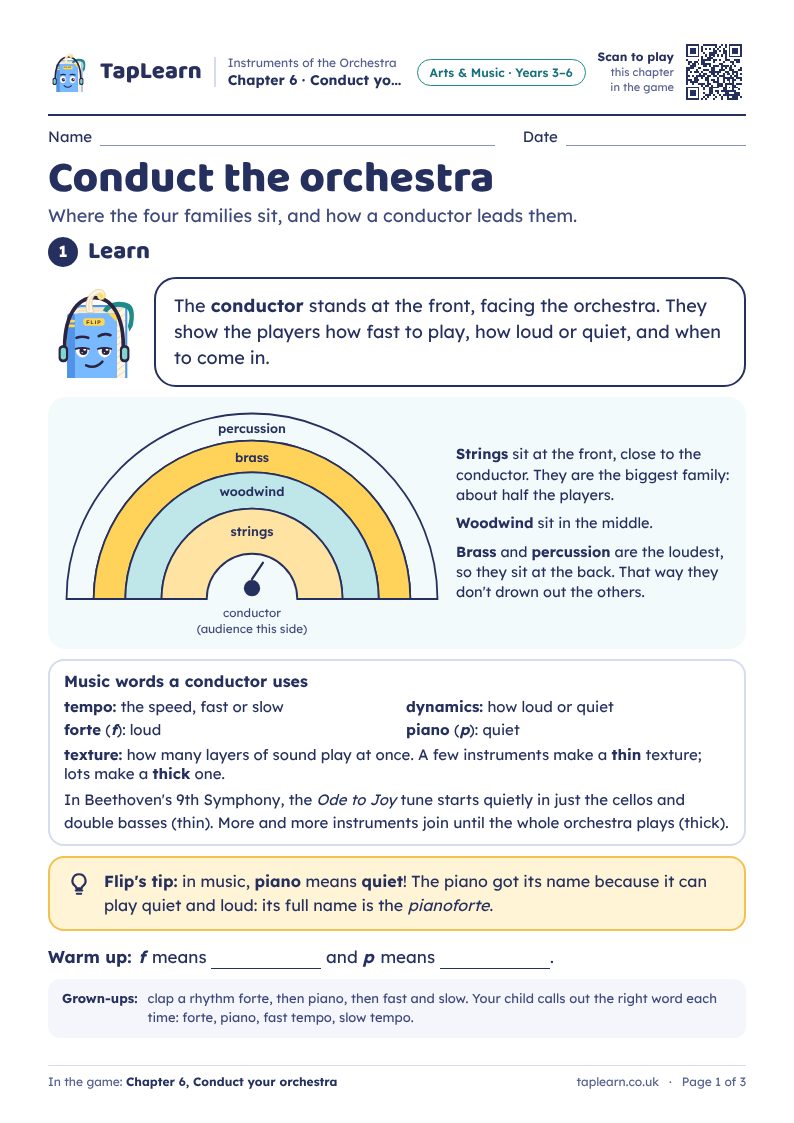
Conduct the Orchestra is a printable orchestra seating plan worksheet for Years 3 to 6 (ages 7 to 11) that teaches where the four families sit, what a conductor does, and the words tempo, dynamics, forte, piano and texture. It supports the national curriculum in England for KS2 music: appreciate and understand high-quality live and recorded music from great composers and musicians.
This worksheet is for members
Membership opens every chapter of every game and every worksheet, for all your children.
See the plansAlready a member? Log in to print it.
Start with the free one: The four families (chapter 1).
Print it on A4, in colour or black and white. Do it after the chapter, or before it to see what your child already knows.
What's on the worksheet
Learn where the four families sit in an orchestra, what a conductor does, and the words tempo, dynamics, forte, piano and texture. With a be-the-conductor activity and answers.
- Page 1 · Learn
- A seating plan with strings at the front and brass and percussion at the back, the conductor's music words, and how Beethoven's Ode to Joy grows from a thin to a thick texture.
- Page 2 · Try it together
- Be the conductor: agree signs for forte, piano, tempo, start and stop, then conduct a grown-up humming Ode to Joy and swap.
- Page 2–3 · Practise
- Label a blank seating plan, match six music words to their meanings, ring thin or thick texture, and name one instrument from each family. Then a challenge about seating the brass.
- Answers sheet
- Every answer, notes on piano meaning quiet and on texture versus dynamics, and listening and conducting ideas.
3 A4 pages and an answers sheet · about 30 minutes
Using it at home
- Play Be the conductor with the whole family as the orchestra. Follow your child's signs exactly so they feel in charge.
- Clap a rhythm loudly, quietly, fast and slow, and let your child call out forte, piano or the tempo each time.
Watch out for
- Thinking piano only means the instrument.
- In music, piano (p) means quiet and forte (f) means loud. The piano's full name, pianoforte, means quiet-loud.
- Mixing up texture and dynamics.
- Texture is how many layers play at once; dynamics is how loud or quiet. A thick texture can still be played quietly.
Questions from the worksheet
- Label the plan with the four families, from the back to the front.
- Match each word to its meaning: tempo, dynamics, forte, piano, texture, conductor.
- Thin or thick texture? All four families play together.
- Sam says, "The brass should sit at the front, so everyone can hear them." Is that a good idea? Explain.
The answers are on the answers sheet, for grown-ups.
National curriculum in England
This worksheet practises these statements from the Years 3–6 music programme of study:
- Listen with attention to detail and recall sounds with increasing aural memory
- Appreciate and understand a wide range of high-quality live and recorded music drawn from different traditions and from great composers and musicians
Source: National curriculum in England: music programmes of study (DfE)
In the classroom
- Seat the class as an orchestra in four families and let pupils take turns conducting with forte, piano and tempo signs.
- Play the Ode to Joy and have pupils raise a hand each time more instruments join, to hear the texture thicken.
Questions and answers
Where do the families sit in an orchestra?
Usually the strings sit at the front, nearest the conductor, the woodwind in the middle, and the brass and percussion at the back. The loudest families sit at the back so they don't drown out the strings.
What does a conductor do?
A conductor leads the orchestra from the front. They beat time to set the tempo, show how loud or quiet to play, and signal when each family should come in or stop.
More worksheets from Instruments of the Orchestra: Build It, Then Conduct It
- Chapter 1: Families of the orchestra worksheet: The four families Free
- Chapter 2: String instruments worksheet: The string family Members
- Chapter 3: Woodwind instruments worksheet: The woodwind family Members
- Chapter 4: Brass instruments worksheet: The brass family Members
- Chapter 5: Tuned and untuned percussion worksheet: The percussion family Members
 TapLearn