Brass instruments worksheet for Years 3–6: The brass family
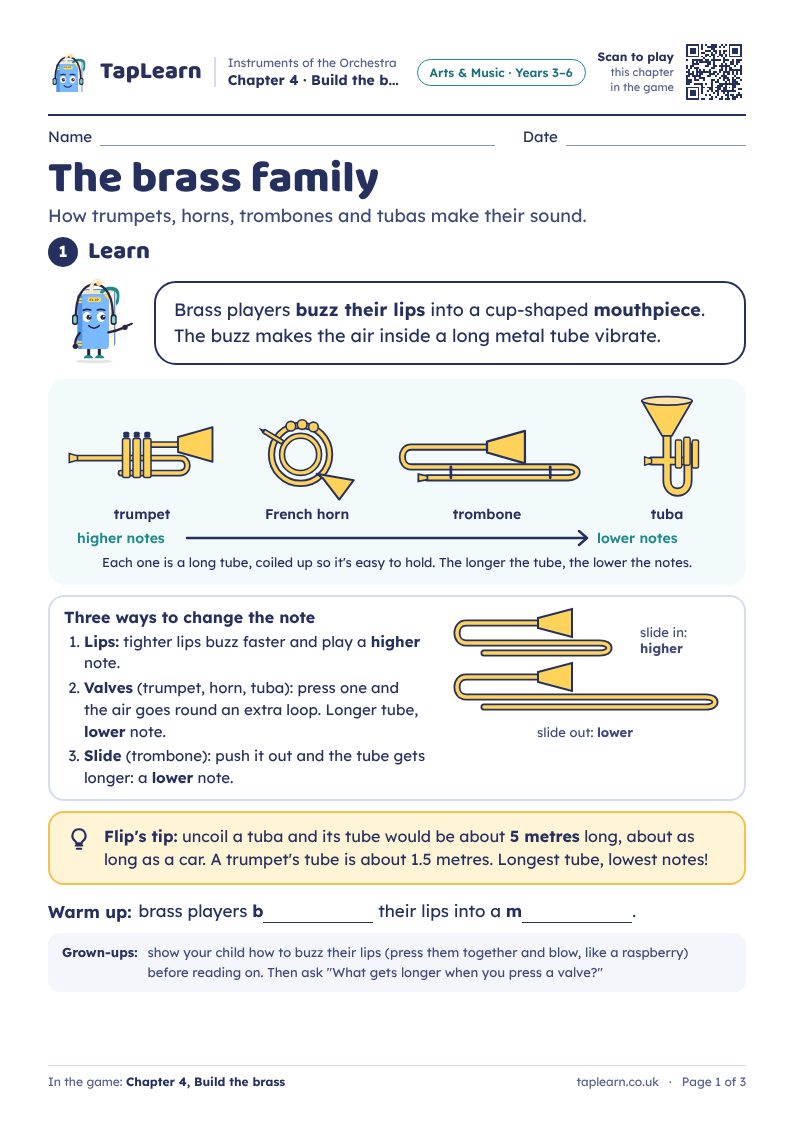
The Brass Family is a printable brass instruments worksheet for Years 3 to 6 (ages 7 to 11) that teaches how buzzing lips make the sound and how valves and the trombone slide make a longer tube and a lower note. It supports the national curriculum in England for KS2 music: listen with attention to detail and recall sounds with increasing aural memory.
This worksheet is for members
Membership opens every chapter of every game and every worksheet, for all your children.
See the plansAlready a member? Log in to print it.
Start with the free one: The four families (chapter 1).
Print it on A4, in colour or black and white. Do it after the chapter, or before it to see what your child already knows.
What's on the worksheet
Learn how buzzing lips make brass instruments sound, how valves and the trombone slide lengthen the tube, and why the tuba plays lower than the trumpet. With a buzzing activity and answers.
- Page 1 · Learn
- The trumpet, French horn, trombone and tuba from higher to lower, three ways to change the note (lips, valves, slide) and a picture of the trombone slide in and out.
- Page 2 · Try it together
- Buzz it: buzz your lips, then buzz into a short and a long cardboard tube and add a funnel bell, recording what changes.
- Page 2–3 · Practise
- Name four brass instruments, explain why the tuba plays lower, fill the gaps, ring higher or lower, and pick the trombone that plays lower. Then a challenge about the trumpet's 3 valves.
- Answers sheet
- Every answer, notes on valves and the high-low mix-up, and ideas such as a garden-hose horn and listening for the wolf in Peter and the Wolf.
3 A4 pages and an answers sheet · about 30 minutes
Using it at home
- Show your child how to buzz their lips before you start, like blowing a raspberry. It tickles, which is a good way to feel vibration.
- Home-made tubes don't always give a clear note. Praise careful listening and describing the change rather than a perfect sound.
Watch out for
- Mixing up which brass instruments play high and low notes: "the tuba is biggest, so it's highest".
- Bigger brass has a longer tube, and a longer tube plays lower notes. The tuba's tube is about 5 metres long.
- Thinking that pressing a valve makes the note higher.
- A valve sends the air round an extra loop of tube, so the tube is longer and the note is lower.
Questions from the worksheet
- Why does the tuba play lower notes than the trumpet?
- Fill the gap: pressing a valve makes the tube ___, so the note goes lower.
- Ring the right word: pulling the trombone slide in makes the note higher / lower.
- Leo says a trumpet only has 3 valves, so it can only play 3 notes. Is he right? Think about the player's lips.
The answers are on the answers sheet, for grown-ups.
National curriculum in England
This worksheet practises these statements from the Years 3–6 music programme of study:
- Listen with attention to detail and recall sounds with increasing aural memory
- Appreciate and understand a wide range of high-quality live and recorded music drawn from different traditions and from great composers and musicians
Source: National curriculum in England: music programmes of study (DfE)
In the classroom
- Use the trombone pictures (slide in and out) as a quick show-me question: pupils point to the one that plays lower.
- Try lip buzzing as a whole class warm-up, moving from loose, low buzzes to tight, high ones.
Questions and answers
How do brass instruments make a sound?
Brass players make the sound by buzzing their lips into a cup-shaped mouthpiece. The buzz makes the air inside the long metal tube vibrate, and the shape of the tube and bell turns it into a note.
How do valves on a trumpet work?
Pressing a valve sends the air round an extra loop of tubing, which makes the tube longer and the note lower. Players also change notes by buzzing their lips tighter or looser.
More worksheets from Instruments of the Orchestra: Build It, Then Conduct It
- Chapter 1: Families of the orchestra worksheet: The four families Free
- Chapter 2: String instruments worksheet: The string family Members
- Chapter 3: Woodwind instruments worksheet: The woodwind family Members
- Chapter 5: Tuned and untuned percussion worksheet: The percussion family Members
- Chapter 6: Orchestra seating plan worksheet: Conduct the orchestra Members
 TapLearn