String instruments worksheet for Years 3–6: The string family
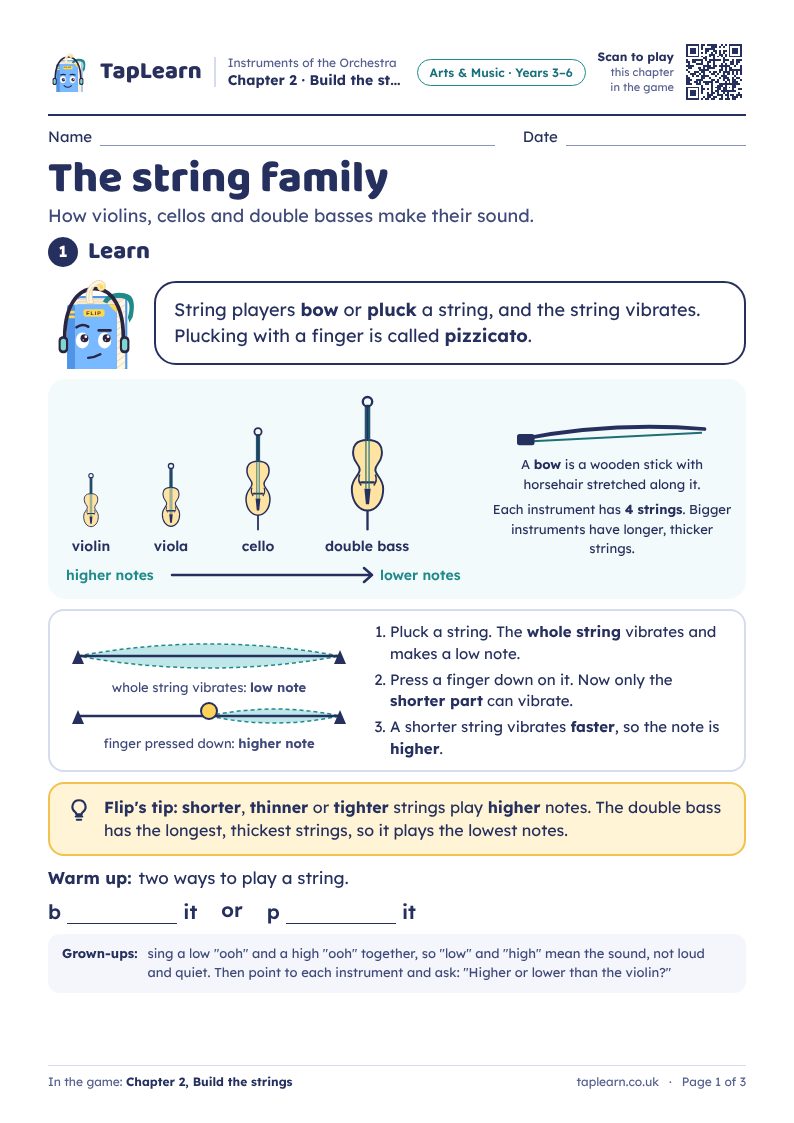
The String Family is a printable string instruments worksheet for Years 3 to 6 (ages 7 to 11) that teaches how bowing and plucking make a string vibrate and why bigger string instruments play lower notes. It supports the national curriculum in England for KS2 music: listen with attention to detail and recall sounds with increasing aural memory.
This worksheet is for members
Membership opens every chapter of every game and every worksheet, for all your children.
See the plansAlready a member? Log in to print it.
Start with the free one: The four families (chapter 1).
Print it on A4, in colour or black and white. Do it after the chapter, or before it to see what your child already knows.
What's on the worksheet
Learn how bowing and plucking make strings vibrate, why shorter, thinner or tighter strings play higher, and order the violin, viola, cello and double bass. With a rubber band activity and answers.
- Page 1 · Learn
- The violin, viola, cello and double bass side by side from higher to lower, a diagram of a finger shortening a string, and Flip's tip: shorter, thinner or tighter strings play higher.
- Page 2 · Try it together
- Rubber band strings: stretch thick and thin bands over a tub, slide a pencil under them as a bridge, and record which changes make the note higher or lower.
- Page 2–3 · Practise
- Number the four string instruments from highest to lowest, sort bowed from plucked, ring higher or lower, and explain what a finger on the string does. Then a challenge about size and loudness.
- Answers sheet
- Every answer, notes on mixing up high and low with loud and quiet, and ideas such as twanging a ruler and listening to a cello and double bass.
3 A4 pages and an answers sheet · about 30 minutes
Using it at home
- Sing a low "ooh" and a high "ooh" together first, so your child hears that high and low are about pitch, not volume.
- In the rubber band activity, let your child decide what to change. Then ask them to say the rule in their own words: shorter, thinner, tighter, higher.
Watch out for
- Mixing up which instruments play high and low notes.
- The bigger the instrument, the lower the notes. Stand tall for the double bass and crouch small for the violin.
- Using high and low to mean loud and quiet.
- Hum one note loudly and then quietly: the pitch stays the same, only the volume changes.
Questions from the worksheet
- Number the violin, viola, cello and double bass from 1 (highest notes) to 4 (lowest notes).
- Bowed or plucked? Leo flicks the violin string with his finger (pizzicato).
- Ring the right word: a thicker string plays a higher / lower note.
- Ava presses a finger down on a violin string and plucks it. What happens to the note? Why?
- Sam says the cello is bigger than the violin, so it plays louder notes. Is he right?
The answers are on the answers sheet, for grown-ups.
National curriculum in England
This worksheet practises these statements from the Years 3–6 music programme of study:
- Listen with attention to detail and recall sounds with increasing aural memory
- Appreciate and understand a wide range of high-quality live and recorded music drawn from different traditions and from great composers and musicians
Source: National curriculum in England: music programmes of study (DfE)
In the classroom
- Run Try it together in small groups with tubs and bands, then share each group's rule for making a higher note.
- Use the challenge (bigger means louder?) as a hinge question before moving on to the woodwind.
Questions and answers
Why does a double bass sound lower than a violin?
A double bass sounds lower because its strings are much longer and thicker, so they vibrate more slowly and make a lower pitch. The violin's short, thin strings vibrate faster and play higher notes.
What is pizzicato?
Pizzicato means plucking a string with a finger instead of playing it with the bow. String players switch between bowing and pizzicato to change the sound.
More worksheets from Instruments of the Orchestra: Build It, Then Conduct It
- Chapter 1: Families of the orchestra worksheet: The four families Free
- Chapter 3: Woodwind instruments worksheet: The woodwind family Members
- Chapter 4: Brass instruments worksheet: The brass family Members
- Chapter 5: Tuned and untuned percussion worksheet: The percussion family Members
- Chapter 6: Orchestra seating plan worksheet: Conduct the orchestra Members
 TapLearn