Tuned and untuned percussion worksheet for Years 3–6: The percussion family
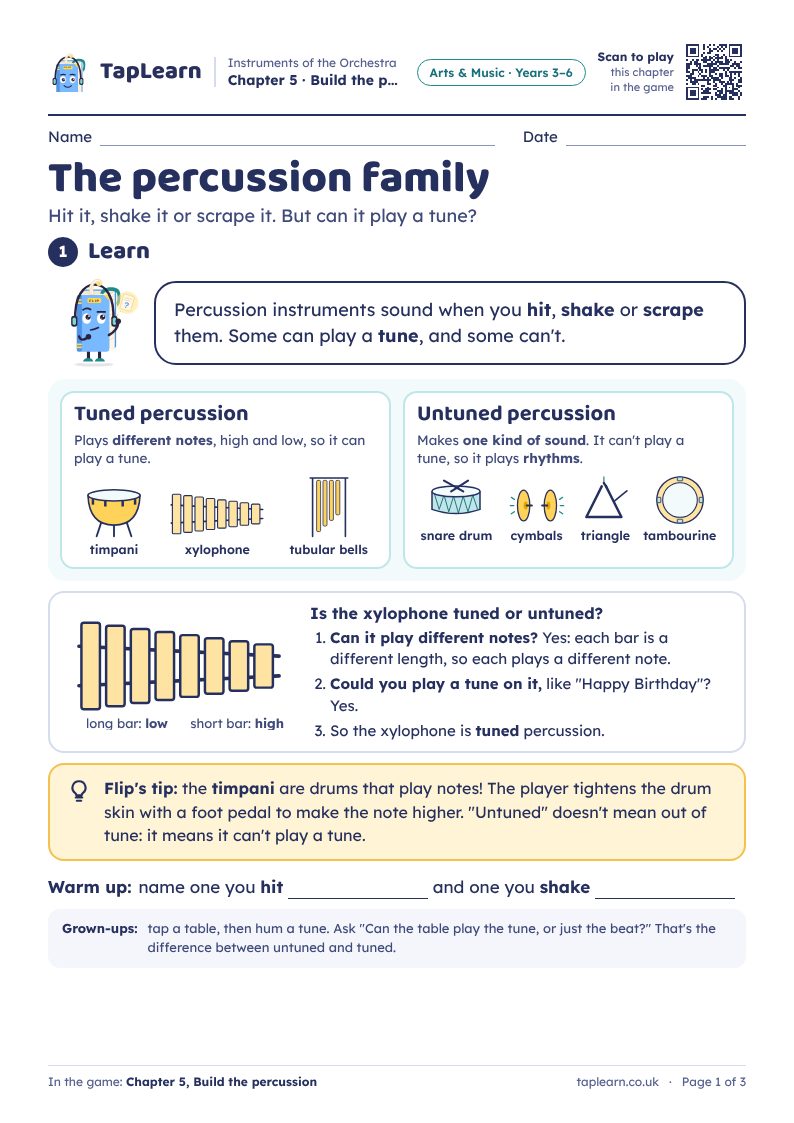
The Percussion Family is a printable tuned and untuned percussion worksheet for Years 3 to 6 (ages 7 to 11) that teaches children to tell tuned percussion, which can play a tune, from untuned percussion, which plays rhythms. It supports the national curriculum in England for KS2 music: listen with attention to detail and recall sounds with increasing aural memory.
This worksheet is for members
Membership opens every chapter of every game and every worksheet, for all your children.
See the plansAlready a member? Log in to print it.
Start with the free one: The four families (chapter 1).
Print it on A4, in colour or black and white. Do it after the chapter, or before it to see what your child already knows.
What's on the worksheet
Learn that percussion is hit, shaken or scraped, and sort tuned percussion, which can play a tune, from untuned percussion, which plays rhythms. With a kitchen percussion activity and answers.
- Page 1 · Learn
- Tuned percussion (timpani, xylophone, tubular bells) beside untuned (snare drum, cymbals, triangle, tambourine), and a worked example: is the xylophone tuned or untuned?
- Page 2 · Try it together
- Kitchen percussion: tap saucepans, shake rice in a tub and scrape a pencil along a comb, then decide whether each is tuned or untuned.
- Page 2–3 · Practise
- Sort eight instruments into tuned and untuned, tick hit, shake or scrape, ring the right word, and explain why the glockenspiel is tuned. Then a challenge: can drums play a tune?
- Answers sheet
- Every answer, notes on the tuned and untuned mix-ups, and ideas such as tapping along to a xylophone tune and body percussion.
3 A4 pages and an answers sheet · about 30 minutes
Using it at home
- Tap a table and then hum a tune: ask whether the table can play the tune or only the beat. It's a quick way into tuned and untuned.
- Use cold, empty pans for Try it together and tap gently. It takes about 10 minutes.
Watch out for
- Thinking untuned percussion, like a snare drum, can play a tune.
- Ask your child to play "Happy Birthday" on a table: they can tap the rhythm but not the tune.
- Not yet knowing that some percussion, like the xylophone or timpani, can play a tune.
- Point out the xylophone's bars of different lengths and the pedal that changes the timpani's note.
- Thinking "untuned" means out of tune.
- Explain that untuned only means the instrument can't play a tune; it plays rhythms instead.
Questions from the worksheet
- Sort the instruments into tuned and untuned: timpani, snare drum, xylophone, triangle, glockenspiel, cymbals, bass drum, tubular bells.
- Ring the right word: on a xylophone, the shortest bar plays the highest / lowest note.
- A triangle and a glockenspiel are both made of metal. Why is the glockenspiel tuned but the triangle untuned?
- Mia says, "Drums can never play a tune." Is she right? Think about the timpani.
The answers are on the answers sheet, for grown-ups.
National curriculum in England
This worksheet practises these statements from the Years 3–6 music programme of study:
- Listen with attention to detail and recall sounds with increasing aural memory
- Appreciate and understand a wide range of high-quality live and recorded music drawn from different traditions and from great composers and musicians
Source: National curriculum in England: music programmes of study (DfE)
In the classroom
- Lay out classroom percussion and have groups sort it into tuned and untuned hoops, then check with Practise A.
- Use the timpani challenge as a hinge question: drums can play a tune, if they are timpani.
Questions and answers
What is the difference between tuned and untuned percussion?
Tuned percussion can play different notes, so it can play a tune; examples are the xylophone, glockenspiel and timpani. Untuned percussion makes one kind of sound and plays rhythms, like the snare drum, cymbals and triangle.
Are timpani tuned or untuned?
Timpani are tuned percussion. They are drums whose skin the player tightens or loosens with a foot pedal to change the note, so they can play notes that fit the music.
More worksheets from Instruments of the Orchestra: Build It, Then Conduct It
- Chapter 1: Families of the orchestra worksheet: The four families Free
- Chapter 2: String instruments worksheet: The string family Members
- Chapter 3: Woodwind instruments worksheet: The woodwind family Members
- Chapter 4: Brass instruments worksheet: The brass family Members
- Chapter 6: Orchestra seating plan worksheet: Conduct the orchestra Members
 TapLearn