Families of the orchestra worksheet for Years 3–6: The four families
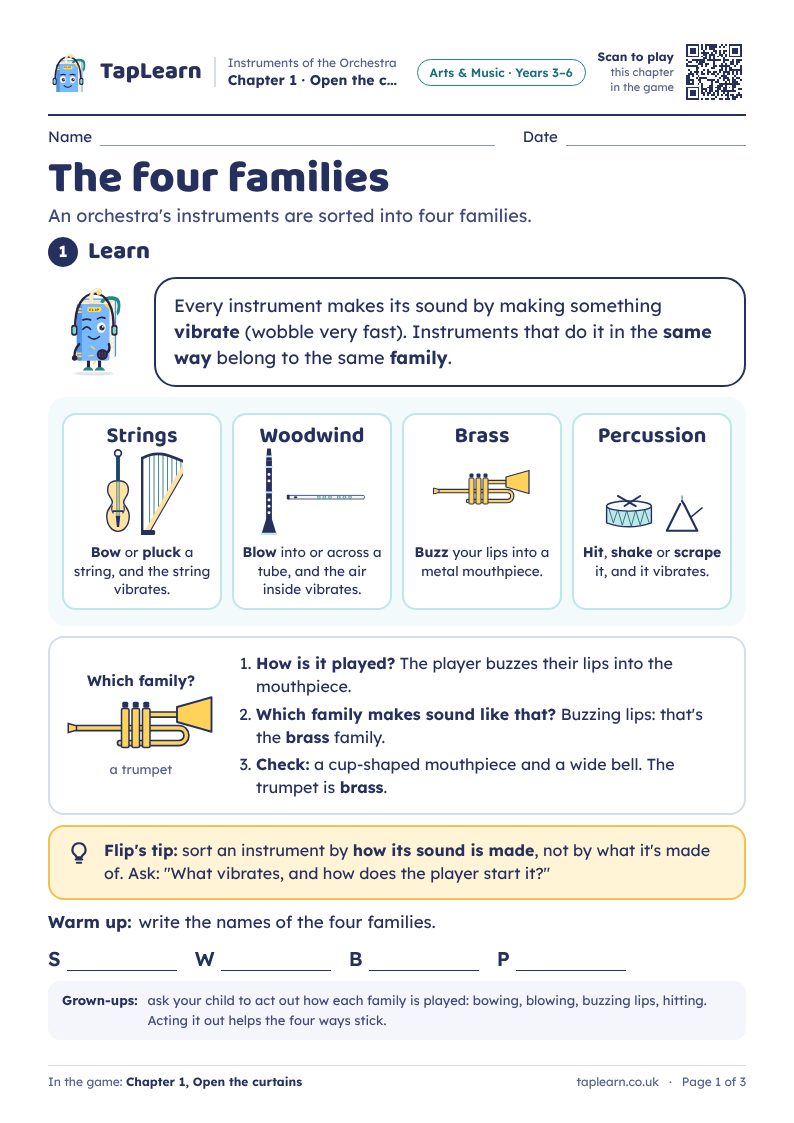
The Four Families is a printable families of the orchestra worksheet for Years 3 to 6 (ages 7 to 11) that teaches children to name strings, woodwind, brass and percussion and sort instruments by how they make their sound. It supports the national curriculum in England for KS2 music: appreciate and understand high-quality live and recorded music from great composers and musicians.
Free to print, no account needed.
Print it on A4, in colour or black and white. Do it after the chapter, or before it to see what your child already knows.
What's on the worksheet
Name the four families of the orchestra (strings, woodwind, brass and percussion) and sort instruments by how they make their sound. With a kitchen-orchestra activity and answers.
- Page 1 · Learn
- Flip explains that every instrument makes sound by vibrating, with pictures of all four families and a worked example: which family is the trumpet in? A warm-up asks for the four family names.
- Page 2 · Try it together
- Kitchen orchestra: pluck a rubber band, blow across a bottle, buzz into a kitchen-roll tube and tap a saucepan, then record what vibrated in each.
- Page 2–3 · Practise
- Write the family under eight instrument pictures, ring the odd one out, fill the gaps, and decide true or false. Then a challenge about the saxophone.
- Answers sheet
- Every answer by page, what to watch out for (sorting by material, percussion as only drums) and quick listening and miming ideas.
3 A4 pages and an answers sheet · about 30 minutes
Using it at home
- Start with Try it together: making each family's sound with kitchen things helps the names stick. It takes about 10 minutes.
- When your child isn't sure of a family, ask "What does the player do to make the sound?" rather than giving the answer.
Watch out for
- Sorting instruments by what they're made of, so the flute goes into brass.
- Ask what the player does: blowing across or through a reed is woodwind, buzzing lips is brass.
- Thinking percussion means only drums.
- Point out cymbals, the triangle and the xylophone: anything you hit, shake or scrape is percussion.
Questions from the worksheet
- Ring the odd one out: violin, cello, trumpet, double bass. Which family are the other three in?
- Fill the gap: brass players ___ their lips into a mouthpiece.
- True or false: the flute is in the brass family because it is made of metal.
- A saxophone is made of brass, but the player blows and a reed vibrates. Leo says it's in the brass family. Is he right?
The answers are on the answers sheet, for grown-ups.
National curriculum in England
This worksheet practises these statements from the Years 3–6 music programme of study:
- Listen with attention to detail and recall sounds with increasing aural memory
- Appreciate and understand a wide range of high-quality live and recorded music drawn from different traditions and from great composers and musicians
Source: National curriculum in England: music programmes of study (DfE)
In the classroom
- Use the eight picture cards as a quick whole-class sort on mini-whiteboards: hold up S, W, B or P.
- The saxophone challenge works well as a talk-partner question to close the lesson.
Questions and answers
What are the four families of the orchestra?
The four families are strings, woodwind, brass and percussion. Instruments are grouped by how they make their sound: strings are bowed or plucked, woodwind are blown, brass players buzz their lips and percussion is hit, shaken or scraped.
Why is the flute in the woodwind family if it's made of metal?
The flute is woodwind because of how it makes its sound: the player blows across an edge and the air inside vibrates. Flutes were once made of wood, and the family is decided by how the sound is made, not the material.
More worksheets from Instruments of the Orchestra: Build It, Then Conduct It
- Chapter 2: String instruments worksheet: The string family Members
- Chapter 3: Woodwind instruments worksheet: The woodwind family Members
- Chapter 4: Brass instruments worksheet: The brass family Members
- Chapter 5: Tuned and untuned percussion worksheet: The percussion family Members
- Chapter 6: Orchestra seating plan worksheet: Conduct the orchestra Members
 TapLearn