Arteries, veins and capillaries worksheet for Year 6: Three kinds of tube
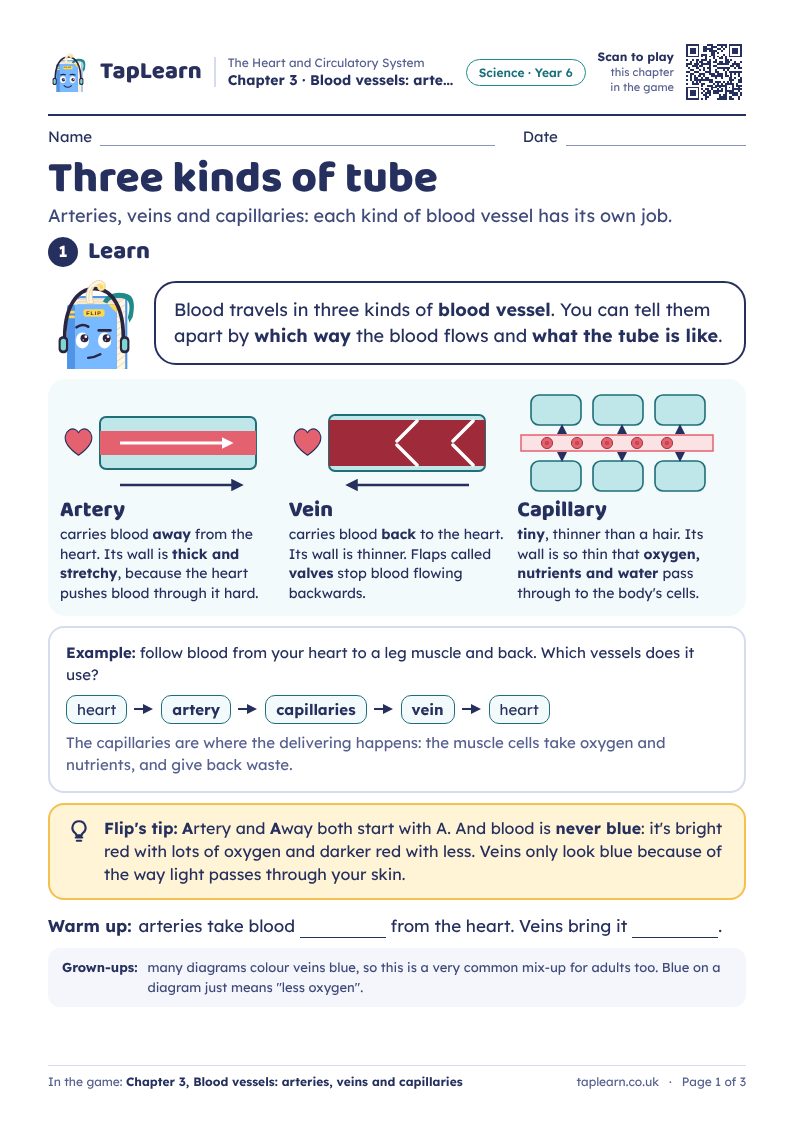
Three Kinds of Tube is a printable blood vessels worksheet for Year 6 (ages 10 to 11) that teaches children what arteries, veins and capillaries do, which way blood flows in each, and why veins look blue. It covers the Year 6 science national curriculum statement: identify and name the main parts of the human circulatory system, and describe the functions of the heart, blood vessels and blood.
This worksheet is for members
Membership opens every chapter of every game and every worksheet, for all your children.
See the plansAlready a member? Log in to print it.
Start with the free one: Your body's delivery team (chapter 1).
Print it on A4, in colour or black and white. Do it after the chapter, or before it to see what your child already knows.
What's on the worksheet
Describe what arteries, veins and capillaries do, which way blood flows in each, and why blood is never blue. With a vein detectives activity on a grown-up's hand, and answers.
- Page 1 · Learn
- How to tell arteries, veins and capillaries apart, following blood from the heart to a leg muscle and back, and Flip's tip: Artery, Away. Warm-up gap fill.
- Page 2 · Try it together
- Vein detectives: find veins on a grown-up's hand, press and slide two fingertips along one to see valves at work, the test William Harvey used.
- Page 3 · Practise
- Sort nine facts into artery, vein or capillary, label vessels to a leg muscle, true or false with corrections, why arteries have thick walls, and Leo's blue-veins challenge.
- Answers sheet
- All answers, three mix-ups to watch for, and pulse-spot and hose-and-sprinkler ideas.
3 A4 pages and an answers sheet · about 25 minutes
Using it at home
- Veins show best on a grown-up's hand: let your arm hang for a minute first, then press gently but firmly during the test.
- Many adults think blood in veins is blue, so learn together: it is always red, and blue on a diagram just means less oxygen.
Watch out for
- Swapping arteries and veins.
- Say "Artery, Away": arteries carry blood away from the heart, and veins bring it back.
- Thinking blood in veins is blue.
- It's always red; diagrams use blue as a code for less oxygen.
- Thinking blood leaks out of capillaries.
- Blood stays in the tubes. Only oxygen, nutrients and water pass through the thin wall.
Questions from the worksheet
- True or false? Blood in your veins is blue. If it's false, put it right.
- True or false? Arteries carry blood back to the heart.
- Why do arteries need thick, stretchy walls?
- Leo colours the veins blue on his diagram. He says, "This shows the blood in my veins is blue." Is he right? What does the blue really show?
The answers are on the answers sheet, for grown-ups.
National curriculum in England
This worksheet practises this statement from the Year 6 science programme of study:
- Identify and name the main parts of the human circulatory system, and describe the functions of the heart, blood vessels and blood
Source: National curriculum in England: science programmes of study (DfE)
In the classroom
- Use the sorting table as a card sort in groups, then compare answers as a class.
- Demonstrate the vein test with a volunteer under a visualiser so everyone can see the valves at work.
Questions and answers
What is the difference between arteries and veins?
Arteries carry blood away from the heart and have thick, stretchy walls. Veins carry blood back to the heart, have thinner walls and contain valves that stop blood flowing backwards.
What do capillaries do?
Capillaries are tiny blood vessels, thinner than a hair. Their walls are so thin that oxygen, nutrients and water pass through them to the body's cells.
Is blood in veins blue?
No, blood is always red: bright red with lots of oxygen and darker red with less. Veins only look blue because of the way light passes through skin.
More worksheets from The Heart and Circulatory System: Ride with Rosie
- Chapter 1: Circulatory system worksheet: Your body's delivery team Free
- Chapter 2: How the heart works worksheet: The heart pump Members
- Chapter 4: Parts of the blood worksheet: What's in blood? Members
- Chapter 5: How nutrients are transported worksheet: From lunch to cells Members
- Chapter 6: Circulation in animals worksheet: Animal delivery systems Members
 TapLearn