Parts of the blood worksheet for Year 6: What's in blood?
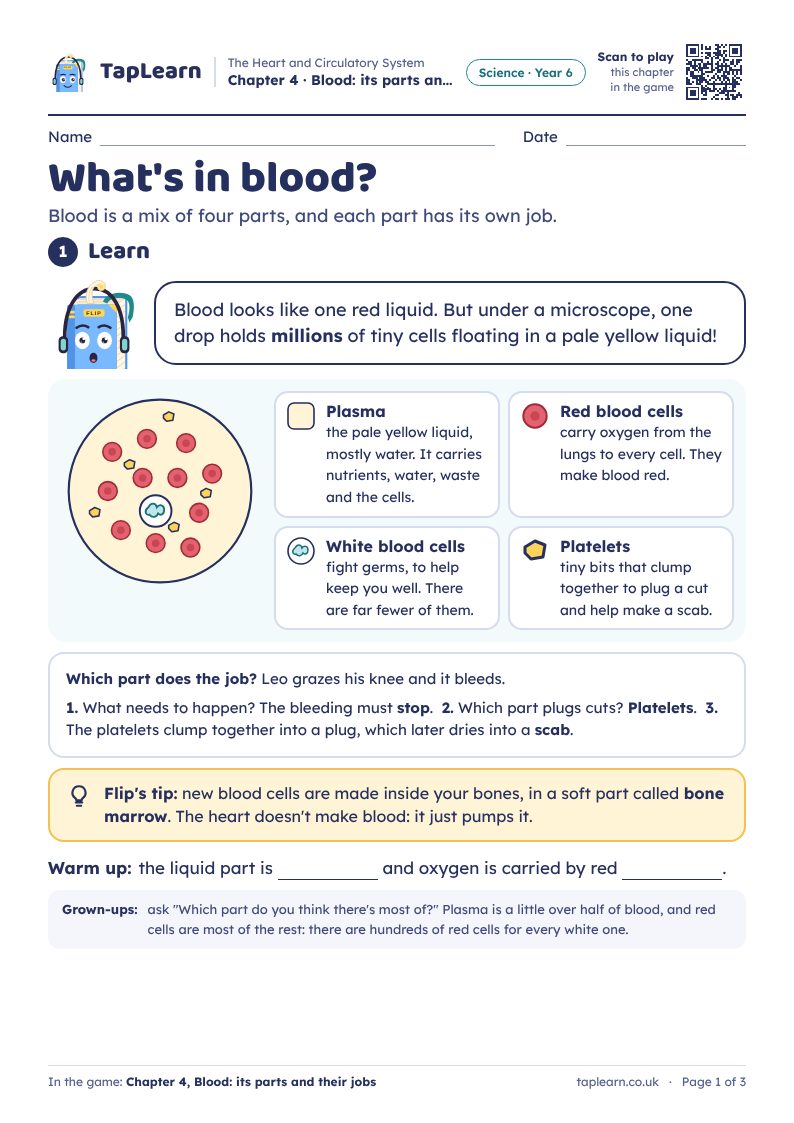
What's in Blood? is a printable worksheet for Year 6 (ages 10 to 11) on the parts of the blood, teaching children what plasma, red blood cells, white blood cells and platelets each do. It covers the Year 6 science national curriculum statement: identify and name the main parts of the human circulatory system, and describe the functions of the heart, blood vessels and blood.
This worksheet is for members
Membership opens every chapter of every game and every worksheet, for all your children.
See the plansAlready a member? Log in to print it.
Start with the free one: Your body's delivery team (chapter 1).
Print it on A4, in colour or black and white. Do it after the chapter, or before it to see what your child already knows.
What's on the worksheet
Describe the four parts of blood (plasma, red blood cells, white blood cells and platelets) and the job each one does. With a blood-in-a-jar model to make together, and answers.
- Page 1 · Learn
- The four parts of blood and their jobs, a worked example of platelets stopping a grazed knee bleeding, and how blood cells are made in bone marrow. Warm-up gap fill.
- Page 2 · Try it together
- Blood in a jar: make pale yellow plasma, then add lots of red lentils or sweets, a few marshmallows and a pinch of sprinkles for the cells and platelets.
- Page 3 · Practise
- Match parts to jobs, label a close-up, say which part is at work in four situations, explain why blood looks red, and Sam's "the heart makes more blood" challenge.
- Answers sheet
- All answers, three mix-ups to watch for, and scab-spotting and blood donation talk ideas.
3 A4 pages and an answers sheet · about 25 minutes
Using it at home
- Keep the small items for the jar away from younger brothers and sisters.
- Ask "Why did we add so few white things?" There are hundreds of red cells for every white one.
Watch out for
- Mixing up the cells' jobs.
- Try: "Red carries oxygen, white wins against germs, platelets patch cuts."
- Thinking the heart makes blood.
- It's a pump. Blood cells are made in bone marrow inside the bones.
- Forgetting plasma.
- It's over half of blood, and it carries the nutrients and water.
Questions from the worksheet
- Which part of blood is at work? A germ gets into your body through a cut.
- Which part of blood is at work? You cut your finger, and soon the bleeding stops.
- Plasma is pale yellow. So why does blood look red?
- Sam says, "If you bleed, your heart makes more blood." Is he right? Explain.
The answers are on the answers sheet, for grown-ups.
National curriculum in England
This worksheet practises these statements from the Year 6 science programme of study:
- Identify and name the main parts of the human circulatory system, and describe the functions of the heart, blood vessels and blood
- Describe the ways in which nutrients and water are transported within animals, including humans
Source: National curriculum in England: science programmes of study (DfE)
In the classroom
- Make blood in a jar as a group demonstration, with pupils adding each part and explaining its job.
- Mini-whiteboard quiz: read out a situation, like running or grazing a knee, and pupils write which part of blood is at work.
Questions and answers
What are the four parts of blood?
Blood is made of plasma, red blood cells, white blood cells and platelets. Plasma is the liquid, red cells carry oxygen, white cells fight germs and platelets help plug cuts.
Where are blood cells made?
New blood cells are made in bone marrow, the soft part inside bones. The heart doesn't make blood: it only pumps it.
More worksheets from The Heart and Circulatory System: Ride with Rosie
- Chapter 1: Circulatory system worksheet: Your body's delivery team Free
- Chapter 2: How the heart works worksheet: The heart pump Members
- Chapter 3: Arteries, veins and capillaries worksheet: Three kinds of tube Members
- Chapter 5: How nutrients are transported worksheet: From lunch to cells Members
- Chapter 6: Circulation in animals worksheet: Animal delivery systems Members
 TapLearn