Circulation in animals worksheet for Year 6: Animal delivery systems
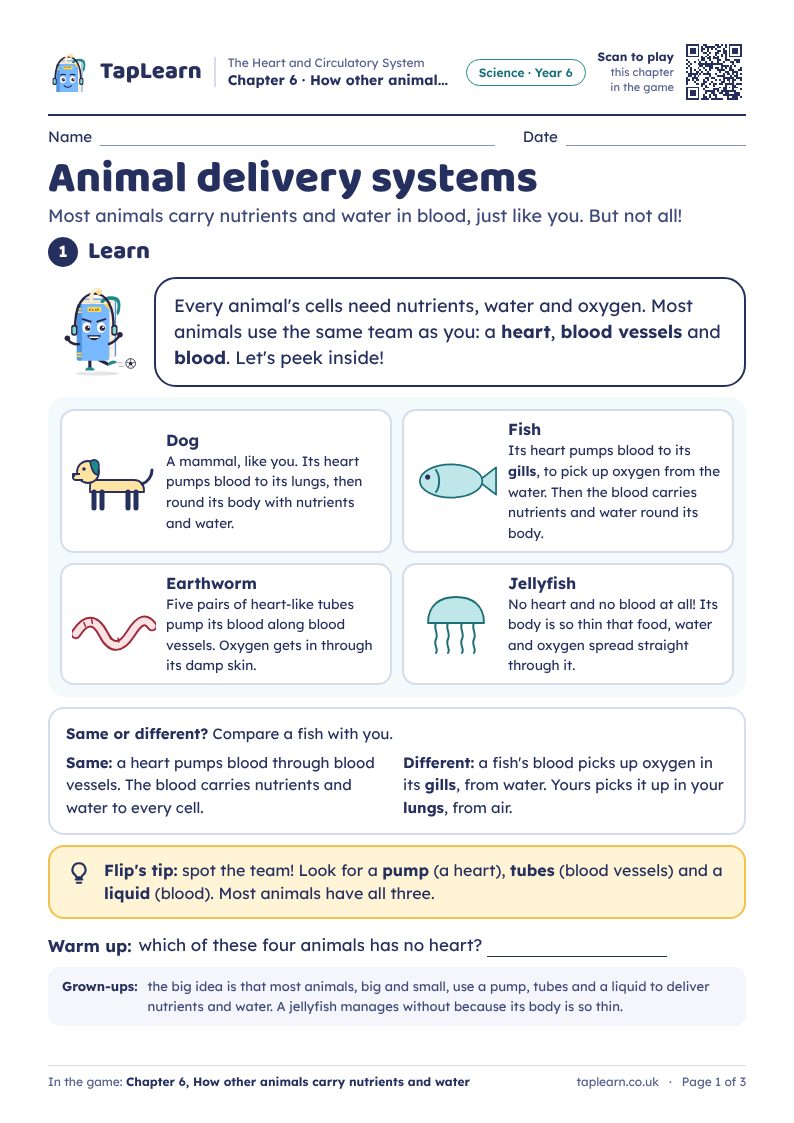
Animal Delivery Systems is a printable worksheet for Year 6 (ages 10 to 11) on circulation in animals, comparing how a dog, a fish, an earthworm and a jellyfish move nutrients, water and oxygen round their bodies. It covers the Year 6 science national curriculum statement: describe the ways in which nutrients and water are transported within animals, including humans.
This worksheet is for members
Membership opens every chapter of every game and every worksheet, for all your children.
See the plansAlready a member? Log in to print it.
Start with the free one: Your body's delivery team (chapter 1).
Print it on A4, in colour or black and white. Do it after the chapter, or before it to see what your child already knows.
What's on the worksheet
Compare how a dog, a fish, an earthworm and a jellyfish carry nutrients and water round their bodies, and why big animals need a heart. With a two-glass stir-it-up experiment, and answers.
- Page 1 · Learn
- Peeks inside a fish, a dog, an earthworm and a jellyfish, and a same-or-different comparison of a fish and a human. Warm-up: which animal has no heart?
- Page 2 · Try it together
- Stir it up: drop colouring into two glasses of water, stir only one, and compare how fast the colour spreads, like a body with and without a heart.
- Page 3 · Practise
- Match four animals to how they move nutrients and water, explain the jellyfish, fill a heart, vessels and blood table, compare a dog and a fish, and Sam's challenge.
- Answers sheet
- All answers, two mix-ups to watch for, and a gentle pet heartbeat check.
3 A4 pages and an answers sheet · about 25 minutes
In the classroom
- Set up the two-glass demonstration at the front, then ask pupils to explain what each glass models.
- Groups research one more animal and add a row to the heart, vessels and blood table.
Questions from the worksheet
- Why can a jellyfish manage without blood, but a dog can't?
- Compare a dog with a fish. Write one way they are the same and one way they are different.
- Sam says, "Only humans need blood to carry nutrients and water." Is he right? Give an example.
The answers are on the answers sheet, for grown-ups.
National curriculum in England
This worksheet practises this statement from the Year 6 science programme of study:
- Describe the ways in which nutrients and water are transported within animals, including humans
Source: National curriculum in England: science programmes of study (DfE)
Using it at home
- Wait until the water is still before adding colour, and count slowly to 30 together before comparing the glasses.
- After the experiment, ask "Why does a big animal need a heart?" and link glass A to a thin jellyfish.
Watch out for
- Thinking only humans have blood.
- Point to a pet or a garden worm: most animals have blood and a heart.
- Skipping digestion in animals.
- Animals digest food too, before nutrients pass into the blood.
Questions and answers
Do all animals have blood and a heart?
No, but most do. Fish, dogs and earthworms pump blood through blood vessels, while a jellyfish has no heart or blood because its body is thin enough for food, water and oxygen to spread through it.
How is a fish's circulation different from a human's?
A fish's heart pumps blood to its gills, where it picks up oxygen from water. A human's heart pumps blood to the lungs, where it picks up oxygen from air.
More worksheets from The Heart and Circulatory System: Ride with Rosie
- Chapter 1: Circulatory system worksheet: Your body's delivery team Free
- Chapter 2: How the heart works worksheet: The heart pump Members
- Chapter 3: Arteries, veins and capillaries worksheet: Three kinds of tube Members
- Chapter 4: Parts of the blood worksheet: What's in blood? Members
- Chapter 5: How nutrients are transported worksheet: From lunch to cells Members
 TapLearn