Circulatory system worksheet for Year 6: Your body's delivery team
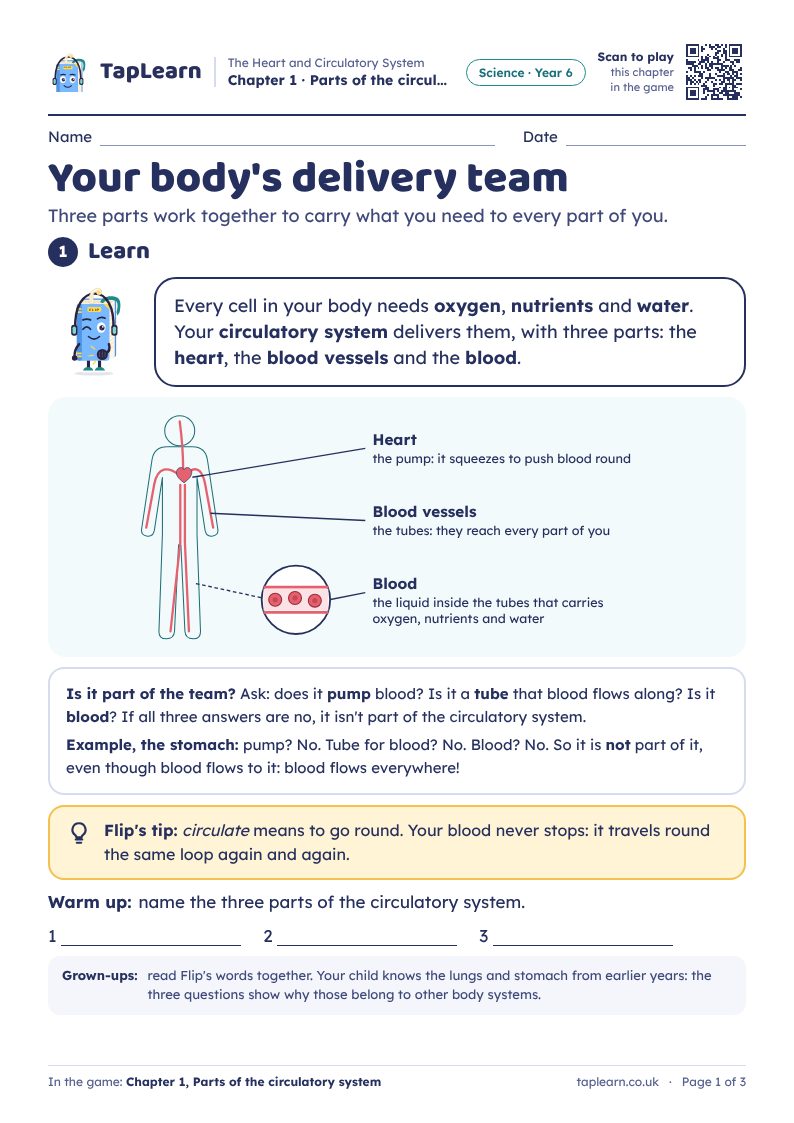
Your Body's Delivery Team is a printable circulatory system worksheet for Year 6 (ages 10 to 11) that teaches children to name the heart, blood vessels and blood and explain why organs like the lungs aren't part of it. It covers the Year 6 science national curriculum statement: identify and name the main parts of the human circulatory system, and describe the functions of the heart, blood vessels and blood.
Free to print, no account needed.
Print it on A4, in colour or black and white. Do it after the chapter, or before it to see what your child already knows.
What's on the worksheet
Name the three parts of the circulatory system (the heart, blood vessels and blood) and say what each one does. With a listen-to-a-heartbeat activity using a cardboard tube, and answers.
- Page 1 · Learn
- The three parts of the circulatory system and their jobs, plus a three-question test (pump? tube? blood?) worked through for the stomach. Warm-up: name the three parts.
- Page 2 · Try it together
- Listen in: compare fist and heart sizes, listen to each other's heartbeat through a kitchen-roll tube, and look for blood vessels on wrists and hands.
- Page 3 · Practise
- Label heart, blood vessel and blood, ring the parts from a list of organs, match parts to jobs, explain the name circulatory, and Leo's lungs challenge.
- Answers sheet
- All answers, three mix-ups to watch for, and delivery-service and branching-tree ideas.
3 A4 pages and an answers sheet · about 25 minutes
Using it at home
- Use a quiet room for the heartbeat activity, and take turns so your child both listens and is listened to.
- Ask "Why does blood need to reach your toes?" and help your child connect it to every cell needing oxygen, nutrients and water.
Watch out for
- Naming other organs, like the lungs, brain or stomach, as parts.
- Blood visits everywhere. Use the three questions: does it pump blood? Is it a tube for blood? Is it blood?
- Not knowing arteries, veins and capillaries are all blood vessels.
- Tell them these are the three kinds of blood vessel, which Chapter 3 explores.
- Thinking the heart is on the left.
- It sits in the middle of the chest, tilted a little to the left.
Questions from the worksheet
- Draw a ring round each part of the circulatory system: heart, lungs, blood, stomach, arteries, brain, veins, skeleton, capillaries, kidneys.
- Why is it called the circulatory system?
- Name two things that blood carries to every cell.
- Leo says, "The lungs are part of the circulatory system, because blood goes there." Is he right? Use the question test to explain.
The answers are on the answers sheet, for grown-ups.
National curriculum in England
This worksheet practises this statement from the Year 6 science programme of study:
- Identify and name the main parts of the human circulatory system, and describe the functions of the heart, blood vessels and blood
Source: National curriculum in England: science programmes of study (DfE)
In the classroom
- Starter: show a list of organs and have pupils vote whether each is part of the circulatory system, using the three-question test.
- Plenary: pupils explain the system as a delivery service (heart = pump, vessels = roads, blood = vans) to a partner.
Questions and answers
What are the three main parts of the circulatory system?
The circulatory system has three main parts: the heart, the blood vessels and the blood. The heart pumps, the vessels carry blood everywhere, and the blood delivers oxygen, nutrients and water.
Are the lungs part of the circulatory system?
No, the lungs belong to the respiratory system. Blood flows through them to pick up oxygen, but blood flows to every organ, and that doesn't make them part of the circulatory system.
More worksheets from The Heart and Circulatory System: Ride with Rosie
- Chapter 2: How the heart works worksheet: The heart pump Members
- Chapter 3: Arteries, veins and capillaries worksheet: Three kinds of tube Members
- Chapter 4: Parts of the blood worksheet: What's in blood? Members
- Chapter 5: How nutrients are transported worksheet: From lunch to cells Members
- Chapter 6: Circulation in animals worksheet: Animal delivery systems Members
 TapLearn