How the heart works worksheet for Year 6: The heart pump
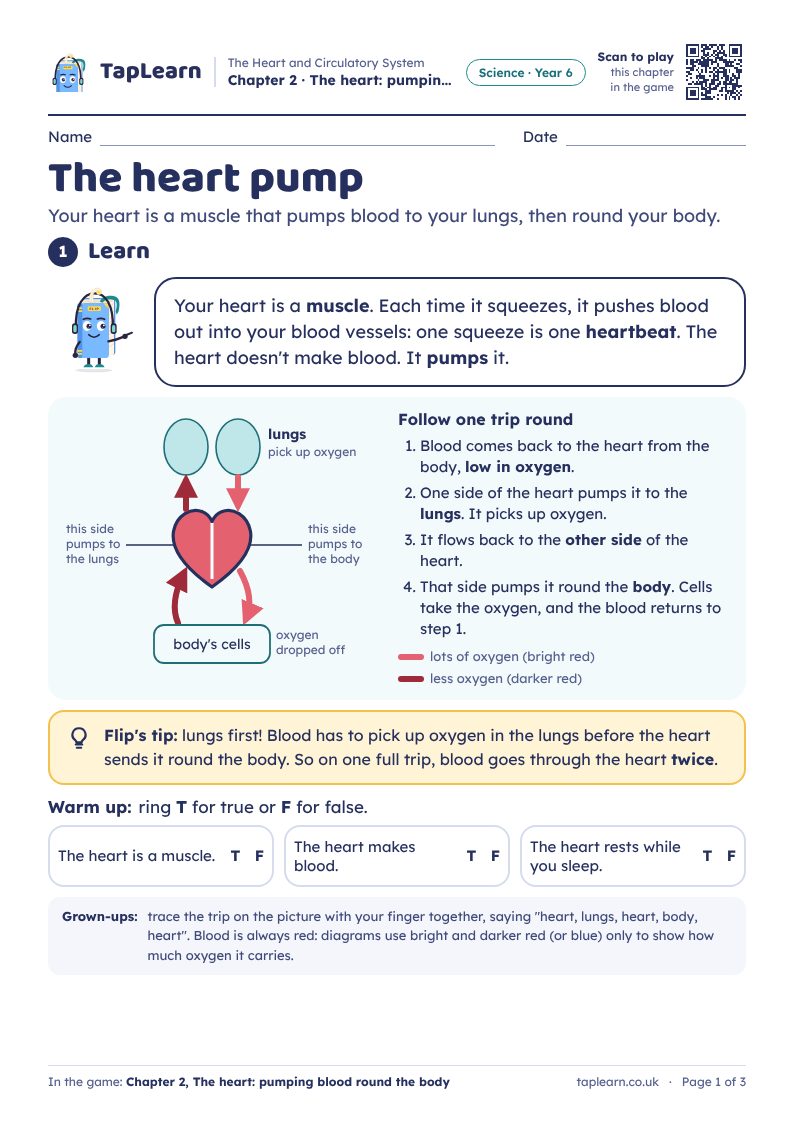
The Heart Pump is a printable worksheet for Year 6 (ages 10 to 11) on how the heart works, teaching children that the heart is a muscle that pumps blood to the lungs for oxygen and then round the body. It covers the Year 6 science national curriculum statement: identify and name the main parts of the human circulatory system, and describe the functions of the heart, blood vessels and blood.
This worksheet is for members
Membership opens every chapter of every game and every worksheet, for all your children.
See the plansAlready a member? Log in to print it.
Start with the free one: Your body's delivery team (chapter 1).
Print it on A4, in colour or black and white. Do it after the chapter, or before it to see what your child already knows.
What's on the worksheet
Explain that the heart is a muscle that pumps blood to the lungs to pick up oxygen and then round the body. With a find-your-pulse activity to try together, a heart diagram to label and answers.
- Page 1 · Learn
- How one heartbeat pushes blood out, and a four-step trip: body, heart, lungs, heart, body. Warm-up: true or false about the heart.
- Page 2 · Try it together
- Feel the pump: find your pulse on your wrist, count beats for 15 seconds and multiply by 4, then squeeze a sponge 20 times to feel how hard the heart works.
- Page 3 · Practise
- Number the 5 steps of blood's trip, label a heart diagram rich or low in oxygen, work out beats per minute and per hour, a gap fill, and Ava's two-mistake challenge.
- Answers sheet
- All answers, three mix-ups to watch for, and walk-the-loop and heartbeat listening ideas.
3 A4 pages and an answers sheet · about 25 minutes
Using it at home
- Trace the trip on the page 1 picture with your finger together, saying "heart, lungs, heart, body, heart".
- If the wrist pulse is tricky, try gently on the side of the neck. Children's hearts usually beat a little faster than adults'.
Watch out for
- Thinking the heart makes blood.
- The heart is a pump, like a fountain's water pump: it moves blood but doesn't make it.
- Forgetting the lungs.
- Ask: "Where does blood get its oxygen from?" It must go to the lungs before it can deliver oxygen.
- Thinking the heart rests at night.
- It slows down but never stops: about 100,000 beats a day.
Questions from the worksheet
- Number the steps of one trip round, from 1 to 5.
- Mia counts 22 beats in 15 seconds. How many beats is that in one minute?
- Sam's heart beats 80 times a minute. How many beats is that in one hour?
- Ava says, "The heart makes blood and sends it straight round the body." There are two mistakes. Can you find them and put them right?
The answers are on the answers sheet, for grown-ups.
National curriculum in England
This worksheet practises this statement from the Year 6 science programme of study:
- Identify and name the main parts of the human circulatory system, and describe the functions of the heart, blood vessels and blood
Source: National curriculum in England: science programmes of study (DfE)
In the classroom
- Walk the loop: lay out a figure of eight around two chairs labelled lungs and body, with a pupil as the heart in the middle.
- Pairs take pulses at rest and record class data for a quick bar chart.
Questions and answers
How does the heart pump blood around the body?
The heart is a muscle that squeezes to push blood into the blood vessels. One side pumps blood to the lungs to pick up oxygen, and the other side pumps it round the body.
Why does blood go to the lungs before the body?
Blood picks up oxygen in the lungs, so it must go there before the heart sends it round the body. On one full trip, blood passes through the heart twice.
More worksheets from The Heart and Circulatory System: Ride with Rosie
- Chapter 1: Circulatory system worksheet: Your body's delivery team Free
- Chapter 3: Arteries, veins and capillaries worksheet: Three kinds of tube Members
- Chapter 4: Parts of the blood worksheet: What's in blood? Members
- Chapter 5: How nutrients are transported worksheet: From lunch to cells Members
- Chapter 6: Circulation in animals worksheet: Animal delivery systems Members
 TapLearn