How nutrients are transported worksheet for Year 6: From lunch to cells
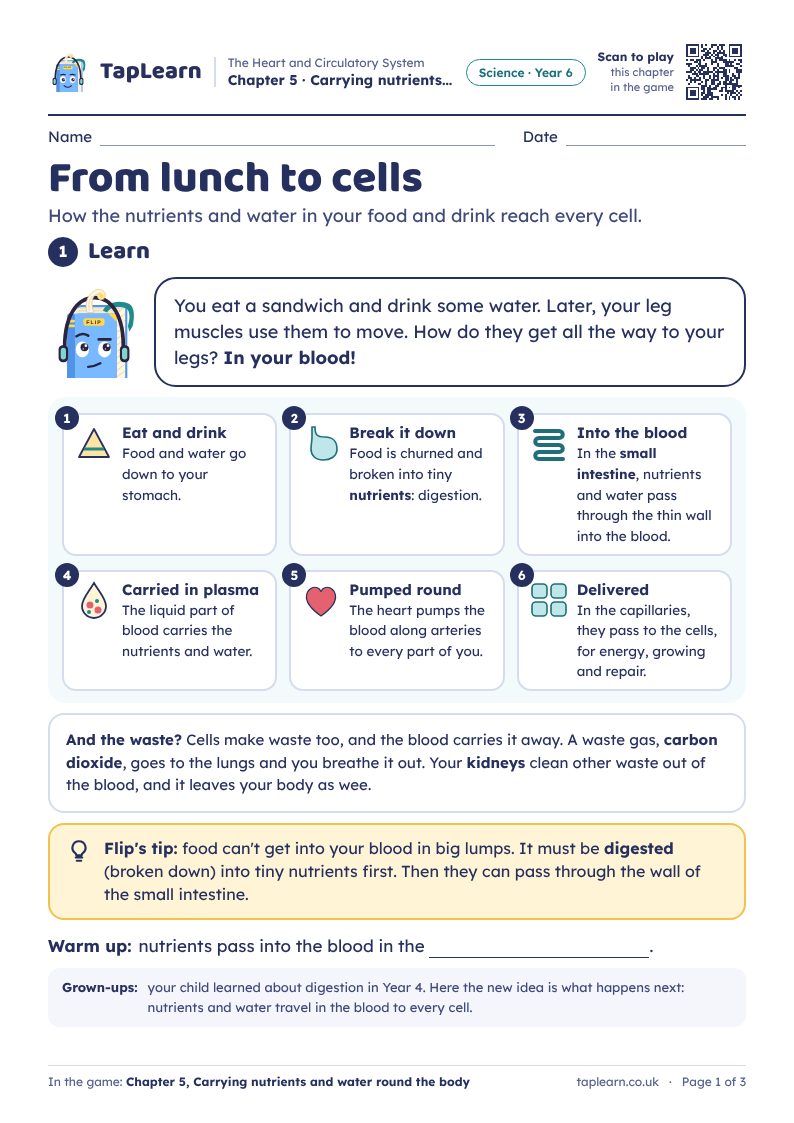
From Lunch to Cells is a printable worksheet for Year 6 (ages 10 to 11) on how nutrients are transported, teaching children how nutrients and water pass into the blood in the small intestine and reach every cell. It covers the Year 6 science national curriculum statement: describe the ways in which nutrients and water are transported within animals, including humans.
This worksheet is for members
Membership opens every chapter of every game and every worksheet, for all your children.
See the plansAlready a member? Log in to print it.
Start with the free one: Your body's delivery team (chapter 1).
Print it on A4, in colour or black and white. Do it after the chapter, or before it to see what your child already knows.
What's on the worksheet
Explain how nutrients and water from food and drink pass into the blood in the small intestine and are pumped round to every cell. With a sieve test to try together, a journey to order and answers.
- Page 1 · Learn
- Six steps from eating a sandwich to cells using its nutrients, plus how blood carries waste to the lungs and kidneys. Warm-up: where nutrients pass into the blood.
- Page 2 · Try it together
- The sieve test: pour bread, water and dissolved sugar through a sieve lined with kitchen roll, then taste a drop to see what passed through, like digested nutrients.
- Page 3 · Practise
- Put 7 steps of the journey in order, a word-box gap fill, choose where each step happens from stomach to kidneys, why toes need blood, and Mia's stomach challenge.
- Answers sheet
- All answers, three mix-ups to watch for, and a follow-one-food idea for mealtimes.
3 A4 pages and an answers sheet · about 25 minutes
In the classroom
- Run the sieve test as a class demonstration and have pupils predict what will pass through before pouring.
- Cut the 7 journey steps into cards for pairs to order, then check against the answers sheet.
Questions from the worksheet
- Put the journey in order. Number the steps 1 to 7.
- Where does it happen? Nutrients pass into the blood.
- Your toes are a long way from your stomach. Why do they still need blood?
- Mia says, "Food stays in your stomach until your body needs the energy." Is she right? Explain.
The answers are on the answers sheet, for grown-ups.
National curriculum in England
This worksheet practises this statement from the Year 6 science programme of study:
- Describe the ways in which nutrients and water are transported within animals, including humans
Source: National curriculum in England: science programmes of study (DfE)
Using it at home
- Use a clean teaspoon for the taste test, and let your child pour the mixture slowly so they can watch what stays behind.
- Your child learned about digestion in Year 4. Ask them what happens to food after digestion, since that is the new idea here.
Watch out for
- Skipping digestion.
- Ask: "Could a whole pea fit through the intestine wall?" Food must be broken down first.
- Thinking nutrients stay in the gut.
- They move on into the blood, so they can reach every cell.
- Thinking drinks go straight to the bladder.
- Water goes into the blood first, and the kidneys take out what isn't needed.
Questions and answers
How are nutrients transported in the human body?
Food is digested into tiny nutrients, which pass into the blood in the small intestine. The plasma carries them, the heart pumps the blood round, and they pass from the capillaries to the cells.
Why does food need to be digested before it enters the blood?
Food can't get into the blood in big lumps. It must be broken down into tiny nutrients small enough to pass through the wall of the small intestine.
More worksheets from The Heart and Circulatory System: Ride with Rosie
- Chapter 1: Circulatory system worksheet: Your body's delivery team Free
- Chapter 2: How the heart works worksheet: The heart pump Members
- Chapter 3: Arteries, veins and capillaries worksheet: Three kinds of tube Members
- Chapter 4: Parts of the blood worksheet: What's in blood? Members
- Chapter 6: Circulation in animals worksheet: Animal delivery systems Members
 TapLearn